


Procurement shock is a common rite of passage for engineers receiving their first high-pressure manufacturing quote. Unlike additive methods, where costs are buried in material volume, the financial barrier to entry for thermoplastic production is dominated by the initial capital expenditure of the tool. Deciding on the appropriate injection molding tooling cost is essentially a high-stakes bet on your product's lifecycle. A simple aluminum mold might demand a $1,500 sacrifice for a few thousand units, while a complex, multi-cavity hardened steel tool for a medical device can easily breach the $50,000 threshold. Understanding this "black box" of pricing is critical for maintaining a lean R&D budget. Navigating the variables of Injection molding cost requires stripping away the mystery of steel selection, mechanical complexity, and cavitation logic. Jucheng Precision operates as a transparent manufacturing partner, providing itemized cost breakdowns that empower your team to optimize the design before a single chip of metal is cut.
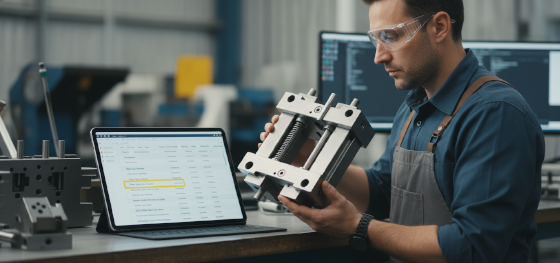
Eliminating "Tooling Debt" begins with matching the material spine of the mold to the expected market demand. Many hardware startups fail because they over-specify their tooling, purchasing a million-shot steel asset for a product that may only see ten thousand units of sales. Conversely, choosing a fragile tool for a high-volume run leads to catastrophic maintenance downtime and dimensional drift. Jucheng Precision eliminates this fiscal misalignment by offering a tiered tooling strategy—ranging from Rapid Tooling in Al 7075 to high-capacity H13 hardened steel production molds. This guide deconstructs the four primary pillars of tooling expense, revealing exactly where your capital is allocated and how our engineering advisory can shave thousands off your initial quote.
Material Foundations: Hardness, Thermal Conductivity, and Cost
Geometric Complexity: The "Tax" of Sliders and Lifters
Cavitation Economics: Balancing Setup vs Part Price
Surface Realism: The High Price of Cosmetic Perfection
JUCHENG Protocol: Slashing Costs via MUD Base Systems
Material Foundations: Hardness, Thermal Conductivity, and Cost
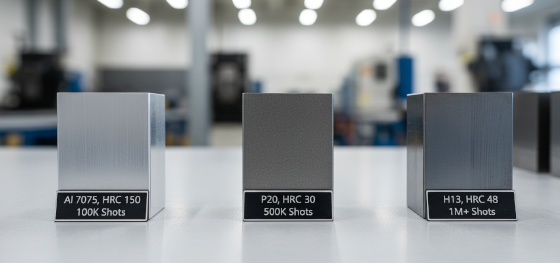
Choosing the metal for your mold is the primary driver of the base injection molding tooling cost. We categorize mold materials into three distinct tiers. For bridge production or prototyping (100 - 5,000 units), Aluminum 7075 is the undisputed champion. It is soft enough to be machined 30% faster than steel, reducing labor hours significantly. More importantly, aluminum possesses superior thermal conductivity, which slashes cooling times and lowers your eventual part price. However, aluminum tools are prone to wear and cannot handle abrasive glass-filled resins. Moving to the mid-tier, P20 "Soft Steel" (pre-hardened to ~30 HRC) offers a robust balance for runs up to 50,000 shots. It resists the clamping pressures of larger machines without the high cost of post-machining heat treatment. For high-volume mass production (100,000+ units), Jucheng Precision mandates H13 hardened steel. This material must be machined, then subjected to a violent thermal quenching process to reach 48-52 HRC, and then final-ground to tolerance. This multi-stage fabrication cycle is the reason why H13 tools carry a 40% premium over P20, yet it is the only way to guarantee dimensional sovereignty over years of continuous operation.
Geometric Complexity: The "Tax" of Sliders and Lifters
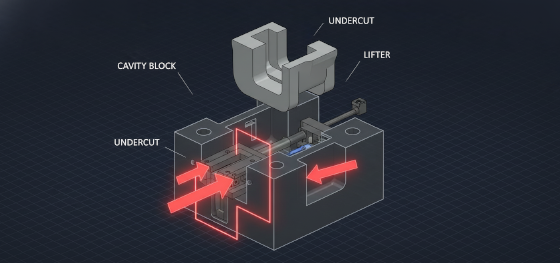
Lateral obstructions in your CAD file translate directly into mechanical "side actions" in the tool. If your part features a snap-fit, a side-hole, or an internal thread that prevents a "straight-pull" ejection, the mold must become a dynamic machine rather than a static block. Every "Undercut" necessitates a slider or a lifter. These are precision-ground steel assemblies that move perpendicularly to the mold opening. A single slider can add $1,500 to $3,500 to the injection molding tooling cost because it requires its own angled horn pins, wear plates, and guiding gibs. Furthermore, complex actions require the use of larger, more expensive mold bases to house the mechanical travel. Jucheng Precision engineers prioritize "Geometric Simplification" during DFM reviews. We often propose shifting a parting line or utilizing a "pass-through" core to eliminate the need for a slider. By removing just two side actions, we can frequently drop a tooling quote by $5,000 without compromising the part's functional soul. Complexity is a choice; we help you choose the most profitable path.
Cavitation Economics: Balancing Setup vs Part Price
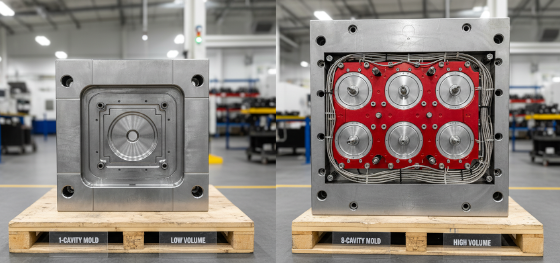
Determining the number of cavities is a calculation of amortized ROI. A single-cavity mold is the cheapest way to start, requiring the least amount of CNC time. However, it is the most expensive way to produce parts in the long run. If your annual demand is 100,000 units, running a single-cavity mold is operational suicide; the machine time and labor will keep your part price prohibitively high. Moving to a 4-cavity or 8-cavity tool multiplies the injection molding tooling cost because we must replicate the geometry perfectly several times and engineer a balanced runner system (often requiring a $10,000+ Hot Runner manifold). Yet, this upfront "sacrifice" slashes the cycle time per part. For instance, an 8-cavity tool produces eight parts every thirty seconds, effectively dropping the labor component of the part cost by nearly 85%. Jucheng Precision runs the math for you, identifying the "Breakeven Point" where the increased tooling investment pays for itself through lower piece prices. We ensure you aren't buying more "machine capacity" than your market demand justifies.
Surface Realism: The High Price of Cosmetic Perfection
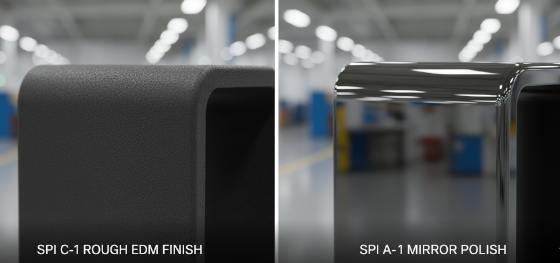
Specular reflection is an expensive engineering requirement. The surface finish of the mold is transferred with 99% fidelity to the plastic part. If your design mandates an SPI A-1 diamond polish for an optically clear lens or a high-gloss consumer enclosure, the injection molding tooling cost must account for dozens of hours of manual, highly skilled labor. A technician must sand the steel progressively—from 320 grit to 600, 1000, and finally buffing with diamond paste. This "Manual Tax" is why a mirror-finished mold can cost $3,000 more than a standard "As-Machined" tool. Furthermore, specialized textures like Mold-Tech leather grains require chemical etching at a specialized facility, adding another layer of logistical cost and time. At Jucheng Precision, we advocate for "Strategic Finishing." We recommend high-gloss only on visible "A-side" surfaces while keeping internal ribs and hidden bosses at a standard "B-3" finish. This balanced approach protects your cosmetic intent while keeping your capital outlay focused on functional performance.
JUCHENG Protocol: Slashing Costs via MUD Base Systems
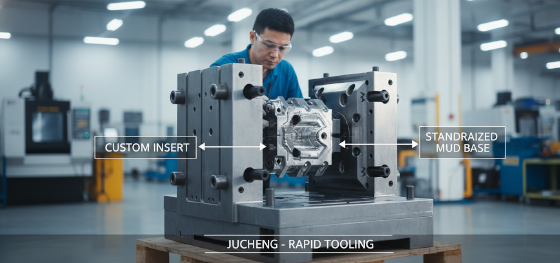
Manufacturing excellence at Jucheng Precision is built on the foundation of shared infrastructure. One of the most effective ways we reduce the injection molding tooling cost for our clients is through the Master Unit Die (MUD) system. A traditional mold requires the purchase of a complete "Mold Base"—massive slabs of steel housing the ejection system and leader pins. With the MUD system, JUCHENG provides the universal frame for free. You only pay for the custom "Inserts" (the core and cavity) that form your specific part. This approach eliminates up to 40% of the raw material and CNC labor required for a dedicated tool. It is the perfect solution for low-to-mid volume projects where the goal is functional validation without the six-figure financial anchor. Our facility, housing over 150 CNC machines and 25 high-precision 5-axis Haas centers, ensures that these inserts are cut with surgical precision and delivered in half the industry-standard lead time. Stop over-paying for a full mold base you don't need. Upload your 3D CAD file to JUCHENG today for a Free DFM Review and let us show you how we can bridge your project to production profitably.

