


Procurement logic in high-pressure manufacturing is often obscured by the complexity of the machine floor. For many project managers, receiving a quote for a new plastic component feels like peering into a financial black box. You understand the "Tooling Debt"—the upfront cost of the steel—but the ongoing injection molding cost per part frequently seems arbitrary. Why does a 10-gram part for a medical device cost $2.15 while a 10-gram toy component costs $0.12? The disparity is not a result of vendor greed; it is a direct reflection of the thermodynamic and mechanical burden placed on the injection press. In the uncompromising environment of industrial production, time is the only true currency. Every second the mold stays closed to cool the plastic is a second the machine cannot produce revenue. Navigating the variables of Injection molding cost requires a forensic deconstruction of material weight, machine overhead, and the often-ignored physics of cycle time. Jucheng Precision operates as a transparent manufacturing partner, providing the mathematical transparency needed to align your part price with your market's margin requirements.
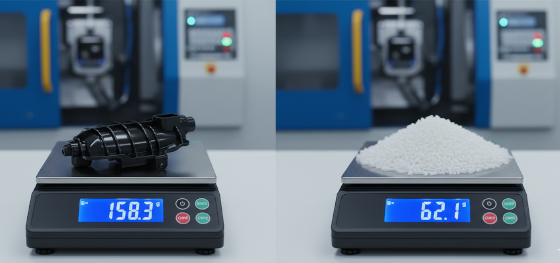
Establishing a sustainable piece price begins with the acknowledgement that plastic is an insulator that resists cooling. Amateurs often obsess over raw material costs, failing to realize that "Machine-Hour Rates" dominate the fiscal architecture of a high-volume run. At Jucheng Precision, we utilize Scientific Molding principles to compress these cycles, effectively diluting the overhead across more units per hour. This guide pulls back the curtain on the piece-price formula, revealing how subtle design choices—like wall thickness and gate placement—can either armor your project against cost overruns or lead it into a financial valley of death. We provide the manufacturing insurance needed to ensure your high-volume launch remains profitable from the first shot to the millionth.
The Master Formula: Deconstructing the Piece Price
Resin Realities: Material Weight, Type, and Waste
Cycle Time Economics: Seconds are Dollars
Machine Tonnage: Matching the Press to the Part
JUCHENG Protocol: Lowering Costs via Scientific Molding
The Master Formula: Deconstructing the Piece Price
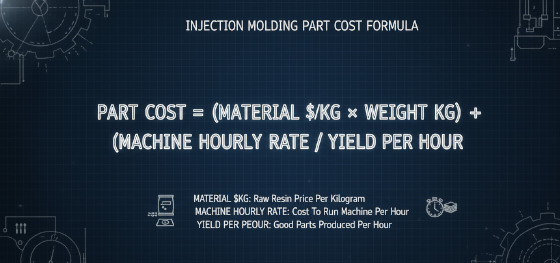
Calculating a professional manufacturing estimate is a dispassionate exercise in algebra. To understand your injection molding cost per part, you must separate the "Setup Debt" (which we covered in our tooling guide) from the "Running Cost." The fundamental equation used by Jucheng Precision and other Tier-1 facilities follows this hierarchy:
Part Cost = (Material Price per Gram × Total Shot Weight) + (Machine Hourly Rate / Parts Produced per Hour) + Packaging/Post-Processing
The "Total Shot Weight" includes the part itself plus the "Runner and Sprue"—the sacrificial plastic that delivers the melt to the cavity. The "Hourly Rate" accounts for the machine's electricity, the technician's labor, and the factory's floor-space overhead. When you look at this formula, it becomes clear that "Yield" (parts per hour) is the most powerful lever you have to lower your costs. If JUCHENG can optimize your tool to produce 120 parts per hour instead of 60, your labor and machine overhead is instantly halved. This mathematical leverage is why we prioritize "Fast-Cycling" designs during the DFM phase; we aren't just making parts, we are optimizing your yield.
Resin Realities: Material Weight, Type, and Waste
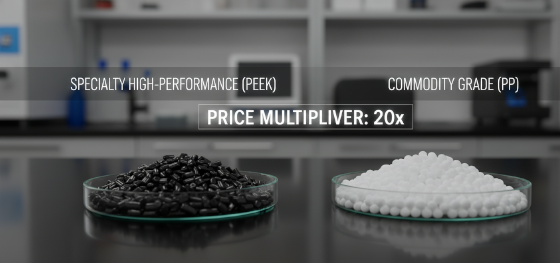
Commodity vs. Specialty resin selection creates the primary floor for your unit price. In Injection molding cost structures, raw material typically accounts for 30% to 50% of the piece price. Choosing a commodity plastic like Polypropylene (PP) or ABS allows you to benefit from global economies of scale. However, moving into high-performance materials like PEEK or Ultem (PEI) changes the financial geometry entirely. These resins can cost fifty times more per kilogram than standard ABS. Furthermore, the "Regrind Policy" significantly impacts the injection molding cost per part. In medical or aerospace applications, using recycled "regrind" from the runner system is often forbidden, meaning 100% of the runner weight is a pure financial loss. Jucheng Precision engineers optimize runner designs—often recommending "Hot Runner" systems for expensive materials—to eliminate waste and ensure every gram of resin paid for ends up in the final part.
Cycle Time Economics: Seconds are Dollars
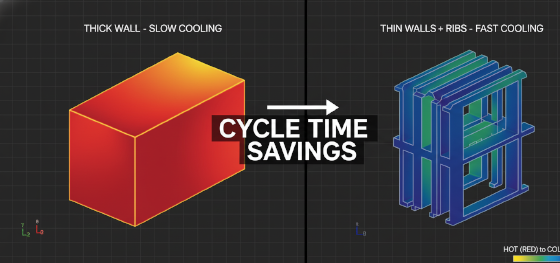
Thermodynamic efficiency is the hidden architect of profitability. The "Cycle Time" consists of three phases: Injection, Cooling, and Ejection. In ninety percent of cases, "Cooling" occupies seventy percent of that time. Because plastic is a thermal insulator, the heat trapped in the center of a thick wall takes an eternity (in manufacturing terms) to migrate to the chilled steel. A design with a 4mm wall will have a cycle time nearly four times longer than a design with a 2mm wall. This directly inflates the injection molding cost per part because you are occupying the machine for longer per unit. Jucheng Precision advocates for "Thin-Wall Optimization" (as discussed in our design guides). By coring out thick sections and replacing them with ribs, we maintain structural rigidity while allowing the plastic to solidify in seconds. Every five seconds we shave off a cycle represents thousands of dollars saved over a 100,000-unit production run. We treat every second as a billable asset to be protected.
Machine Tonnage: Matching the Press to the Part
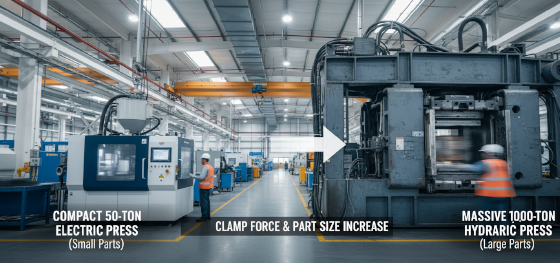
Clamping force requirements dictate which "Financial Bracket" your part belongs to. Larger parts, or parts with high "Projected Areas," require massive machines with high clamping tonnage to prevent the mold from being blown open by the injection pressure. Running a part on a 500-ton press carries a significantly higher "Machine-Hour Rate" than running it on a 50-ton press. The 500-ton machine consumes more power, requires more floor space, and has a higher capital depreciation rate. Jucheng Precision eliminates the "Tonnage Tax" by optimizing your tool design. We may suggest multi-gating or lower-viscosity resins to reduce the required injection pressure, potentially allowing the part to run on a smaller, more cost-effective machine. By matching the physics of the part to the most efficient press size, we ensure your injection molding cost per part remains as low as the laws of mechanics allow.
JUCHENG Protocol: Lowering Costs via Scientific Molding
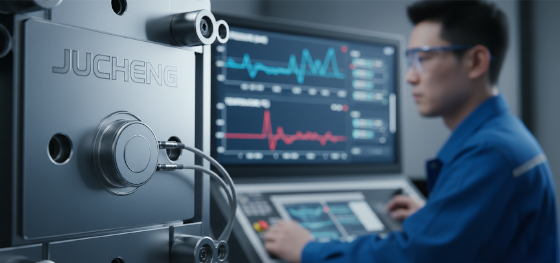
Manufacturing excellence at Jucheng Precision is built on the foundation of the "Stability-to-Savings" feedback loop. We do not rely on artisanal "knob-turning" by machine operators; we utilize Scientific Molding to establish a robust, repeatable process window. By using in-cavity pressure and temperature sensors, we identify the exact moment the gate freezes and the part is stable. This precision allows us to run at the absolute minimum cycle time required for quality, without the "safety margins" of 10-20 seconds that amateur shops often build in to compensate for process instability. Our facility, housing over 150 CNC machines for tool maintenance and elite injection bays, ensures your part price remains steady throughout the project lifecycle. Stop paying for the "Inefficiency Tax" of outdated manufacturing. Not sure if your cycle time is optimized or your machine tonnage is correct? Upload your 3D CAD file to JUCHENG today for a Free DFM Review. Our experts will identify Injection molding cost bottlenecks before they affect your bottom line, ensuring your mass production launch is lean, predictable, and retail-ready.

