


Binary choices are the enemy of engineering excellence. In the past, designers were forced to pick a side: accept the geometric limitations of a mill to ensure precision, or accept the surface roughness of a printer to achieve complexity. This "either/or" trap has finally been dismantled by the rise of hybrid manufacturing systems 3d printing cnc machining. We are no longer living in a world where a cnc machine vs 3d printer represents a zero-sum game. Instead, we are entering an era of technical symbiosis, where additive manufacturing is used to grow the "unmachinable" internal labyrinths, and subtractive manufacturing is used to carve the "unprintable" micron-level interfaces. This fusion isn't just a trend; it is the definitive solution for high-stakes aerospace, medical, and mold-making applications where performance cannot be traded for accuracy.
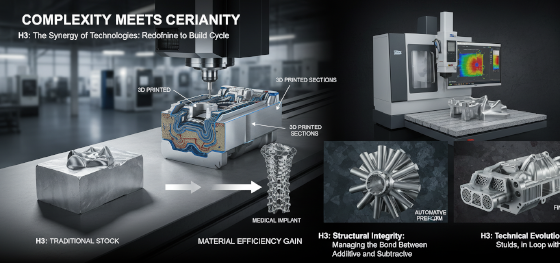
JUCHENG operates at the epicenter of this industrial convergence. We don't view a 3D printer as a standalone tool, but as a high-tech foundry that produces an "advanced preform." By integrating over 25 high-precision 5-axis centers with our DMLS and MJF fleet, we have eliminated the accountability gap that plagues fragmented supply chains. When a part moves from the build plate to the spindle within the same facility, the "Digital Thread" remains unbroken. This guide moves past the basic process comparisons to explore the thermodynamics of hybrid bonding, the economic logic of material conservation, and why JUCHENG’s commitment to integrated metrology ensures your most complex designs are functionally sound, dimensionally perfect, and ready for flight.
Efficiency in the modern factory is found in the management of the transition. You aren't just buying two different processes; you are buying a single, unified manufacturing roadmap. Whether you are building a mold with conformal cooling or a skeletal titanium implant, the logic of the hybrid is your greatest competitive asset. Let us break down the mechanical and metallurgical pillars of integrated production and see how JUCHENG locks the soul of your design into a physical reality that defies traditional limits.
Synergy of Technologies: Redefining the Build Cycle
Material Efficiency: Strategic Stock and Net-Shape Preforms
Structural Integrity: Managing the Bond Between Additive and Subtractive
Industrial Evolution: Case Studies in Molds, Aerospace, and Medical
Technical Verification: Closing the Loop with Metrology
JUCHENG’s Recommendation: The Path to Hybrid Success
Synergy of Technologies: Redefining the Build Cycle
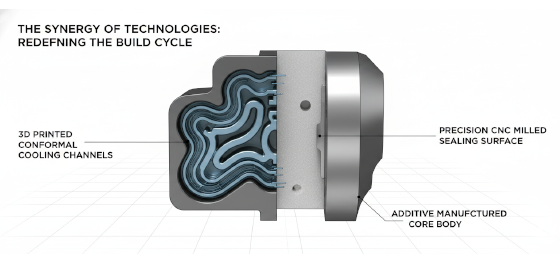
The operational brilliance of hybrid manufacturing systems 3d printing cnc machining lies in the sequence of events. In a traditional workflow, a part is born and finished in a single modality. Hybrid manufacturing treats the build cycle as an evolution. We begin with the "Additive Foundation"—using DMLS or SLA to grow the bulk geometry. This allows us to integrate features that would be nightmares for a mill, such as internal lattice structures for weight reduction or curved fluid paths for laminar flow. By using the 3D printer to create the initial mass, we are essentially building a custom, near-net-shape blank that is already 90% optimized for the design’s mission.
The second phase is the "Subtractive Strike." Once the complex additive preform is stress-relieved and stabilized, it moves to our 5-axis CNC floor. Here, we use high-speed spindles to mill away the "machining stock" from critical zones—bearing seats, seal grooves, and threaded holes. This ensures that the surfaces where the part actually *interacts* with the rest of the assembly possess the mirror-like finish and sub-ten-micron tolerances that 3D printing alone can never achieve. At JUCHENG, this synergy is managed through a single master CAM file, ensuring that the coordinate system of the printer and the mill are perfectly aligned. We don't just use two machines; we engineer a continuous manufacturing thread that captures the speed of light and the power of the spindle in a single, high-performance lifecycle.
Material Efficiency: Strategic Stock and Net-Shape Preforms
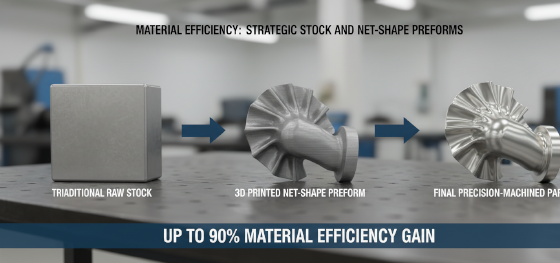
Economics is the ultimate governor of the hybrid manufacturing systems 3d printing cnc machining choice. In the subtractive world, the cost is driven by the material you throw away—the "Buy-to-Fly" ratio. If you are machining a complex titanium manifold from a solid 50kg billet to get a 2kg part, you are paying for 48kg of unrecyclable waste. For high-value aerospace alloys, this is a financial disaster. Hybrid manufacturing solves this by utilizing the "Net-Shape" advantage. We print only the 2kg of titanium required, plus a thin 1.5mm "skin" of sacrificial machining stock.
This strategic material allocation reduces raw material costs by up to 80% for high-complexity parts. Furthermore, it drastically reduces "Spindle Fatigue." Instead of a CNC machine spending 40 hours roughing out a block, it spends 2 hours performing the final precision pass on the pre-printed part. At Jucheng Precision, we pass these time and material savings directly to our clients. We treat the 3D printer as a precision-volume engine and the mill as a precision-surface engine. This economic logic is why hybrid manufacturing has become the mandatory standard for sustainable, high-fidelity production. We help you spend your budget on the functional integrity of the part, not on the chips in the waste bin.
Structural Integrity: Managing the Bond Between Additive and Subtractive
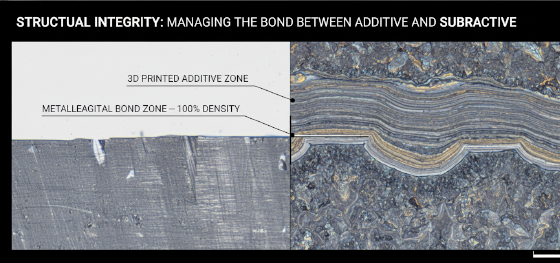
The primary technical concern in any hybrid assembly is the "Metallurgical Interface." If you machine a feature into a 3D printed metal part, you are exposing the internal grain structure of the additive build. If the build was porous or suffered from poor layer-adhesion, the CNC tool will reveal these defects, leading to surface pitting or structural failure. JUCHENG eliminates this risk through a rigorous "Densification Protocol." Before any hybrid part moves to the CNC floor, it undergoes Hot Isostatic Pressing (HIP) and vacuum-annealing.
These thermal cycles "heal" any microscopic voids and stabilize the crystal lattice, ensuring the material is as homogeneous as a forged billet. When our 5-axis cutters strike the material, they encounter a consistent, high-hardness substrate that holds a mirror finish without tearing. This structural integrity is vital for medical implants where the porous, 3D printed surface is designed for bone integration, but the threaded connection points must be rock-solid and free of burrs. We treat the bond between the "grown" metal and the "milled" surface as a primary engineering specification, providing our clients with the metallurgical data and cross-section analysis needed to prove the part is functionally invincible. By managing the atomic soul of the hybridpart, we ensure it survives the brutal cyclic loads of jet engines and robotic joints.
Industrial Evolution: Case Studies in Molds, Aerospace, and Medical
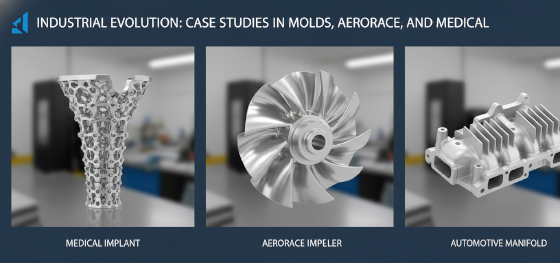
Where does the theory of hybrid manufacturing systems 3d printing cnc machining meet the reality of the field? At Jucheng Precision, we have deployed this synergy across three critical industrial frontiers. In the Mold-Making sector, we produce tool inserts with conformal cooling. We use DMLS to print cooling channels that follow the 3D curve of the cavity—something no drill could ever do—and then we use our high-speed mills to finish the mold face to a SPI A-1 mirror polish. This combination reduces plastic injection cycle times by 30%, providing a massive ROI for our high-volume clients.
In the Aerospace sector, we utilize hybrid manufacturing to create monolithic structural brackets. We CNC machine the primary load-bearing frame for absolute grain-flow strength, then use additive deposition to add complex, lightweight aerodynamic fairings or internal cable guides. This reduces part count from ten components to one. In the Medical industry, we produce patient-specific hip and knee replacements. We use 3D printing to create the trabecular surface needed for bone ingrowth, while the high-wear ball-and-socket interfaces are precision-turned on our CNC lathes to a sub-micron finish. These case studies prove that hybrid manufacturing is not just a niche process; it is the new industrial standard for high-complexity hardware that refuses to compromise on quality.
Technical Verification: Closing the Loop with Metrology
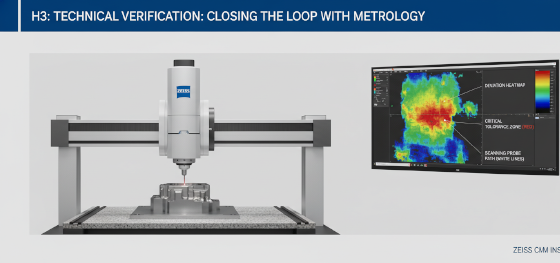
The final hallmark of a professional hybrid facility is the audit of the convergence. You cannot manage a multi-technology part without a unified inspection protocol. At Jucheng Precision, we close the loop through an investment in elite metrology. We utilize non-contact 3D scanners to verify the "As-Printed" preform before it ever reaches the CNC department, ensuring that the machining stock is exactly where the CAM program expects it to be.
Once the subtractive finishing is complete, the part moves to our climate-controlled CMM lab. We perform a "Feature-to-Lattice" verification, ensuring that the 5-axis milled bores are perfectly aligned with the internal 3D printed structures. We provide our clients with a "Digital Birth Certificate" for every part—a comprehensive report that includes material XRF analysis, density verification, and a 100% dimensional heatmap. This transparency is why JUCHENG is the preferred partner for global innovators who need more than just a part; they need the verified engineered certainty that their hybrid components will fit and function in the most demanding assemblies. We don't just combine machines; we coordinate data to deliver perfection.
JUCHENG’s Recommendation: The Path to Hybrid Success
Choosing between a cnc machine vs 3d printer is an outdated dilemma. At Jucheng Precision, our recommendation is almost always to stop choosing and start integrating. We act as an unbiased technical hub because we own the entire spectrum of capability. Our engineering team provides a free DFM review for every project, helping you identify exactly where 3D printing will save you weight and where CNC machining will save your tolerances.
The JUCHENG Hybrid Strategy:
• Use 3D Printing for internal complexity, conformal cooling, and topological optimization.
• Use CNC Machining for bearing seats, precision threads, and high-gloss sealing surfaces.
• Use JUCHENG for the "One-Stop Solution" that manages the transition between both worlds.
Don't let your designs be compromised by the limitations of a single process. Experience the clarity and the capability that hybrid manufacturing systems 3d printing cnc machining can bring to your next industrial breakthrough. Contact Jucheng Precision today and let our engineers help you build a bigger, better, and more profitable physical reality. We bridge the gap between design theory and real-world assembly, ensuring your most ambitious visions are armored for survival.

