


Metal is the ultimate frontier of structural integrity. In the high-stakes sectors of aerospace, defense, and medical implants, the choice between a cnc machine vs 3d printer is not a cosmetic one—it is a decision of life-cycle physics. Most engineers view 3D printing as the future and CNC as the past, but the reality of metal 3d printing vs cnc machining is a sophisticated standoff between geometric freedom and metallurgical purity. One allows you to grow labyrinths inside of solid walls; the other ensures that every cubic micron of the material possesses the consolidated strength of a forged legacy. Choosing correctly is the difference between a part that survives the launch pad and one that delaminates under the first wave of high-frequency vibration.

Jucheng Precision operates at the intersection of these two worlds. We don't believe in the "either/or" trap. We understand that a DMLS (Direct Metal Laser Sintering) part is often just a "near-net-shape" preform that requires the surgical accuracy of a 5-axis mill to become a finished engineered solution. By operating a facility that marries 25 high-precision CNC centers with industrial-tier metal additive systems, we act as unbiased process architects. This guide moves past the surface-level hype to explore the hard thermodynamics of the melt pool, the structural sovereignty of wrought billets, and why JUCHENG’s integrated hybrid approach is the only way to deliver complex metal designs that meet aerospace and ISO 13485 standards.
Efficiency in high-end metalwork is found in the management of the "Buy-to-Fly" ratio. You aren't just paying for the final part; you are paying for the energy required to transform raw matter into functional security. Whether you are building an innovative heat exchanger or a high-torque drivetrain node, the logic of the bond is your primary manufacturing governor. Let us examine the technical pillars of the metal divide and see how JUCHENG locks the integrity of your most ambitious designs into physical reality.
Complexity Sovereignty: When Internal Voids Mandate DMLS
Structural Homogeneity: Why Wrought Alloys Rule Under Fatigue
Metallurgical Realities: Wrought Billets vs. Powder Bed Fusion
Cost-to-Volume Ratio: Identifying the Production Cross-over
Integrated Synthesis: JUCHENG’s Hybrid Metal Protocol
Complexity Sovereignty: When Internal Voids Mandate DMLS
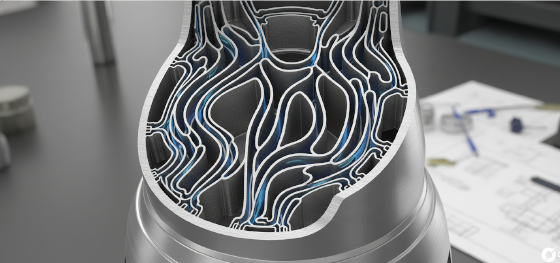
The primary victory of DMLS over CNC is found in the "Internal Void." In traditional subtractive manufacturing, the tool is a slave to the line-of-sight. If you need a cooling channel inside a solid titanium block, you are forced to drill straight holes and plug the exits. This creates "Thermal Bottlenecks" where heat cannot escape efficiently. Metal 3d printing vs cnc machining becomes a clear-cut decision the moment your design requires conformal cooling or organic internal lattices. DMLS allows JUCHENG to "grow" these channels in any direction, mirroring the exact geometry of the heat source.
For the aerospace engineer, this complexity sovereignty means the ability to create monolithic structures that combine multiple parts into one. We can print a fuel nozzle with integrated filters and swirler vanes that would require a twenty-part assembly if machined via traditional methods. By eliminating the fasteners and the weld joints, we reduce the weight and the potential points of failure. In this niche, additive doesn't just "compete" with CNC; it enables a level of thermodynamic performance that subtractive tools cannot physically achieve. If your part is defined by what is on the inside, the powder bed is your only logical sanctuary.
Structural Homogeneity: Why Wrought Alloys Rule Under Fatigue
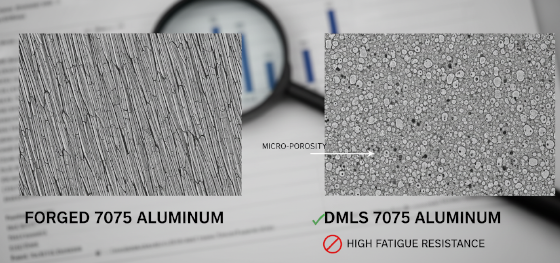
Despite the allure of complexity, raw mechanical strength is where CNC machining remains the heavyweight champion. A CNC machined part begins its life as a wrought metal billet—a material that has been forged, rolled, and stabilized under intense industrial pressure. This process eliminates microscopic air pockets and ensures an Isotropic structure where the strength is identical in every direction. When comparing metal 3d printing vs cnc machining for high-vibration engine mounts or rotating axles, the "Solid Billet" advantage is absolute.
DMLS parts, while nearly 100% dense, are still essentially "micro-welded" structures. They can possess microscopic voids or "gas porosity" that act as starting points for fatigue cracks. Under the relentless cycle of mechanical stress, a 3D printed metal part will often fail sooner than a machined wrought part. At Jucheng Precision, we advocate for CNC machining for any component that serves as a primary load-bearing pivot or a safety-critical structural frame. We treat the grain of the metal with technical reverence, ensuring that your parts possess the "Structural Homogeneity" needed to survive millions of load cycles. When the mission is pure endurance, the mill is the only tool that can guarantee the metallurgical soul of the component.
Metallurgical Realities: Wrought Billets vs. Powder Bed Fusion

Data is the only cure for engineering ambiguity. To help you choose between metal 3d printing vs cnc machining, Jucheng Precision provides the following baseline comparison for 17-4 PH Stainless Steel—a common material in both departments. These numbers illustrate the "Gap" between forged performance and additive simulation.
| Property (17-4 PH) | CNC (Wrought Stock) | DMLS (As-Printed) | DMLS (Heat-Treated) |
|---|---|---|---|
| Tensile Strength | ~1170 MPa | ~800-900 MPa | ~1050-1100 MPa |
| Yield Strength | ~1000 MPa | ~600-700 MPa | ~900-950 MPa |
| Elongation % | ~14-18% | ~20-25% | ~10-15% |
| Density | 100% (Consolidated) | ~99.5% | ~99.9% (via HIP) |
As the table shows, a 3D printed part can approach wrought strength, but it usually requires post-process intervention. At JUCHENG, we utilize vacuum-annealing and Hot Isostatic Pressing (HIP) to bridge this gap, ensuring that our additive metal parts meet the mechanical expectations of the defense sector. However, the wrought billet used in CNC machining provides a natural advantage in ductility and through-hardenability that is ready to work directly from the machine bed. We help our clients navigate these metallurgical realities, ensuring that your choice isn't just about "how" it's made, but "how well" it survives.
Cost-to-Volume Ratio: Identifying the Production Cross-over

Economics is the ultimate governor of the metal 3d printing vs cnc machining choice. In the subtractive world, you pay for the material you throw away. For a complex titanium bracket, the "Buy-to-Fly" ratio can be 10:1—meaning you buy 10kg of titanium to get a 1kg part. The remaining 9kg is turned into unrecyclable waste chips. At $100 per kilogram, the material waste alone can make CNC non-viable for complex geometries. 3D printing reverses this logic; you only pay for the powder that stays in the part. Material utilization in DMLS is nearly 98%.
However, DMLS is slow. A machine that costs a million dollars might only produce three large parts a day. This makes the "Rental Fee" of the machine very high. In the cnc machine vs 3d printer ROI analysis, the breakeven point is usually found between 20 and 50 units. For a single complex prototype, DMLS is almost always cheaper because there are no fixtures or NRE costs. For a production run of 100 parts, the speed of the CNC spindle amortizes the setup debt so effectively that the total cost per part drops by 60% compared to additive. Jucheng Precision performs a "Total Volume Audit" for our clients, helping you decide if you should grow your part in a powder bed to save material, or mill it in a 5-axis center to save machine time. We bridge the gap between "Prototyping Agility" and "Production Scale," ensuring your budget is optimized for your volume.
Integrated Synthesis: JUCHENG’s Hybrid Metal Protocol

The final hallmark of a professional manufacturing partner is the refusal to accept "additive only" or "subtractive only" limitations. The future of high-performance metal is the Hybrid Solution. At Jucheng Precision, we have mastered the protocol of "Printing for Complexity, Milling for Fit." We treat the 3D printer as a high-tech foundry that produces an "advanced preform." We print your complex metal parts with extra material—known as machining stock—on every critical datum and mating face.
Once the build is complete and stress-relieved, the part moves to our 5-axis CNC floor. We use our high-speed mills to carve away the "near-net" texture, revealing mirror-smooth bearing seats, precision-tapped holes, and +/- 0.01mm tolerances. This integrated approach is the reason why JUCHENG is the preferred partner for global aerospace and robotics leaders. We eliminate the accountability gap between vendors, providing a single, verified engineered solution that possesses the geometric freedom of 3D printing and the surgical certainty of CNC. We don't just provide a part; we provide the metallurgical assurance that your design is flight-certified and ready for service. Whether you are building an innovative medical heart pump or a high-pressure aerospace nozzle, our dual-technology cell clarifies and elevates your most difficult designs. Contact Jucheng Precision today for a technical DFM review and see how our hybrid metal protocols can armor your next breakthrough.

