


Precision in CAD is a mathematical certainty, but precision on the factory floor is a thermodynamic struggle. When an engineer specifies a tolerance on a digital model, they are assuming a world without friction, heat, or gravity. However, the choice between a cnc machine vs 3d printer is exactly where these physical laws begin to exert their will. A 3D printer builds a part through a series of micro-welds or chemical transitions, each introducing a tiny variable of shrinkage. A CNC machine, by contrast, removes material with a rigid, documented force. This is the technical battlefield of CNC vs 3D Printing Tolerances. It is a decision that determines whether your parts will assemble with a satisfying "click" or whether you will spend weeks in a remedial rework loop.
JUCHENG operates as a unified technical hub, and we’ve noticed a consistent "Micron Trap": designers often expect 3D printers to hold the same H7 tolerances as a precision mill. The reality is that additive manufacturing is a "Near-Net-Shape" technology. It excels at complex volume but struggles with the absolute sovereignty of the coordinate. We utilize over 25 high-precision 5-axis centers specifically to close the accuracy gap that additive methods leave behind. This guide moves past the standard datasheets to explore the actual mechanics of thermal drift, the logic of linear scales, and why JUCHENG’s integrated hybrid approach is the only way to achieve sub-ten-micron fits in high-performance hardware.
Reliability in high-stakes engineering is born from the control of deviation. You aren't just buying a shape; you are buying the verified relationship between features. Whether you are building a complex medical valve or a high-speed aerospace spline, the logic of the tolerance is your primary manufacturing governor. Let us break down the physical laws of dimensional integrity and see how technical foresight can lock the soul of your next design into reality.
Thermal Hostility: Why 3D Printing Drifts in the Tank
The Sovereignty of the Spindle: Machining Without Deviation
Dimensional Benchmarks: The Additive vs. Subtractive Chart
The Press-Fit Crisis: Why H7 Bores Demand the Mill
JUCHENG’s Hybrid Standard: Printing for Mass, Milling for Fit
Thermal Hostility: Why 3D Printing Drifts in the Tank
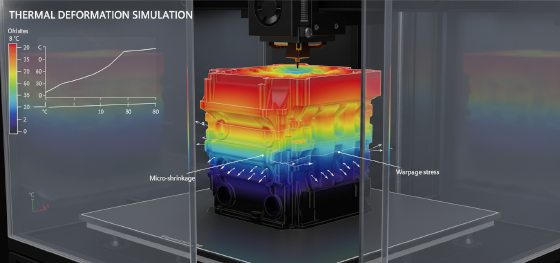
The primary differentiator in the CNC vs 3D Printing Tolerances standoff is the management of phase changes. Every 3D printing technology relies on adding heat or UV energy to transform a liquid or powder into a solid. As the material cools or cures, it shrinks. This shrinkage is not always uniform; it is influenced by the part's cross-sectional mass and the ambient temperature of the build chamber. In a large FDM or SLS part, the corners want to pull inward, creating "bowing" that can move a feature out of tolerance by as much as 0.3mm. Even in high-precision SLA (Resin) systems, the act of "peeling" the part off the vat can cause microscopic distortions.
This "Thermal Hostility" makes additive manufacturing a game of compensation rather than absolute control. Slicer software attempts to predict this shrinkage and scale the part accordingly, but these are mathematical estimates, not physical certainties. For a cosmetic part, a 0.2mm deviation is invisible. But for a medical manifold where internal channels must align perfectly with a machined sensor, that drift is a failure. JUCHENG mitigates this by utilizing industrial-tier 3D systems with actively heated chambers and stabilized cooling ramps, but we are honest with our clients: if your part is defined by long, unsupported spans and requires +/- 0.05mm accuracy, the physics of 3D printing are fighting against you from layer one. We treat additive as a tool for complexity, not for the absolute mastery of the micron.
The Sovereignty of the Spindle: Machining Without Deviation
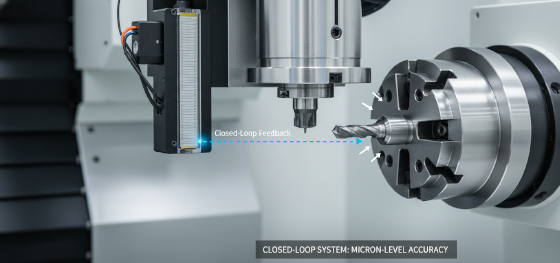
CNC machining operates on the principle of mechanical imposition. We don't wait for the metal to react; we force it into shape. The accuracy of the cnc machine vs 3d printer choice is rooted in the rigidity of the motion system. A CNC mill uses massive cast-iron components and precision-ground ball screws to lock the tool's position. Most importantly, high-end machines at JUCHENG utilize "Closed-Loop" feedback. High-resolution linear scales measure the physical position of the table and provide real-time corrections to the servo-motors, accounting for thermal expansion of the machine's own components.
This Sovereignty of the Spindle allow us to hit +/- 0.01mm (0.0004 inches) with staggering repeatability. Unlike 3D printing, where the material is "formed" in place, CNC removes material from a stabilized, wrought billet that has already been heat-treated and stress-relieved. This eliminates the "warpage" that occurs when creating new solids from liquid or powder. If you are machining 17-4 PH stainless steel or Machining Nylon 6, the mill maintains the geometric truth of the CAD file because the tool rigidity overcomes the material's internal resistance. We treat every CNC operation as a surgical event, providing the dimensional certainty needed for the world’s most demanding aerospace and defense assemblies. In the tolerance race, the mill is the undisputed heavy-lifter.
Dimensional Benchmarks: The Additive vs. Subtractive Chart
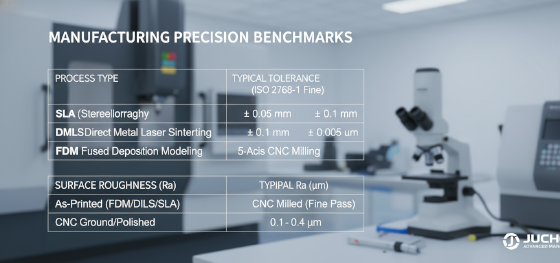
Data is the only cure for manufacturing ambiguity. To simplify your manufacturing strategy, Jucheng Precision has developed a realistic benchmark of CNC vs 3D Printing Tolerances. These values represent the "Standard Industrial Performance" of parts produced and inspected in our climate-controlled lab at 20°C.
| Technology | Standard Tolerance | Precision Limit | Typical Surface Finish |
|---|---|---|---|
| 5-Axis CNC Milling | +/- 0.05 mm | +/- 0.005 mm | Ra 0.8 - 1.6 |
| Industrial SLA (Resin) | +/- 0.15 mm | +/- 0.10 mm | Ra 1.6 - 3.2 |
| DMLS (Metal 3D) | +/- 0.20 mm | +/- 0.10 mm | Ra 6.3 - 12.5 |
| MJF / SLS (Powder) | +/- 0.30 mm | +/- 0.20 mm | Ra 3.2 - 6.3 |
The Press-Fit Crisis: Why H7 Bores Demand the Mill
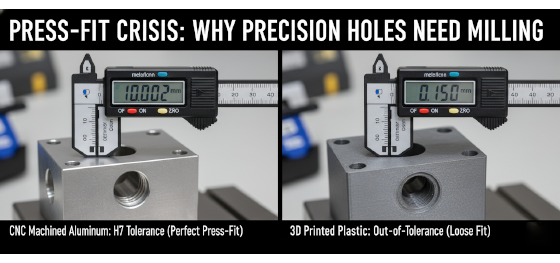
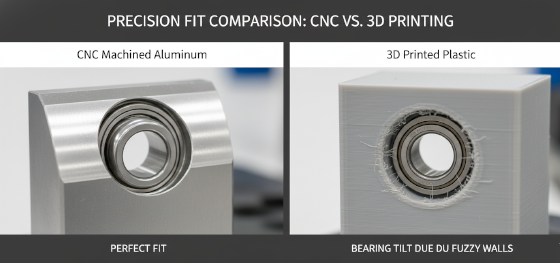
The "Fit" of an assembly is where CNC vs 3D Printing Tolerances move from a theoretical discussion to a functional crisis. If your part features a bearing seat, a locating pin hole, or a high-pressure seal groove, you are likely operating in the world of H7 or g6 fits. These ISO standards allow for a margin of error measured in single-digit microns. 3D printing is physically incapable of hitting these tolerances consistently. The layer lines and stair-stepping effects create "peaks" on the internal surface of a hole that prevent a bearing from seating flat. If you try to force a fit on an "as-printed" hole, you will likely crack the part or cause a misalignment that leads to early failure.
At JUCHENG, we manage the "Press-Fit Crisis" by auditing every assembly interface during the DFM review. We don't just "hit go" on the printer for your complex manifolds. We identify the zones where additive manufacturing will fail to meet the functional requirement and we propose a hybrid solution. This ensures that the primary weight-saving and complex geometry is handled by the 3D printer, while the critical "interfacing" features are handled by our CNC department. We understand that a part that looks good but doesn't fit is a wasted investment. By separating the "structural mass" from the "precision interface," we deliver a component that works flawlessly in your final assembly, regardless of the complexity of the design.
JUCHENG’s Hybrid Standard: Printing for Mass, Milling for Fit
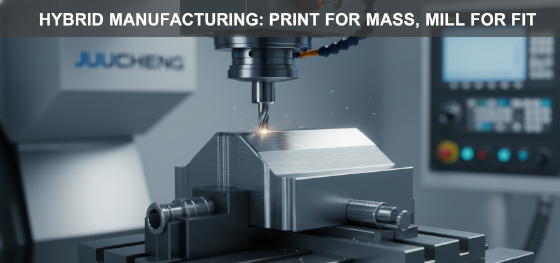
The final hallmark of a professional manufacturing partner is the move away from "Either/Or" thinking. The future of CNC vs 3D Printing Tolerances is not a choice between two machines, but the synchronization of both. Jucheng Precision has mastered the "Hybrid Workflow." We print your complex metal or plastic parts with extra material (machining stock) on all critical faces. We then move the part to our 5-axis CNC floor, where we mill the features back to absolute zero-deviation.
This integrated approach provides our clients with the geometric freedom of 3D printing and the surgical accuracy of CNC machining. We use our high-resolution CMMs to verify this hybrid bond, providing you with 100% inspection reports that prove every H7 bore and every datum face meets your print. When you receive a component from JUCHENG, you aren't just getting additive or subtractive work; you are getting a verified engineered solution that has been audited for survival. Whether you are building an innovative medical heart pump or a high-performance satellite manifold, our dual-technology protocols clarify and elevate your most ambitious projects. Contact Jucheng Precision today for a technical DFM review and see how our tolerance mastery can stabilize your next manufacturing breakthrough.

