


Hardware commercialization suffers a violent setback when the chemistry of the cavity turns against the polymer. In the high-velocity world of precision manufacturing, encountering injection molding burn marks—dark brown or black carbonized scars appearing at the end of a flow path—is a physical proof that your mold has transitioned from a forming tool into a combustion chamber. This specific failure is not merely an aesthetic blemish; it is a chemical degradation event that compromises the structural integrity of your housings and brackets. Navigating the pathology of Injection molding defects requires moving beyond the simplistic idea that "the plastic is too hot." Most burn marks are actually caused by the "Diesel Effect," where trapped atmospheric air is compressed so rapidly that it reaches auto-ignition temperatures. Jucheng Precision operates as a thermal engineering sanctuary, utilizing surgical micro-venting and scientific flow control to ensure your Class-A surfaces remain pristine and free of carbonized oxidation.
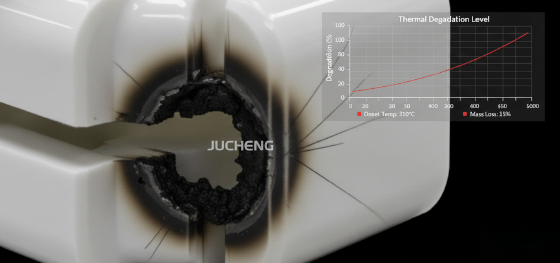
Eliminating thermal scars requires a forensic interrogation of "Atmospheric Evacuation." As molten plastic screams into a mold at twenty thousand pounds of pressure, it must displace the air currently occupying that space. If that air becomes trapped in a "blind pocket" or at the furthest extremity of the part, it has nowhere to go. Under the crushing force of the melt front, this gas undergoes adiabatic compression, spiking in temperature within milliseconds and literally scorching the plastic surface. Jucheng Precision eliminates these "Combustion Events" by performing a surgical DFM audit on every CAD file. We identify gas-trap risks and engineer 0.015mm precision vents that allow air to escape at the speed of sound while keeping the plastic contained. This guide deconstructs the physics of ignition, the dangers of excessive residence time, and the processing maneuvers needed to keep your high-volume production batches chemically stable and cosmetically flawless.
Thermal Ignition: Defining the Diesel Effect
Atmospheric Traps: The Sabotage of Poor Venting
Melt Integrity: Residence Time and Material Breakdown
Velocity Control: Managing the Shear Heat Barrier
JUCHENG Protocol: Surgical Micro-Venting for Zero Burns
Thermal Ignition: Defining the Diesel Effect
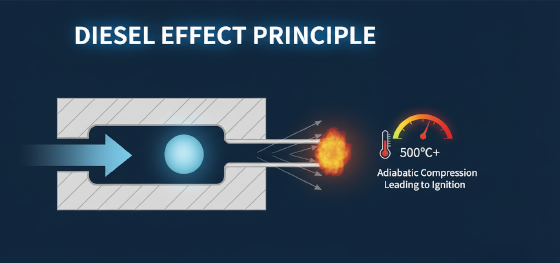
Molecular destruction occurs when the laws of thermodynamics are ignored in tool design. The "Diesel Effect" is the primary catalyst for injection molding burn marks. It follows the same principle as a diesel engine: compress a gas enough, and it will ignite without a spark. When the molten polymer front closes off an area of the mold—common in deep ribs or complex internal corners—the air inside is trapped. As the machine continues to push with immense pressure, the volume of that trapped air is reduced to a fraction of its original size. This compression generates a massive spike in localized temperature, often exceeding 600°C. Since most engineering plastics begin to carbonize at 300°C, the result is an instant scorch mark. Amateurs often attempt to fix this by lowering the melt temperature, but this only leads to short shots. The real solution is to provide an escape route for the gas. At Jucheng Precision, we treat gas management as a mandatory safety protocol for your design, ensuring that no pocket of air ever reaches the point of ignition.
Atmospheric Traps: The Sabotage of Poor Venting
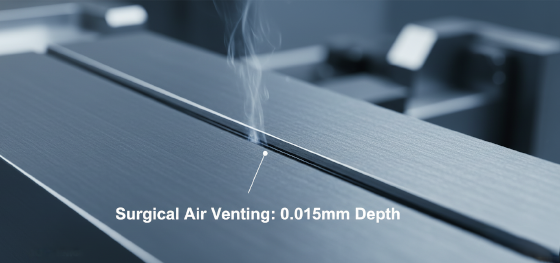
Venting discipline is the hallmark of a master mold maker. Every injection molding burn marks failure at the end of a flow path is a physical proof of inadequate venting. A mold must breathe to survive. However, designing vents is a high-precision balancing act: too shallow, and the air stays trapped; too deep, and you trigger "Injection Molding Flash" where plastic escapes the tool. Jucheng Precision utilizes sub-micron machining to cut "Surgical Vents." We calibrate the depth based on the resin's viscosity—0.015mm for "watery" materials like Nylon and 0.03mm for thicker resins like ABS. We place these micro-channels at the "last-to-fill" locations identified by our Moldflow simulations. We also utilize porous mold steels or "vented pins" in deep, blind bosses where standard parting-line venting is impossible. By managing the atmosphere inside the steel, we remove the fuel for the Diesel Effect, ensuring your parts emerge without a single speck of carbonization.
Melt Integrity: Residence Time and Material Breakdown
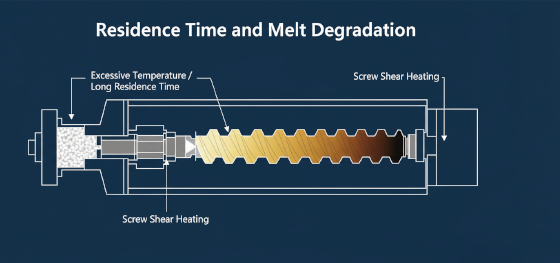
Chemical instability can also originate inside the machine's barrel before the plastic ever touches the mold. injection molding burn marks that appear randomly across the part surface, rather than at flow extremities, are usually a symptom of "Material Degradation." This occurs when the resin's "Residence Time"—the total time the plastic spends at high temperature inside the barrel—exceeds its thermal limits. If the shot size is very small compared to the barrel capacity, the plastic can sit for ten cycles or more under intense heat, slowly breaking down its polymer chains. Furthermore, "Screw Shear" can add uncontrolled frictional heat, spiking the melt temperature beyond the digital setting on the controller. Jucheng Precision process engineers utilize scientific molding to match the barrel size to the shot volume, ensuring a "First-In, First-Out" material flow. We monitor melt temperatures with manual probe audits to verify our digital sensors, preventing the chemical breakdown that leads to brownish streaks and compromised mechanical spine in your hardware.
Velocity Control: Managing the Shear Heat Barrier

Speed is a double-edged sword in the injection room. High-speed injection is necessary to fill thin-walled medical or electronic housings before they freeze, but excessive speed triggers "Shear Heating." As plastic is forced through a narrow gate or a thin rib, the friction between molecules generates intense heat. If the injection velocity is set to a constant "maximum," this shear heat can push the material past its carbonization point, resulting in injection molding burn marks localized around the gate area. Jucheng Precision eliminates this risk through "Velocity Profiling." We program our machines to "slow down" as the melt front passes through restrictive geometries, then accelerate to fill the main volumes. This precision allows us to fill your parts at the lowest possible temperature and pressure, minimizing the thermal burden on the polymer and ensuring the structural and visual soul of your design remains uncompromised by the manufacturing process.
JUCHENG Protocol: Surgical Micro-Venting for Zero Burns
Engineering excellence at Jucheng Precision is built on the foundation of the proactive DFM audit. We do not wait for burnt parts to appear during trials; we hunt for gas traps in the digital CAD space. When you upload a project to our facility, our veteran engineers utilize advanced simulation to predict exactly where air will be trapped. We propose "Venting Inserts" or "Split-Cavity" designs to provide an escape route before the first block of steel is machined. Our facility, housing over 150 CNC machines and elite injection bays, ensures that the micro-venting we propose is executed with sub-micron fidelity. Stop gambling your R&D budget on designs that will inevitably fail the visual audit. Not sure if your wall thickness is uniform or your venting is sufficient? Upload your 3D CAD file to JUCHENG today for a Free DFM Review. Our experts will identify Injection molding defects before they cost you money, ensuring your mass production launch is stable, clean, and retail-ready.

