


Procurement disasters in oversized hardware usually manifest as "Sticker Shock" during the tooling phase. For hardware innovators in the Shenzhen precision manufacturing hub, navigating the Large plastic parts manufacturing landscape requires more than just a big machine; it requires a dispassionate audit of the "Cost-to-Volume" ratio. Attempting to manufacture a 1.5-meter medical MRI shroud or a heavy-duty industrial robot base using high-pressure injection molding often results in a six-figure financial anchor that kills niche programs before they ever reach the market. Deciding on the appropriate Large plastic molding cost strategy is a high-stakes calculation of thermodynamic efficiency versus structural longevity. Jucheng Precision operates as a strategic manufacturing navigator, providing the technical depth to bridge the gap between "experimental scaling" and "profitable sovereignty." We don't just "mold parts"; we engineer a financial roadmap that ensures your largest designs remain capital-efficient and retail-ready.

Establishing a resilient launch for oversized hardware demands the rejection of high-pressure dogmas. In the hyper-agile environment of 2026, waiting twelve weeks for a multi-ton steel mold is an eternity that drains your cash reserves. Jucheng Precision eliminates this "Tooling Debt" by positioning Reaction Injection Molding (RIM) as the primary engine for your large-part budget. By utilizing low-pressure liquid chemistry and cost-effective aluminum molds, we deliver parts up to two meters in length with injection-molded precision but for 80% less in upfront CapEx. This guide deconstructs the four primary pillars of Large plastic molding cost, providing the data needed to secure your project's ROI. We provide the manufacturing insurance needed to ensure your largest designs survive the test track and dominate the boardroom without shattering your capitalization strategy.
Why do traditional steel molds bankrupt large-scale niche programs?
How does low-pressure RIM physics reduce tooling cost by 80%?
How do high-tonnage machine rates impact the large plastic molding cost?
What is the economic balance between material weight and tooling CapEx?
How does JUCHENG DFM analysis shave thousands off large mold costs?
Frequently Asked Questions: Large Molding Costs
Why do traditional steel molds bankrupt large-scale niche programs?
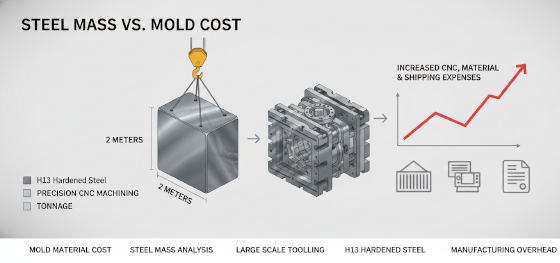
Mechanical violence inside the mold cavity requires a massive financial sacrifice. In traditional Large plastic parts manufacturing, the tool must withstand injection pressures exceeding 20,000 psi. For a two-meter part, this means the mold must be constructed from massive, multi-ton slabs of H13 or P20 steel to prevent the plates from physically bowing. The cost of the raw steel alone can reach $30,000, not including the thousands of hours of high-velocity CNC milling and EDM sparking required to carve the geometry. Jucheng Precision recognizes that if your project requires fewer than 5,000 units per year, this "Steel Ransom" is a misallocation of capital. We eliminate this hurdle by utilizing low-pressure RIM technology, which allows for the use of lightweight aluminum tools that can be machined in two weeks rather than three months, ensuring your budget remains as agile as your engineering team.
How does low-pressure RIM physics reduce tooling cost by 80%?

Thermodynamic passivity represents the "unfair advantage" of the RIM process. Unlike injection molding that rams molten pellets into a tool, RIM utilizes a chemical reaction between two low-viscosity liquid components. These liquids enter the cavity at less than 100 psi—a fraction of the pressure used in standard molding. This transition in physics means Jucheng Precision can utilize aluminum molds that are ten times lighter and 70% cheaper to manufacture. Below is the comparative matrix for Large plastic molding cost based on a 1.2-meter industrial housing:
| Cost Driver | High-Tonnage Injection | JUCHENG RIM (Polyurethane) |
|---|---|---|
| Mold Material | P20/H13 Steel ($$$$) | Al 7075 / Epoxy ($) |
| NRE / Setup | $60,000 - $120,000 | $8,000 - $18,000 |
| Lead Time | 10 - 14 Weeks | 2 - 4 Weeks |
| Breakeven Point | > 10,000 Units | 100 - 2,000 Units |
How do high-tonnage machine rates impact the large plastic molding cost?
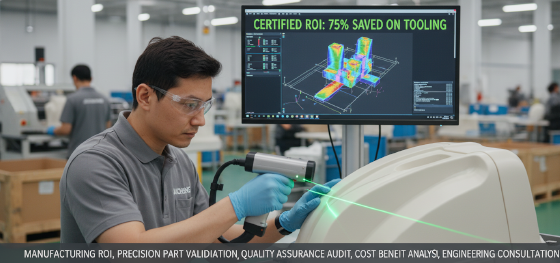
Machine-hour overhead is the silent killer of mid-volume margins. In the injection room, a 2000-ton press required for large parts consumes massive amounts of electricity and occupies a footprint the size of a small house. These machines carry an hourly rate that can exceed $200 per hour. RIM units, conversely, are compact, low-power dispensing systems with minimal hydraulic requirements. Jucheng Precision leverages this "Operational Lean" to provide Low volume large plastic parts at a fraction of the running cost. We effectively shift your project from a high-overhead high-pressure environment to a surgical low-pressure casting bay, ensuring your unit price remains competitive even for batches of five hundred. We turn "Machine Density" into "Client Profitability."
What is the economic balance between material weight and tooling CapEx?
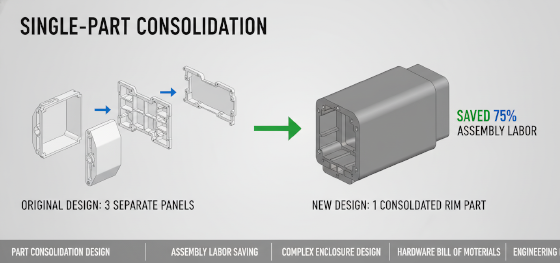
Molecular weight dictates the baseline material expense. While standard thermoplastic pellets (ABS/PP) are cheaper by the pound than two-part polyurethanes, the "Total Cost of Fulfillment" tells a different story. In Large plastic parts manufacturing, the tooling savings of RIM often outweigh the material premium for the first five years of a product's life. For a medical cart, a $50,000 tooling saving buys a lot of polyurethane resin. Furthermore, RIM allows for the elimination of separate brackets and mounting hardware by molding them directly into the part shell. Jucheng Precision performs a "Holistic BOM Audit" for our clients, identifying how part consolidation can reduce your total assembly cost by 30%. We don't just sell you plastic; we optimize your entire hardware economy.
How does JUCHENG DFM analysis shave thousands off large mold costs?
Engineering excellence at Jucheng Precision is built on the foundation of "Proactive Financial DFM." We don't just "quote and cut"; we interrogate your CAD file to find "Hidden Expenses." For large enclosures, we look for opportunities to simplify the parting line and reduce the number of side-actions (sliders). In a large-format mold, a single slider can add $5,000 to the Large plastic molding cost. Our facility, housing over 150 CNC machines and elite toolmakers, specializes in "Two-Plate Efficiency." We suggest minor geometric tweaks—such as shifting a mounting boss or tapering a wall—that allow your part to be ejected without complex mechanical movements. This digital foresight ensures your tool is as robust as it is affordable. Stop gambling your budget on vendors who only want to sell you more steel. Leverage our decade of large-scale mastery to validate rapidly and scale profitably.
Frequently Asked Questions: Large Molding Costs
Question: Why is the Large plastic molding cost so much lower with RIM?
Answer: The primary reason is the "Low-Pressure Factor." Because the material is poured, not rammed, the mold plates don't need to be multi-ton steel blocks. This slashes the material and CNC machining cost of the tool by 60% to 80%.
Question: How does part volume affect the choice between injection molding and RIM?
Answer: For quantities between 100 and 2,000 units, RIM is the clear financial winner. As you approach 10,000 units, the faster cycle times and lower material costs of high-tonnage injection molding begin to favor the larger initial tooling investment.
Question: Can JUCHENG help me reduce the weight of my Custom large plastic enclosures?
Answer: Yes. Our engineers utilize rib-optimization and wall-thinning strategies to ensure your large RIM parts have a high strength-to-weight ratio, which reduces both shipping costs and user handling fatigue.
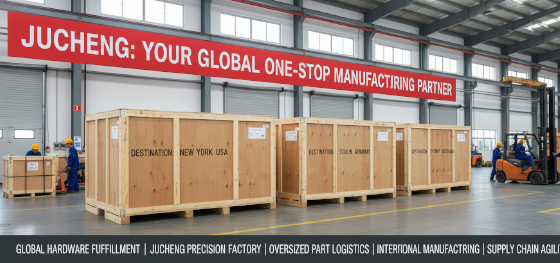
Manufacturing sovereignty on a large scale requires a partner who values your ROI over their machine uptime. Jucheng Precision eliminates the friction of vendor-hopping by offering integrated CNC, RIM, and high-tonnage injection molding under a single roof. We provide full material lot traceability and CMM dimensional inspection reports for every oversized batch, ensuring your hardware journey is lean, predictable, and market-ready. Contact our technical team today for a free DFM review and see how we can turn your digital intent into a structurally sovereign, large-scale reality that is documented for success.

