


Clinical feedback dictates the survival of disruptive healthcare technology. In the hyper-agile environment of 2026, forcing a chief surgeon to evaluate a new robotic interface using a rough, fragile 3D-printed mockup is a strategy for rejection. Doctors judge a tool by its weight, its balance, and the immediate tactile feedback of its controls; if the prototype feels like a toy, the underlying million-dollar software is instantly discredited. Navigating this requirement for absolute physical realism requires the strategic deployment of Medical robot prototyping. This highly specialized phase within Medical Robotics Manufacturing focuses on the rapid creation of "Functional Surrogates"—devices that possess the exact mechanical modulus, dual-material haptics, and visual authority of a mass-produced unit. Jucheng Precision operates as a high-fidelity iteration laboratory in the Shenzhen precision manufacturing hub, providing the technical depth to transform CAD files into clinical-grade assemblies in a matter of days. We don't just "print parts"; we engineer a persuasive physical reality that allows your startup to secure venture funding, pass early ergonomic audits, and confidently freeze your design for high-volume tooling.
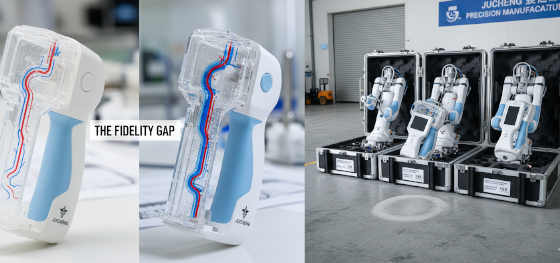
Establishing a resilient development roadmap demands the rejection of "low-fidelity" validation. Amateurs often spend months tweaking digital geometries, only to discover during physical assembly that the internal routing for the pneumatic lines interferes with the harmonic drive. Jucheng Precision eliminates these "Virtual Blind Spots" by providing a multi-process manufacturing ecosystem. We combine 5-axis CNC machining for rigid skeletal joints, DMLS (Direct Metal Laser Sintering) for complex titanium bone structures, and vacuum casting for retail-ready exterior enclosures. Whether you are developing a portable diagnostic bot or a multi-arm surgical suite, our facility provides the material science and metrological rigor required to identify flaws before they cost you a $50,000 tooling penalty. This guide deconstructs the physics of rapid material mimicry, the necessity of 50-unit clinical batches, and why JUCHENG’s "High-Speed Iteration" protocol is the mandatory foundation for anyone developing healthcare hardware.
Haptic Sovereignty: Tricking the Surgeon’s Senses
Skeletal Validation: DMLS Titanium and Machined Joints
Clinical Batches: The 50-Unit Vacuum Casting Bridge
Regulatory Insurance: Front-Loading the Failure Modes
JUCHENG Protocol: 14-Day Delivery for Complex Assemblies
Frequently Asked Questions: Medical Prototyping
Haptic Sovereignty: Tricking the Surgeon’s Senses
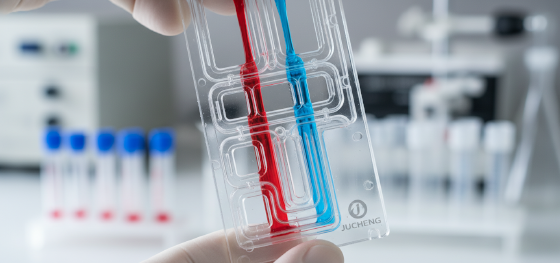
Ergonomic validation requires physical hardware that doesn't lie to the hand. When evaluating Medical robot prototyping for surgeon-side consoles or handheld effectors, the "Touch and Feel" is the dominant variable. Standard additive manufacturing cannot seamlessly fuse a rigid plastic chassis with a soft, medical-grade rubber grip. Jucheng Precision utilizes advanced vacuum casting and overmolding techniques to deliver monolithic, dual-durometer prototypes. We can cast a rigid ABS-like core and chemically bond a Shore 40A elastomer directly over it in a single prototype assembly. This provides the surgeon with the exact vibration-damping and grip-security intended for the final product. Furthermore, we apply automotive-grade 2K paints and pad-printed corporate logos in our cleanroom finishing bays. We turn "grey resin" into a "Showroom Asset," ensuring that when your clinical advisory board evaluates the device, their feedback is focused on the functionality of the tool, not the crudeness of its manufacture.
Skeletal Validation: DMLS Titanium and Machined Joints
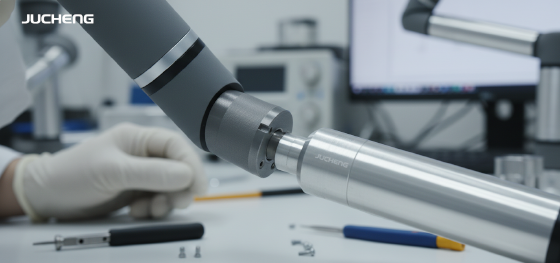
Kinetic performance cannot be tested with plastic gears. The "bones and muscles" of a surgical assistant robot require extreme rigidity to ensure zero-backlash movement. Jucheng Precision engineers act as your "Skeletal Navigators" during the prototyping phase. We utilize DMLS 3D printing to create highly complex, generative-designed titanium brackets that consolidate multiple components into a single, lightweight lattice structure. For the high-torque movement centers, we rely on our fleet of 5-axis CNC machines to carve bearing seats and actuator housings from solid blocks of 7075 Aluminum or 316L Stainless Steel. By maintaining +/- 0.005mm tolerances on these critical interfaces, we ensure that your prototype robot moves with the exact kinematic accuracy dictated by your software. This allows your team to tune the PID control loops and calibrate the motors using hardware that possesses the actual mass and inertia of the final production unit.
Clinical Batches: The 50-Unit Vacuum Casting Bridge
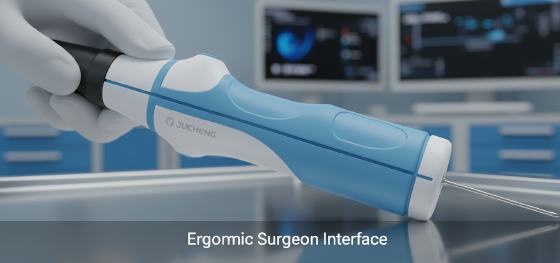
Testing a medical device across multiple hospitals simultaneously requires a fleet of identical machines. While CNC machining is excellent for 1 or 2 structural units, scaling up to 50 cosmetic enclosures for a beta-test quickly becomes cost-prohibitive. Medical robot prototyping relies heavily on polyurethane vacuum casting to solve this "Quantity Gap." By machining a single, highly polished master pattern, we create a flexible silicone tool capable of pouring 20 to 25 identical polyurethane copies. These resins are chemically engineered to simulate the structural spine and heat deflection temperature of production plastics like Polycarbonate or flame-retardant ABS. Jucheng Precision can deliver 50 flawless, painted, and assembled enclosures in two weeks for a fraction of the cost of injection molding. This "Bridge Batch" enables your startup to distribute units to key opinion leaders (KOLs) and regulatory testing labs simultaneously, slashing your time-to-market and keeping your R&D budget remarkably lean.
Regulatory Insurance: Front-Loading the Failure Modes
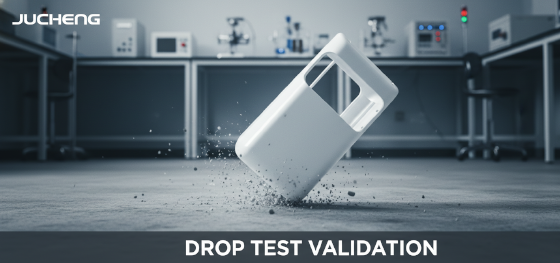
FDA and CE Mark certifications are ruthless bureaucratic hurdles that demand physical proof of safety. A product that fails an IP67 waterproof test or shatters during a 1.5-meter drop test will require a total redesign, delaying the launch by months. Jucheng Precision utilizes the prototyping phase as a "Failure Sandbox." By using materials that closely mimic the final production intent, we allow you to "front-load" these regulatory risks. You can subject our vacuum-cast housings to high-voltage dielectric tests or chemical wipe-down audits using hospital-grade bleach. If a weakness is identified, we simply update the CAD file and machine a new master pattern in days. We don't just provide parts; we provide the physical insurance needed to ensure your design is robust, compliant, and ready to pass the most grueling clinical audits on the first attempt, long before you authorize the cutting of hardened steel molds.
JUCHENG Protocol: 14-Day Delivery for Complex Assemblies
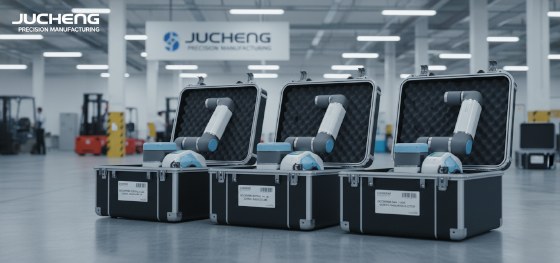
Manufacturing excellence at Jucheng Precision is built on the foundation of single-source accountability. We don't believe you should manage three different vendors for a single robotic prototype. Our facility, housing over 150 machines, integrates CNC machining, vacuum casting, sheet metal fabrication, and automated painting under one ISO 13485 certified roof. When you upload a complex multi-part assembly to our facility, our veteran engineers perform a comprehensive DFM audit, routing each component to the optimal manufacturing process for speed and cost. We provide full CMM dimensional inspection reports for every batch, ensuring your hardware journey is predictable and dimensionally sovereign. Stop gambling your venture capital on slow, fragmented suppliers. Leverage our decade of medical replication mastery to iterate rapidly, validate safely, and launch profitably. Contact our technical team today for a free DFM review and see how we can turn your digital healthcare intent into a clinically ready physical reality.
Frequently Asked Questions: Medical Prototyping
Question: How fast can JUCHENG deliver a fully functional medical robot prototype?
Answer: Depending on complexity, we typically deliver complete, multi-process Medical robot prototyping assemblies (including CNC joints and painted cast enclosures) within 10 to 14 business days from CAD approval.
Question: Are vacuum cast polyurethane parts safe for medical skin contact?
Answer: Yes. Jucheng Precision can utilize specialized medical-grade polyurethane resins that pass ISO 10993 standards for cytotoxicity and skin irritation, making them ideal for wearable or handheld clinical trial units.
Question: Can you provide transparent parts for diagnostic windows in the prototype phase?
Answer: Absolutely. We use deep-vacuum degassing to cast optical-grade clear resins (simulating Polycarbonate or PMMA) and hand-polish the master patterns to achieve an SPI A-1 mirror finish, ensuring 90%+ light transmission.

