


Quote shock is a rite of passage for every hardware startup founder. You finalize a brilliant CAD design for a new IoT enclosure, send it out for quotes, and receive a number that stops your heart: $12,000 for a single steel mold. Your budget for the entire pilot run was only $5,000. This financial collision is the primary reason why great products die before they ever reach the market. The battle over Tooling Cost: Vacuum Casting vs Injection Molding is not merely a comparison of manufacturing techniques; it is a fundamental question of asset allocation. Hard tooling is an investment class asset designed to print money over decades. Soft tooling is a tactical expense designed to validate ideas over weeks. Confusing the two leads to catastrophic burn rates. To navigate this minefield, we must tear apart the quote sheet and understand exactly what you are paying for when you commission a mold—whether it is cut from hardened P20 steel or poured from liquid RTV silicone.
The Anatomy of Expense: Why Steel Molds Cost $10k+
Liquid Logic: The Low-CapEx Advantage of Silicone
The Aluminum Middle Ground: Rapid Tooling Explained
The Lifespan Curve: Assets vs Consumables
JUCHENG Strategy: Escaping the Tooling Debt
The Anatomy of Expense: Why Steel Molds Cost $10k+
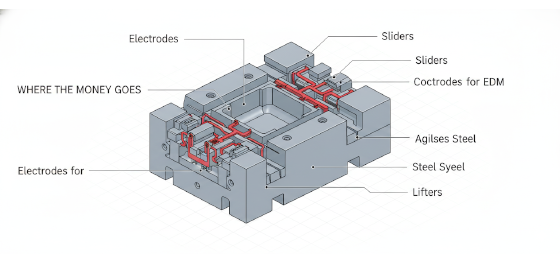
When you pay for an injection mold, you are not buying a block of metal. You are paying for hundreds of hours of high-precision engineering and subtractive violence. An injection mold must withstand clamping forces often exceeding 100 tons and injection pressures of 10,000 psi. To survive this environment, the tool is machined from pre-hardened tool steels like P20, NAK80, or H13. These materials are notoriously difficult to cut.
The cost driver lies in the complexity. A simple "open-and-shut" mold is rare. Most plastic parts have undercuts, snap fits, or side holes. To form these features, the mold requires mechanical sliders, lifters, and collapsing cores—intricate moving assemblies that must fit together with tolerances tighter than a human hair. Furthermore, sharp internal corners cannot be cut by a rotating CNC end mill. They require Electrical Discharge Machining (EDM), where a custom copper electrode is machined and then used to burn the steel away spark by spark. You are paying for the CNC programming, the copper electrode fabrication, the slow EDM burn time, the complex water cooling channels drilled deep into the steel, and the manual polishing required to eject the part cleanly. It is a thermodynamic engine built to last for a million cycles, and priced accordingly.
Liquid Logic: The Low-CapEx Advantage of Silicone
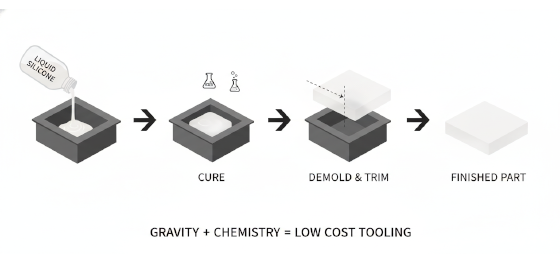
Vacuum casting cheats this entire equation by utilizing liquid conformity. We do not fight the material; we pour it. The "tool" in this process is simply a negative void created by curing RTV silicone around a master pattern. There is no heavy CNC machining of hard steel. There are no copper electrodes to burn. There are no complex mechanical sliders because the flexible silicone can simply stretch over undercuts during demolding.
This radically simplifies the bill of materials for the toolmaker. The primary cost is the master pattern (usually a single high-quality 3D print or CNC part) and the labor to pour and de-gas the silicone. Consequently, a complex mold that would cost $12,000 to cut in steel might only cost $800 to cast in silicone. For a startup needing 50 units for validation, this difference is existential. You are trading high-volume durability for low-volume agility, effectively bypassing the entry fee of the mass production club.
The Aluminum Middle Ground: Rapid Tooling Explained
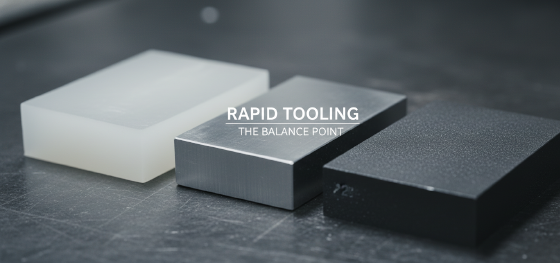
What happens when you need 500 parts? Silicone molds degrade too quickly, but steel is still too expensive. This is the "No Man's Land" of manufacturing. Jucheng Precision bridges this gap with "Rapid Tooling" utilizing 7075 Aluminum or soft mild steels. Aluminum cuts significantly faster than tool steel—often 30% to 50% faster. It dissipates heat better, allowing for simpler cooling channel designs.
Because the material is softer and easier to machine, we can produce an aluminum mold in half the time and at half the cost of a production steel tool. It won't last for a million shots—the parting lines might wear out after 5,000 cycles—but for a bridge production run of 1,000 units, it is the perfect financial instrument. It offers the injection-molded quality of a hard tool with an investment profile closer to soft tooling.
The Lifespan Curve: Assets vs Consumables
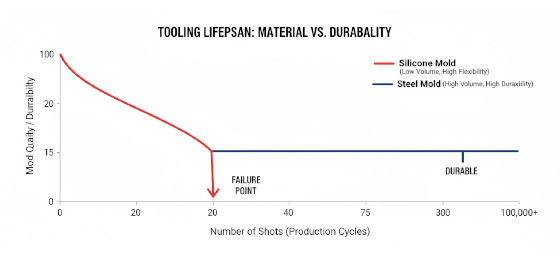
Procurement managers must classify these tools correctly. A steel mold is a "Capital Asset." It sits on your balance sheet. It produces parts for years, amortizing its high cost over hundreds of thousands of units until the per-part tooling cost is a fraction of a penny. You buy it once, and it serves you forever.
A silicone mold is a "Consumable." It is chemically unstable. Every time the thermoset polyurethane cures inside it, the exothermic heat and chemical attack degrade the silicone surface. After 20 to 25 shots, the mold becomes brittle, the surface finish deteriorates, and dimensions drift. It must be discarded and replaced. Therefore, vacuum casting is a high-marginal-cost process. You are constantly paying for new molds. This makes it financially toxic for high volumes but mathematically perfect for low volumes where the total quantity never justifies the purchase of the permanent asset.
JUCHENG Strategy: Escaping the Tooling Debt
Jucheng Precision operates as a strategic buffer against tooling debt. We do not force you to commit to a $10,000 asset before you have sold your first unit. Our integrated factory floor allows for a seamless "stair-step" scaling strategy. We begin with vacuum casting to produce your first 50 marketing samples and engineering validation units. This incurs minimal risk.
Once your design is frozen and initial orders arrive, we transition you to Aluminum Rapid Tooling for your first 2,000 units. This allows you to generate revenue and fund the eventual purchase of the P20 steel production mold. By matching the tooling investment to the current stage of your product's lifecycle, JUCHENG ensures you are never over-capitalized or under-equipped. We are not just making parts; we are managing your manufacturing cash flow.

