


Clinical environments operate under a mandate of absolute biological and electrical safety. When an engineering team transitions a complex robotic surgical assistant or a mobile diagnostic cart from a digital CAD file to a physical asset, the exterior housing must function as an impenetrable armor. Traditional manufacturing methods often force a perilous compromise: heavy, expensive sheet metal fabrication that looks industrial, or high-pressure injection molding that requires a $100,000 tooling investment before the first unit is clinically validated. Navigating this financial and regulatory chasm requires the strategic deployment of Medical robot enclosure manufacturing. This specialized discipline within Medical Robotics utilizes Reaction Injection Molding (RIM) to deliver oversized, complex, and cosmetically perfect polymer shells without the catastrophic CapEx of steel tooling. Jucheng Precision operates as an ISO 13485-certified manufacturing sanctuary in the Shenzhen high-precision hub, providing the technical depth to ensure your robotic enclosures possess the mechanical spine, fire-retardant chemistry, and chemical resistance required for global FDA and CE Mark approval. We don't just "mold plastic covers"; we engineer regulatory firewalls that protect your internal electronics and your company's liability.
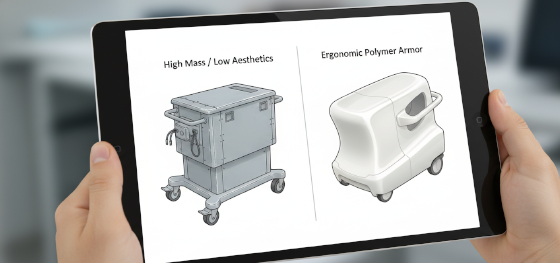
Establishing a resilient launch for oversized healthcare hardware demands the rejection of "General Purpose" production logic. Amateurs often specify standard ABS for large medical carts, unaware that the harsh cleaning agents used in hospitals—such as bleach and Isopropyl Alcohol—will cause rapid environmental stress cracking (ESC). Jucheng Precision eliminates these "Field Failures" by enforcing a strict "Material Sovereignty" protocol. We formulate specialized polyurethane resins that simulate the impact toughness of engineering thermoplastics while providing the structural rigidity needed to support heavy monitors and articulated arms. This guide deconstructs the economics of aluminum RIM tooling, the physics of zero-sink geometric design, and why JUCHENG’s in-house 2K painting and EMI shielding capabilities are the mandatory foundation for anyone developing robotic medical systems in 2026.
Capital Efficiency: Why RIM Dominates Low-Volume Medical Housings
Atmospheric Defense: UL94 V-0 Flame Retardancy Standards
Clinical Durability: Surviving Hospital Sterilization with 2K Coatings
Geometric Sovereignty: Designing Massive Ribs Without Sink Marks
Signal Integrity: Integrating EMI/RFI Shielding for Diagnostics
JUCHENG Protocol: ISO 13485 Traceability and Metrology
Frequently Asked Questions: Medical Robot Enclosures
Capital Efficiency: Why RIM Dominates Low-Volume Medical Housings

Tooling amortization dictates the survival of niche medical hardware programs. Medical robot enclosure manufacturing typically involves part volumes between 100 and 2,000 units per year—the exact definition of the "Valley of Death" for traditional injection molding. A 1.5-meter long housing for a surgical robot base would require a massive steel mold costing well over $80,000, creating an insurmountable barrier to market entry. Jucheng Precision bypasses this financial anchor by utilizing Reaction Injection Molding (RIM). Because RIM involves mixing two low-viscosity liquid polymers that fill the cavity at extremely low pressures (under 100 psi), we can utilize lightweight, highly conductive aluminum tools. This reduces your initial tooling investment by up to 80% and slashes the lead time from 12 weeks to just 3 or 4 weeks. This "Bridge Tooling" strategy allows MedTech startups to launch pilot runs, conduct clinical trials, and generate revenue while maintaining cash-flow sovereignty. You receive parts with the identical structural modulus and retail-ready finish of high-pressure molding, but scaled precisely to your actual market demand.
Atmospheric Defense: UL94 V-0 Flame Retardancy Standards
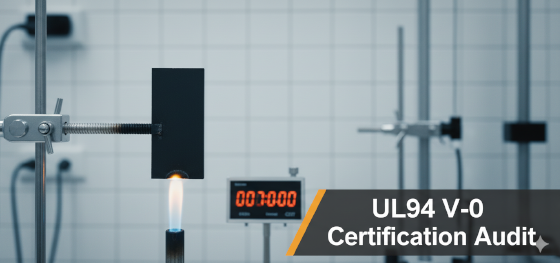
Fire hazard mitigation represents the primary legal barrier for powered clinical devices. If your robotic cart houses high-capacity lithium-ion batteries or complex power distribution units, the exterior shell must act as a sacrificial firewall. Jucheng Precision engineers utilize specialized flame-retardant polyurethane resins formulated specifically to meet the UL94 V-0 standard. This stringent certification requires that the plastic self-extinguishes within ten seconds of flame removal and produces zero flaming drips. Unlike generic additives that can compromise the impact strength of the resin, our halogen-free FR systems maintain the structural "toughness" required to survive a hospital corridor collision. By integrating this safety compliance at the molecular level during the RIM process, we ensure that your hardware is primed for immediate CE Mark and FDA regulatory audits, preventing the catastrophic delays associated with late-stage material failures.
Clinical Durability: Surviving Hospital Sterilization with 2K Coatings
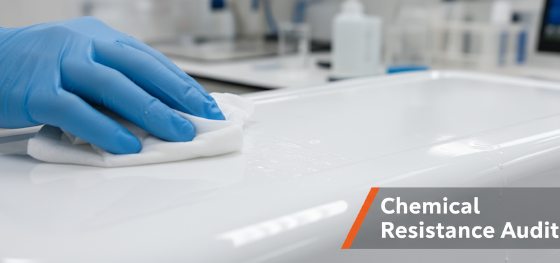
Surface energy and chemical resilience determine the lifecycle of a medical robot. In an operating room or diagnostic suite, equipment is subjected to a relentless barrage of harsh cleaning protocols. Traditional plastics or cheap spray paints will quickly craze, blister, or fade under the assault of aggressive disinfectants. Medical robot enclosure manufacturing at Jucheng Precision includes an integrated, world-class finishing department. We apply automotive-grade 2K (Two-Component) Polyurethane paints within our oversized Class 100,000 cleanroom spray booths. The chemical cross-linking of the 2K clear coat creates a glass-like armor that is impervious to common hospital solvents. Furthermore, this coating seals the microscopic surface porosity of the plastic, creating a hygienic, easy-to-clean surface that prevents bacterial colonization. We deliver enclosures that not only look like premium, high-gloss medical assets on day one but retain their pristine, sterile appearance after years of aggressive wiping.
Geometric Sovereignty: Designing Massive Ribs Without Sink Marks
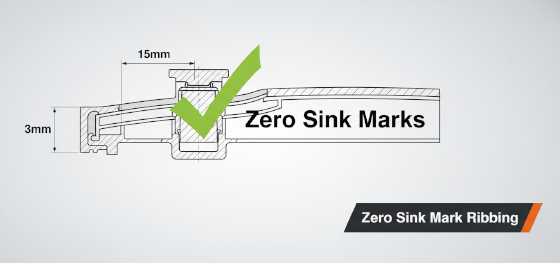
Structural consolidation is the hallmark of advanced DFM (Design for Manufacturing). In standard injection molding, an internal strengthening rib cannot exceed 60% of the nominal wall thickness without causing an ugly "Sink Mark" on the exterior cosmetic face. For a heavy medical robot base, this severe limitation forces engineers to use weak, thin ribs or resort to heavy metal sub-frames. The low-pressure physics of the RIM process completely shatters this rule. Because the liquid polyurethane expands to fill the mold and cures uniformly via an exothermic reaction, there is virtually zero differential shrinkage. At Jucheng Precision, we routinely mold massive 15mm thick mounting bosses directly behind a 3mm "A-side" exterior wall with absolutely zero cosmetic distortion. This "Zero-Sink Advantage" allows your team to consolidate metal brackets and heavy internal skeletons directly into the plastic housing, slashing your Bill of Materials (BOM) count and reducing assembly labor by up to 40%.
Signal Integrity: Integrating EMI/RFI Shielding for Diagnostics
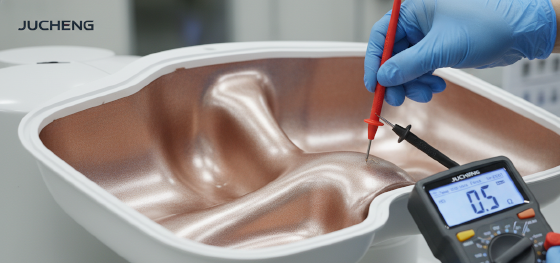
Electromagnetic Interference (EMI) is the invisible predator of delicate diagnostic signals. When housing sensitive electronics—such as ECG monitors or surgical navigation cameras—the plastic enclosure must provide a "Faraday Cage" to prevent signal cross-talk or external corruption from nearby MRI machines. Because polyurethane is a natural insulator, it offers zero electromagnetic shielding. Jucheng Precision solves this by providing integrated EMI/RFI shielding services. Prior to final assembly, we apply highly conductive copper or silver-based paints to the interior surfaces of the RIM enclosure. We verify the "Surface Resistance" using precise multimeters, ensuring the coating provides the high-decibel attenuation required for FCC and medical EMC compliance. This seamless secondary operation turns a standard plastic shell into an active electronic defense perimeter, eliminating the need for heavy, expensive stamped-metal internal shields.
JUCHENG Protocol: ISO 13485 Traceability and Metrology
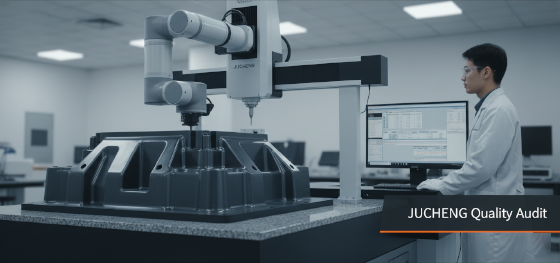
Manufacturing excellence at Jucheng Precision is built on the foundation of the documented pedigree. We recognize that an uncertified medical component is a massive liability. Our facility operates under strict ISO 13485 quality management systems, ensuring that every Medical robot enclosure manufacturing batch is accompanied by full material lot traceability and CMM dimensional inspection reports. We utilize high-precision 5-axis CNC machines to finish our RIM tools, guaranteeing that large multi-part enclosures fit together with sub-millimeter accuracy, maintaining "Flush and Gap" perfection across spans of over a meter. Stop gambling your clinical trials on fragmented vendors who treat medical housings like toy boxes. Leverage our decade of large-scale replication mastery to validate rapidly and scale profitably. Contact our technical team today for a free DFM review and see how we can turn your digital intent into a structurally sovereign, fully compliant physical reality.
Frequently Asked Questions: Medical Robot Enclosures
Question: What is the maximum size for a medical enclosure produced via RIM at JUCHENG?
Answer: Our specialized RIM facility in Shenzhen can manufacture monolithic plastic panels up to 2.5 meters in length, making it ideal for full-size MRI shrouds and surgical cart bases.
Question: Can JUCHENG match specific corporate Pantone colors for medical devices?
Answer: Absolutely. We offer precise spectrophotometer color matching for our 2K automotive-grade paints, ensuring your enclosures maintain exact brand fidelity with a Delta-E variance of less than 1.0.
Question: How long does it take to produce the aluminum tooling for a large RIM enclosure?
Answer: Typically, Jucheng Precision can CNC machine the required aluminum tools and deliver the first T1 sample units in just 3 to 4 weeks, significantly compressing your time-to-market compared to steel injection molds.

