


Surgical efficacy reaches its most critical limit at the distal tip of a robotic arm. In the high-velocity landscape of 2026, the transition from open surgery to minimally invasive robotic-assisted platforms requires an uncompromising approach to micro-scale mechanical integrity. For MedTech innovators, the primary adversary is not the distal control loop—it is the physical "Micro-Burr" or surface inclusion that can trigger a catastrophic biological response if detached inside a patient. Navigating the requirements for these microscopic end-effectors, such as forceps, scalpels, and needle drivers, requires the strategic deployment of Robotic surgical instrument machining. Jucheng Precision operates as a high-fidelity manufacturing sanctuary in the Shenzhen precision manufacturing hub, providing the technical depth to deliver long-aspect-ratio shafts and surgical jaws that possess the mechanical spine needed for bionic dexterity. Within the broader framework of Medical Robotics, we bridge the gap between "digital CAD intent" and "surgical-grade reality," ensuring your instruments maintain their sub-micron sharpness and corrosion resistance through hundreds of sterilization cycles.
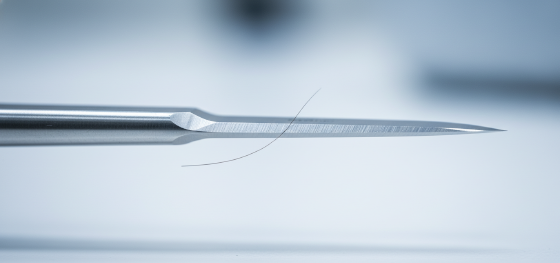
Establishing a resilient surgical supply chain demands the absolute rejection of "commodity" machining logic. Amateurs often treat a robotic scissor blade like a standard industrial tool, unaware that the work-hardening of 316L or 17-4PH stainless steel can lead to microscopic stress fractures during high-pressure CNC milling. Jucheng Precision eliminates these "Biological Risks" by enforcing a strict ISO 13485-compliant micro-machining workflow. Whether you are developing a robotic cautery tool or a specialized ocular grasper, our facility provides the material science and metrological rigor required for 2026 market entry. We turn "sub-millimeter concepts" into "biocompatible assets," delivering hardware that is documented for survival in the most hostile environment on earth—the human body. This guide deconstructs the necessity of Swiss-style turning, the physics of micro-deburring, and why JUCHENG’s "Passivation Protocol" is the mandatory foundation for anyone developing high-stakes Robotic surgical instrument machining projects.
Mechanical Sovereignty: Swiss CNC for Long-Aspect Ratios
Atmospheric Integrity: The War on Micro-Burrs and Inclusions
Chemical Defense: Passivation and Electropolishing for Body Use
Material Sovereignty: Why 17-4PH and 316L Rule the OR
JUCHENG Protocol: Zero-Defect Manufacturing for Clinical Launch
Frequently Asked Questions: Robotic Surgical Tools
Mechanical Sovereignty: Swiss CNC for Long-Aspect Ratios
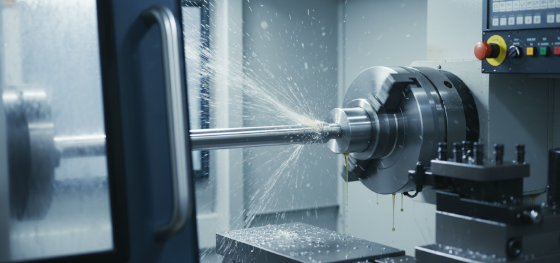
Dimensional accuracy in robotic instrument shafts is a battle won against material deflection. Robotic surgical instrument machining often involves parts that are 300mm long but only 5mm in diameter. On a standard CNC lathe, the cutting force would cause such a slender part to bend, ruining the concentricity. Jucheng Precision eliminates this "Mechanical Drift" by utilizing a fleet of advanced Swiss-style CNC turning centers. In a Swiss machine, the part is supported by a guide bushing mere millimeters away from the cutting tool. This provides absolute rigidity, allowing us to machine surgical-grade stainless steel with +/- 0.005mm tolerances. We turn "vulnerable rods" into "high-stiffness shafts," ensuring your robotic effectors navigate the trocar port without friction or binding. Our facility optimizes the spindle harmonics to ensure the surface finish is mirror-smooth, reducing the risk of tissue adhesion during complex surgical procedures.
Atmospheric Integrity: The War on Micro-Burrs and Inclusions
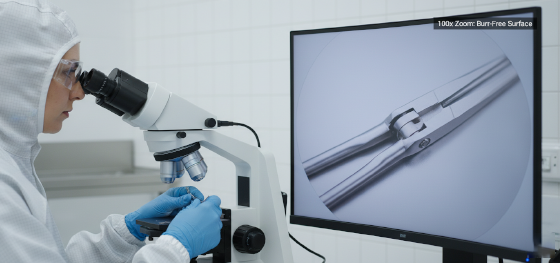
Manufacturing "Inclusions" represent the primary architect of surgical failure. Every time a CNC cutter removes metal, it leaves behind microscopic "Burrs"—jagged flaps of material at the edge of the cut. In the context of Robotic surgical instrument machining, these burrs are not just aesthetic flaws; they are lethal. If a burr detaches inside the abdominal cavity, it can cause infection or embolization. Jucheng Precision manages this risk through a multi-stage "Surgical Finishing" protocol. We utilize centrifugal barrel finishing and ultrasonic deburring to remove 100% of the mechanical noise from your parts. Every effector jaw and pulley is inspected under 50x digital magnification to ensure the edges are "Radiused" rather than sharp. We turn "industrial components" into "clinical-ready assets," providing the documented proof of burr-free execution your regulatory auditors demand.
Chemical Defense: Passivation and Electropolishing for Body Use
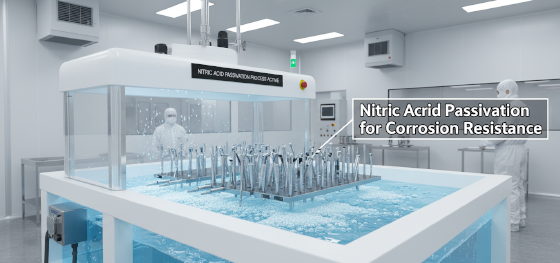
Molecular stability dictates the success of reusable surgical hardware. Stainless steel is not naturally "stain-less"; its resistance to corrosion comes from a thin, transparent layer of chromium oxide. During Robotic surgical instrument machining, the heat and pressure of the CNC process can contaminate this layer with free iron from the cutters. Jucheng Precision restores the material's chemical sovereignty through a mandatory nitric or citric acid passivation cycle. This process removes surface contaminants and enriches the chromium layer, ensuring your tools survive thousands of high-temperature autoclave cycles without rusting. For parts with complex internal channels, we utilize electropolishing—an electrochemical process that "melts" the microscopic peaks of the metal, resulting in a surface so smooth that bacteria cannot find a sanctuary to hide. We don't just "cut metal"; we engineer a sterile chemical barrier for your hardware.
Material Sovereignty: Why 17-4PH and 316L Rule the OR
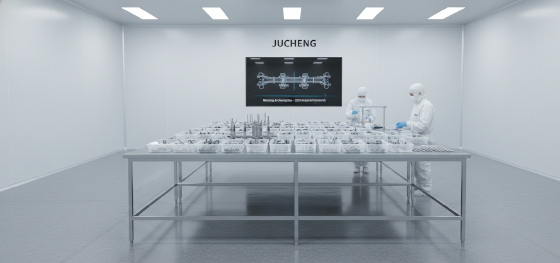
Engineering confidence in the operating room is built on the foundation of high-strength alloys. For the "business end" of a surgical robot, Jucheng Precision recommends 17-4PH Stainless Steel. This alloy can be heat-treated to H900 condition, providing the extreme hardness (40+ HRC) needed for scissor edges to stay sharp and forceps to grip without deforming. For fluidic manifolds and sensor housings, we pivot to 316L for its superior resistance to pitting corrosion. Jucheng Precision engineers act as your "Alloy Navigators," suggesting material switch-outs that optimize the "Duty-Cycle" of your robot. We provide full material lot traceability and Spectrometer verification for every batch, ensuring your project meets the strict requirements of Medical Robotics. Below is the technical performance matrix utilized by our facility:
| Metric | 316L Stainless Steel | 17-4PH (H900) |
|---|---|---|
| Corrosion Resistance | Excellent | Good |
| Hardness (HRC) | 25 (Soft) | 40 - 45 (Sharp) |
| Primary Use | Valves / Ports | Jaws / Blades / Pins |
JUCHENG Protocol: Zero-Defect Manufacturing for Clinical Launch
Manufacturing excellence at Jucheng Precision is built on the foundation of the "Clean-Billet" mandate. We don't just "take orders"; we act as your manufacturing accelerator. Our facility, housing over 150 CNC machines and elite Swiss turning bays, is optimized for the agile middle-ground of MedTech—delivering 100 units for a clinical trial or 5,000 units for a global instrument launch with identical metrological rigor. We provide full CMM dimensional inspection reports and material pedigree records for every Robotic surgical instrument machining batch, ensuring your hardware journey is lean, predictable, and market-ready. Stop gambling your venture funding on slow, uncertified machine shops. Leverage our decade of surgical replication mastery to validate rapidly and scale profitably. Contact our technical team today for a free DFM review.
Frequently Asked Questions: Robotic Surgical Tools
Question: What is the best way to remove burrs from microscopic surgical jaws?
Answer: Jucheng Precision utilizes a combination of chemical electropolishing and centrifugal barrel finishing to ensure every edge is radiused to a sub-micron level, eliminating any risk of material detachment during surgery.
Question: Can JUCHENG machine surgical-grade Titanium for robotic effectors?
Answer: Yes. We specialize in 5-axis and Swiss CNC machining of Titanium Grade 5 (Ti-6Al-4V) for high-strength, biocompatible robotic components that require extreme fatigue resistance.
Question: Do you provide passivation certificates for ISO 13485 audits?
Answer: Absolutely. Every batch of Robotic surgical instrument machining that undergoes passivation is issued a formal Certificate of Conformance (CoC), documenting the chemical bath parameters and ASTM compliance.
Question: How do you handle the tight tolerances of long surgical shafts?
Answer: We utilize specialized Swiss-type CNC lathes with guide bushing support, maintaining concentricity and diameter tolerances within +/- 0.005mm even for parts with a 50:1 length-to-diameter ratio.

