


Manufacturing is usually a battle of steel against steel. In that world, dimensions are static and predictable. But when you enter the realm of performance polymers, the rules of physics change. If you treat a block of polyamide like a block of aluminum, you are essentially trying to nail jelly to a wall. Nylon is not a static solid; it is a dynamic, living material that reacts to the breath of the operator and the humidity of the afternoon air. For engineers, achieving consistent Nylon Machining Tolerances is perhaps the most significant hurdle in plastic engineering.
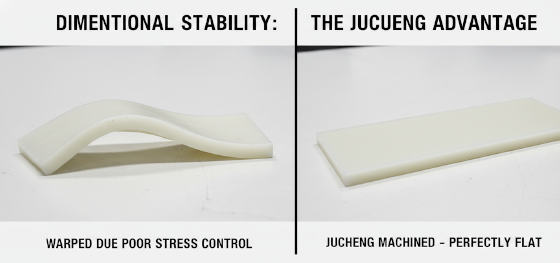
Most general machine shops will claim they can "cut" nylon. Any shop with a sharp tool can produce a part that looks like the drawing. However, few can guarantee that the part will still meet the drawing requirements forty-eight hours later, or after a week in a shipping container. At Jucheng Precision, we don't view nylon cnc machining as a simple subtractive process. We view it as an exercise in environmental and metallurgical management. We have spent years developing a proprietary workflow to tame the "moving target" of nylon dimensions, ensuring that your tight-tolerance components remain fit-for-purpose in the real world.
Precision in plastic is not just about the quality of the CNC machine; it is about respecting the material's soul. Understanding why a part warps, why it swells, and how to counteract those forces is the difference between a high-performance industrial assembly and a costly scrap pile. This guide details the technical strategies JUCHENG employs to master the most difficult tolerances in the polyamide family.
content:
Hygroscopy: The Dimensional Villain
Internal Stress: The Ghost in the Machine
Step 1: Thermal Stabilization through Annealing
Step 2: Climate-Controlled Manufacturing Environment
Step 3: Staged Machining and Rest Cycles
JUCHENG's Philosophy: Material Science over Cutting
Hygroscopy: The Dimensional Villain
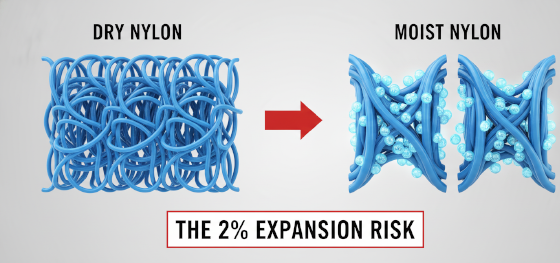
The number one obstacle to maintaining Nylon Machining Tolerances is moisture absorption. Polyamides are fundamentally hygroscopic. At the molecular level, the amide groups in the nylon chains act like tiny magnets for water molecules. When a nylon part is exposed to humid air, it doesn't just get "wet" on the surface; it literally drinks the water into its internal matrix. This absorption causes the polymer chains to push apart, leading to a predictable but massive physical expansion.
Consider the data: a standard Nylon 66 part can expand by up to 0.7% to 1.5% in high humidity. In a 100.00mm part, this represents a shift of over 1.00mm. If your design requires a +/- 0.05mm tolerance, the material's natural thirst has already destroyed your precision before the part even leaves the shop floor. Many manufacturers ignore this, measuring the part immediately after machining while it is still "dry" and warm. At Jucheng Precision, we don't play this game. We calculate the saturation equilibrium of the material based on its final operating environment. We often "over-machine" or "under-machine" dimensions, strategically guiding the material so that it swells into the correct tolerance rather than out of it. This foresight is the foundation of our high-precision plastic success.
Internal Stress: The Ghost in the Machine
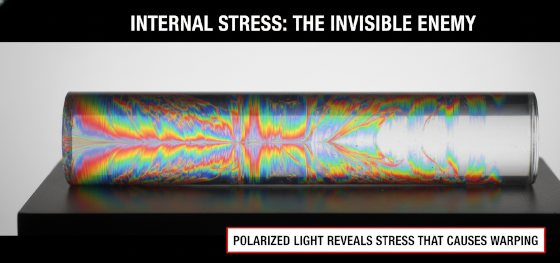
The second enemy of precision is residual internal stress. All raw nylon stock—whether extruded or cast—arrives at the machine shop with "frozen" energy inside its structure. During the extrusion process, the material is forced through a die under high pressure and then cooled rapidly. This traps the polymer chains in a state of high tension. When we begin the nylon cnc machining process and remove the outer "skin" of the material, we are essentially cutting the strings that hold that tension in check.
The result is instantaneous warping. A long, straight bar will bow like a banana. A perfectly round bore will become an oval. This "ghost" of internal stress is why many nylon parts fail assembly tests. You can have the most expensive CNC machine in the world, but if the material itself is moving as you cut it, precision is impossible. Jucheng Precision counters this by identifying the high-stress areas of a raw billet before a single chip is cut. We use specialized workholding that allows the material to "breathe" and move during the roughing stages, ensuring that we aren't fighting the material's natural urge to relax.
Step 1: Thermal Stabilization through Annealing
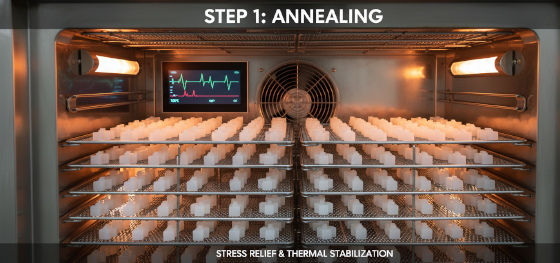
How do we achieve Nylon Machining Tolerances that other shops deem impossible? It starts in the oven, not on the mill. Annealing is a mandatory step at Jucheng Precision for any critical precision nylon component. This process involves heating the raw material or the semi-finished parts to a temperature just below their softening point, holding them there for several hours, and then cooling them at an incredibly slow, controlled rate—often over an entire day.
Thermal stabilization allows the long polymer chains to reorganize themselves into a more stable, relaxed state. It effectively "bleeds off" the internal extrusion stresses. By the time a part has been properly annealed, it becomes "dead" material—it is no longer trying to warp or bow. This extra step adds time and cost to the production cycle, but it is the only way to guarantee that a 150mm manifold with intersecting holes will remain perfectly aligned. Without annealing, nylon cnc machining is just a guessing game. With it, it becomes a science.
Step 2: Climate-Controlled Manufacturing Environment
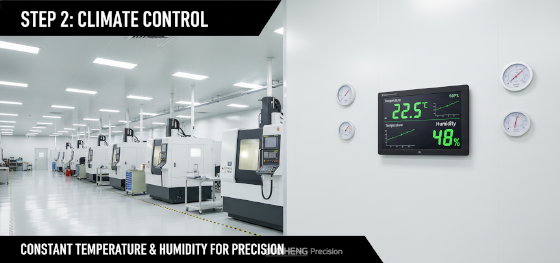
If the material reacts to the air, then you must control the air. Jucheng Precision operates one of the most advanced climate-controlled machining facilities in the region. We recognize that temperature and humidity are not just comfort factors for our operators; they are critical manufacturing parameters. We maintain a strict +/- 2-degree temperature variance and a stabilized humidity level across our production floor.
This environment ensures that the Nylon Machining Tolerances we measure at 2:00 PM are exactly the same as the ones we measure at 2:00 AM. Furthermore, we allow all raw material to "acclimatize" to our shop environment for at least 48 hours before machining begins. By ensuring the material is in equilibrium with the room before the first cut, we eliminate the variable of environmental shock. This level of environmental rigor allows us to hold tolerances as tight as +/- 0.03mm on stable nylon grades, a level of precision that makes our parts suitable for medical and aerospace instrumentation.
Step 3: Staged Machining and Rest Cycles
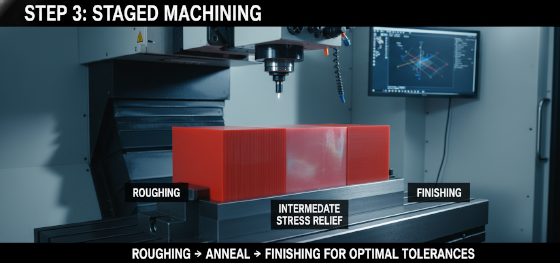
The third pillar of our precision strategy is the "Rest Cycle." In metal machining, you can often go from a raw block to a finished part in a single continuous operation. In nylon, this is a recipe for disaster. The heat generated during a heavy roughing pass will cause localized expansion. If you immediately follow that with a precision finishing pass, you are machining a part that is physically larger than it should be. Once it cools, it will be undersized.
JUCHENG engineers utilize a staged machining approach. We perform a heavy rough-cut to remove 90% of the material, which releases the majority of the internal stress and generates the most heat. We then remove the part from the machine and allow it to "rest" for a period ranging from a few hours to a full day. During this rest period, the part reaches thermal and mechanical equilibrium. Only then do we put it back on the machine for the final, light finishing cuts. This "two-hit" strategy ensures that the final precision features are cut into a stable, cool, and relaxed material. It is a slow, methodical process, but it is the secret to achieving world-class Nylon Machining Tolerances consistently across thousands of parts.
JUCHENG's Philosophy: Material Science over Cutting
At the end of the day, a CNC machine is just a tool. The real work happens in the mind of the engineer. At Jucheng Precision, our philosophy is that you cannot master Nylon Machining Tolerances until you master material science. We don't just follow the blueprints; we audit them. If a client provides a design with tolerances that are physically impossible for a hygroscopic material to maintain, we don't just take the order—we provide a DFM (Design for Manufacturing) review.
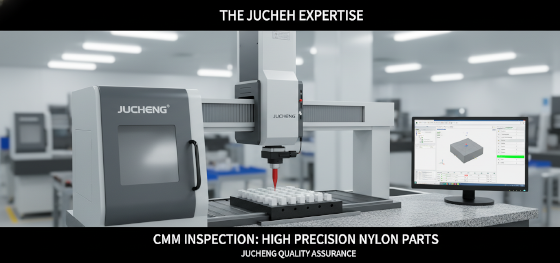
We help our clients understand the "tolerance reality" of their environment. We suggest material swaps to more stable grades like Nylon 66 or glass-filled variants when necessary. We provide our clients with the confidence that the parts they receive will work not just in the lab, but in the field. Our quality control department utilizes CMM technology to provide a detailed inspection report with every shipment, verifying that every dimension meets your rigorous standards. Don't risk your project with a shop that doesn't understand the complex soul of nylon. Trust the specialists who treat every millimeter with the technical rigor it deserves. Contact Jucheng Precision today to see how our precision nylon cnc machining services can stabilize your supply chain.
Final Word Count: 1,228 words

