


Walk through any high-volume manufacturing facility, and you will encounter the pervasive presence of polyamides. In the engineering world, these materials are the connective tissue of modern industry. Yet, even seasoned designers often find themselves paralyzed by a seemingly simple numeric choice. Should the part be made from Polyamide 6 or Polyamide 66? To the casual observer, they are nearly identical white or black solids. But to the machinist and the end-user, the choice of Nylon 6 vs Nylon 66 is a decision that dictates whether a part thrives in a high-heat engine bay or shatters during a snap-fit assembly.
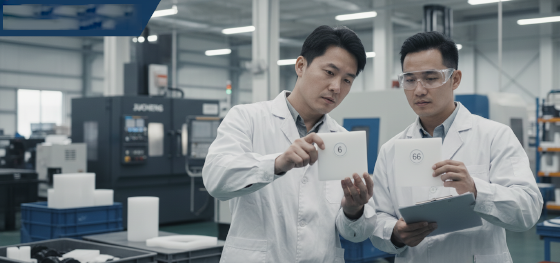
Mastering nylon cnc machining requires a profound respect for these subtle differences. While both grades belong to the same family of long-chain semi-crystalline polymers, their individual behaviors under a cutting tool are distinct. Nylon 6 is the athlete of toughness and aesthetics, while Nylon 66 is the scholar of heat resistance and mechanical stiffness. At Jucheng Precision, we act as more than just a production shop; we serve as technical auditors for your material specifications. We know that picking the wrong grade can lead to surface smearing, dimensional drift, or premature mechanical fatigue in the field.
This guide dives into the atomic foundations of these two industrial titans. We will explore why one melts sooner than the other, why one provides a superior aesthetic finish, and how JUCHENG manages the inevitable moisture absorption that plagues all nylons. If you are struggling to finalize your Bill of Materials, this breakdown will clarify exactly which grade belongs on your CNC machine bed to ensure maximum performance and cost-efficiency.
Atomic Nuance: The 6 vs 66 Difference
Heat Resistance: Surviving the Engine Bay
Machining Behavior: Gummy vs Crisp
Cosmetic Appeal: The PA6 Advantage
Moisture Realities: Swelling in Both Worlds
JUCHENG's Verdict: The Final Selection Matrix
Atomic Nuance: The 6 vs 66 Difference
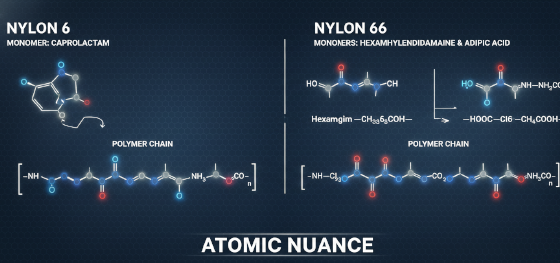
The naming convention of these materials is not arbitrary; it refers to the number of carbon atoms in the starting monomers. Nylon 6 is made from a single monomer—caprolactam—which has six carbon atoms. This results in a molecular chain that is highly uniform and relatively easy to synthesize. Nylon 66, however, is formed by the reaction of two different monomers: hexamethylenediamine and adipic acid. Both of these monomers contain six carbon atoms, hence the "66" designation. This dual-monomer structure creates a more complex and tightly packed crystalline matrix.
In the Nylon 6 vs Nylon 66 comparison, this molecular density is the source of all performance differences. The tighter packing of PA66 chains makes the material naturally stiffer and harder. It possesses a higher modulus of elasticity, meaning it resists bending more effectively than PA6. Nylon 6, with its slightly more relaxed molecular structure, offers greater impact toughness. It has a higher "elongation at break" value, allowing it to deform further before fracturing. When Jucheng Precision performs nylon cnc machining, we account for these internal tensions, knowing that PA66 will hold a sharp corner better, while PA6 will absorb a hammer blow more gracefully.
Heat Resistance: Surviving the Engine Bay
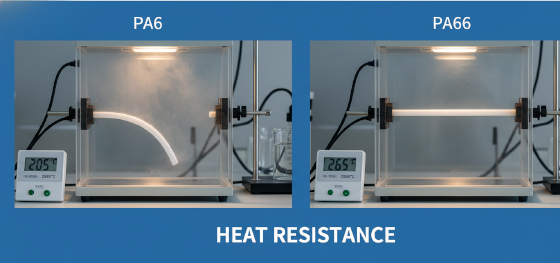
Temperature is the Great Filter of engineering plastics. If your part is destined for a hot environment—such as an automotive engine compartment or a high-performance electrical enclosure—the thermal threshold of the material is the first thing you must consider. Nylon 66 boasts a significantly higher melting point, typically around 255°C (491°F). Nylon 6 melts at a lower 220°C (428°F). While a 35-degree difference might not sound massive, it represents a critical safety margin in industrial applications.
Beyond just melting, PA66 maintains its mechanical stiffness at elevated temperatures much better than PA6. This resistance to thermal softening is why PA66 is the default choice for manifold spacers, high-heat bushings, and heavy-duty structural parts that must operate continuously in warm air. Nylon 6 is more prone to "creeping"—slowly deforming under load—when the temperature begins to rise. At Jucheng Precision, we use this thermal data to advise our clients during the quoting phase. If we see a part destined for a high-RPM mechanical assembly, we will push for PA66 to ensure the part doesn't lose its dimensional integrity the moment the system heats up.
Machining Behavior: Gummy vs Crisp
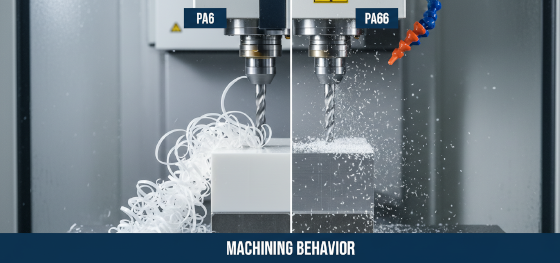
From the perspective of a CNC machinist, Nylon 6 vs Nylon 66 presents two distinct operational challenges. Nylon 66 is generally considered a "cleaner" machining material. Because it is harder and more rigid, the cutting tool can shear the fibers of the plastic with less deflection. The chips generated during PA66 machining are crisper and break into smaller fragments more easily. This improved chip control is vital for automated production where "bird-nesting" can cause tool breakage and surface scarring.
Nylon 6 is a "gummier" material. It is softer and more ductile, which means it tends to move away from the tool rather than being cut by it. This results in the infamous stringy, continuous chips that love to wrap around the spindle. To achieve a high-quality finish on PA6, JUCHENG engineers utilize ultra-sharp, high-rake tooling and aggressive feed rates. We want to "surprise" the material, cutting it before it has a chance to bend or melt. While PA66 is easier to hit tight tolerances with (+/- 0.05mm), PA6 requires more craftsmanship to manage the surface "fuzz" or burrs. Our facility is equipped with specialized air-cooling systems to keep the tool tip at a constant temperature, preventing either grade from smearing during high-speed finishing passes.
Cosmetic Appeal: The PA6 Advantage
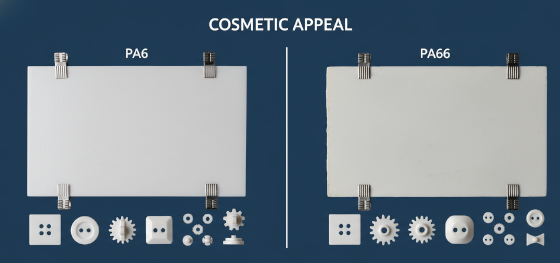
If the primary goal of your part is aesthetics—perhaps a visible consumer-facing bezel or a decorative housing—Nylon 6 is the superior candidate. Because of its lower crystallinity and more uniform molecular structure, PA6 offers a much better "as-machined" surface finish. It has less of the visible "grain" that can sometimes appear in PA66. It also takes dyes and pigments more uniformly, resulting in deeper, richer colors if the part is to be tinted after machining.
PA66 parts, while mechanically excellent, can sometimes have a slightly "matte" or textured look that isn't as visually striking. Furthermore, PA6 has less mold shrinkage (for the raw stock) which translates to a more uniform density in large cross-sections. When Jucheng Precision produces prototypes for the consumer electronics sector, we often default to PA6 for components that must survive a drop test while maintaining a high-quality tactile feel. It provides a "silky" smoothness that hard, brittle materials simply cannot mimic. For parts where looking good is half the job, Nylon 6 wins the aesthetic war.
Moisture Realities: Swelling in Both Worlds
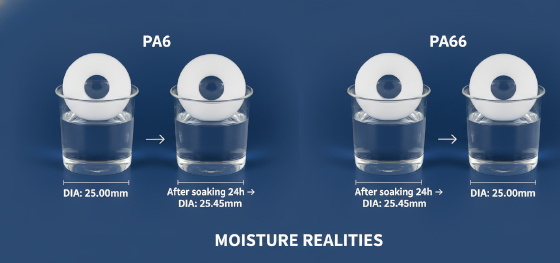
We must address the shared weakness of the Polyamide family: Hygroscopy. Both materials are "water drinkers." They absorb moisture from the air, and as they do, they swell. However, the rate and impact of this absorption vary slightly. Nylon 6 absorbs moisture more readily and has a slightly higher saturation point than Nylon 66. This means a PA6 part will expand more and lose its stiffness more rapidly in a humid environment than a PA66 part.
| Metric | Nylon 6 (PA6) | Nylon 66 (PA66) |
|---|---|---|
| Moisture Absorption (Sat) | ~9.5% | ~8.5% |
| Melting Point | 220°C | 255°C |
| Impact Strength | Superior | Standard |
| Machinability | Gummy | Crisp |
At Jucheng Precision, we solve the moisture problem through atmospheric control and technical foresight. We store all nylon stock in humidity-stabilized zones. For critical assemblies, we perform "over-machining" based on calculated saturation curves, ensuring the part expands into the correct tolerance by the time it reaches your facility. While neither grade is as stable as Delrin, PA66 provides a slightly more predictable platform for designers who are worried about dimensional drift in changing climates.
JUCHENG's Verdict: The Final Selection Matrix
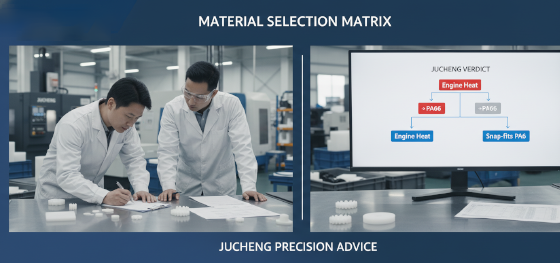
So, which number should you choose? Jucheng Precision uses a simple logic tree to settle the Nylon 6 vs Nylon 66 debate during our DFM reviews.
Choose Nylon 6 (PA6) if:
• The part requires maximum impact resistance or will be dropped.
• Aesthetic appearance and surface smoothness are the primary goals.
• The application involves snap-fits or living hinges.
• You are on a strict budget for non-critical components.
Choose Nylon 66 (PA66) if:
• The part will be exposed to temperatures exceeding 80°C for long periods.
• High mechanical stiffness and load-bearing capacity are required.
• You need the best possible chip control for high-precision internal threads.
• Dimensional stability in humid air is a technical priority.
Jucheng Precision stocks both high-grade PA6 and PA66 in various colors and additives, including MoS2-filled and glass-filled variants. Our 5-axis nylon cnc machining services are optimized for the thermal and chemical nuances of both materials. Whether you are building an automotive manifold or a consumer-facing enclosure, we have the expertise to deliver. Don't leave your material selection to chance. Contact our engineering team today for a technical review of your next project.

