


In the heart of an automated bottling plant or inside the heavy-duty drive systems of a mining conveyor, two materials fight a constant battle against gravity, friction, and time. If you choose the wrong one, your machine will scream with vibration or grind to a halt within weeks. These two materials—Nylon and Ultra-High Molecular Weight Polyethylene (UHMW)—are the twin titans of the wear-resistant world. At first glance, they appear interchangeable. They are both durable, both relatively lightweight, and both are standard choices for nylon cnc machining providers. However, their internal physics tell a story of two completely different survival strategies.
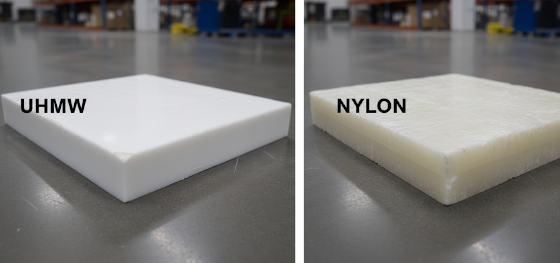
The debate of Nylon vs UHMW is not a question of which plastic is superior in a vacuum. It is a question of the nature of the "enemy" your part will face. Is the primary threat the constant, fast sliding of a metal chain? Or is it the crushing load of a heavy gear and the abrasive grit of a dirty environment? At Jucheng Precision, we act as engineering partners to help you navigate this choice. We know that one material wins on "slipperiness," while the other wins on "backbone." Selecting the right one ensures that your maintenance cycles are measured in years, not days.
This technical guide explores the molecular differences between Polyamides and Polyethylenes. We will examine why UHMW feels like wax and why Nylon feels like bone. We will dive into the critical issues of moisture absorption, load capacity, and chemical resistance. If you are struggling to decide which material belongs on your CNC machine bed, this breakdown will provide the clarity you need to optimize both performance and cost.
content:
Wear Mechanisms: Sliding vs. Abrasive Mastery
Structural Integrity: The Load-Bearing Divide
The Moisture Villain: Dimensional Stability Realities
Chemical Resistance and Environmental Survival
Machining Performance: From Precision to Plowing
JUCHENG's Verdict: The Final Decision Matrix
Wear Mechanisms: Sliding vs. Abrasive Mastery
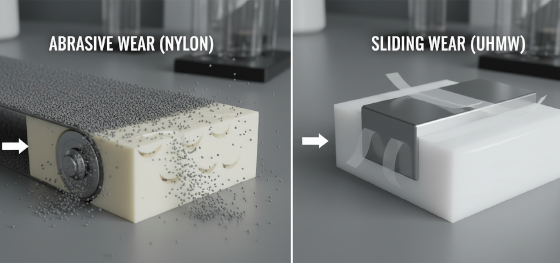
To understand the Nylon vs UHMW conflict, we must first define "wear." Not all friction is the same. There is sliding wear, where two smooth surfaces move across each other, and there is abrasive wear, where sharp particles like sand or metal shavings try to gouge into the material. UHMW is the undisputed champion of sliding wear. Its molecular chains are incredibly long and straight, giving it a waxy, low-friction surface that is slipperier than almost any other polymer except PTFE. If you are building guide rails for a high-speed conveyor, UHMW allows parts to glide with minimal resistance, reducing energy consumption and noise.
Nylon, however, takes the prize for abrasive wear resistance. While it has a higher coefficient of friction than UHMW, it is also much harder. In an environment where grit, dust, or dirt is present, UHMW is too soft; the abrasive particles can become embedded in the plastic and turn it into a piece of sandpaper that destroys the mating metal shaft. Nylon is resilient enough to resist this gouging. It "fights back" against abrasive particles, making it the preferred choice for outdoor machinery, agricultural equipment, and industrial sheaves. Jucheng Precision often advises clients that if their machine is "clean," go with the slipperiness of UHMW. If it is "dirty," rely on the toughness of Nylon.
Structural Integrity: The Load-Bearing Divide
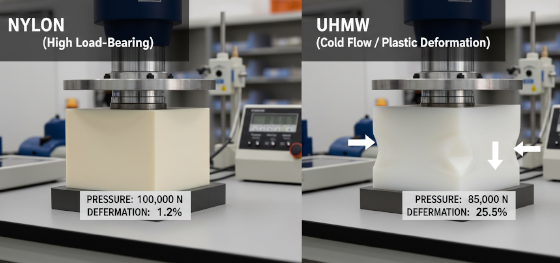
A major limitation of UHMW is its tendency to "flow" under pressure. This phenomenon, known as creep or cold flow, means that if you put a heavy static load on a UHMW block, it will slowly deform and flatten out over time, even at room temperature. It lacks the structural rigidity needed for parts that must carry a significant load while maintaining their shape. This makes UHMW a poor choice for gears, high-pressure bushings, or structural mounting plates.
Nylon is a much more robust mechanical material. It has a significantly higher tensile strength and flexural modulus than UHMW. In nylon cnc machining, we frequently produce gears and sprockets because Nylon has the stiffness to hold a tooth profile under high torque without stripping. While UHMW is great for a passive guide rail, Nylon is the better "active" component. If your part needs to do work—pushing, pulling, or rotating under load—Nylon is the only choice that provides the necessary mechanical backbone. At Jucheng Precision, we perform stress analysis during the DFM phase to ensure that your material choice won't "mush" out of its tolerances after a few months of service.
The Moisture Villain: Dimensional Stability Realities
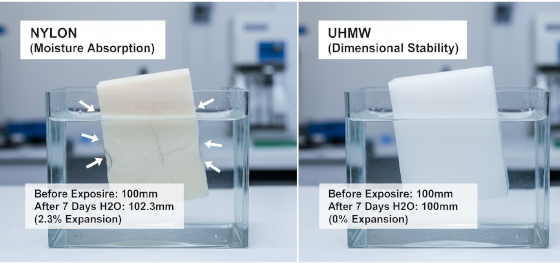
We cannot discuss the Nylon vs UHMW comparison without addressing the Achilles' heel of Polyamides: water. As we have emphasized throughout this series, Nylon is hygroscopic. It actively pulls moisture from the atmosphere, causing it to swell and lose some of its stiffness. In high-humidity environments, a precision-machined Nylon part can change its dimensions by over 1%, which is unacceptable for tight-tolerance assemblies. This is the moment where Nylon's mechanical superiority is cancelled out by its chemical instability.
UHMW is the polar opposite. It has a moisture absorption rate of virtually zero. It is essentially waterproof. Whether it is submerged in a liquid tank or used in a steam-filled food processing facility, UHMW maintains its exact dimensions indefinitely. For designers working on subsea equipment or marine components, UHMW is often the winner simply because it is predictable in wet conditions. JUCHENG manages this trade-off by suggesting specialty Nylon grades or post-machining treatments, but for applications where zero swelling is the primary requirement, UHMW is the technically superior foundation.
Chemical Resistance and Environmental Survival
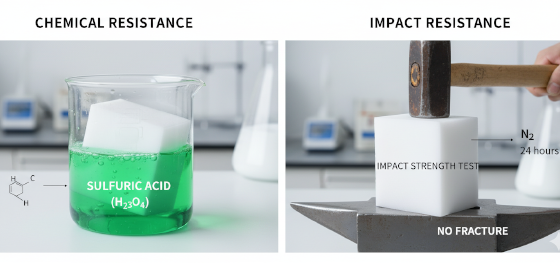
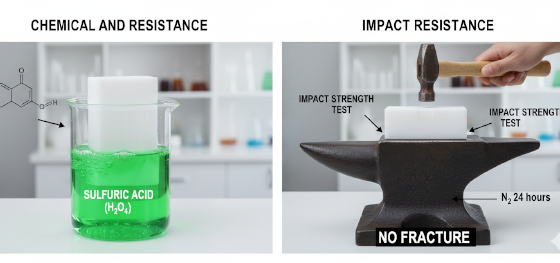
In harsh chemical environments, the two materials behave very differently. Nylon has good resistance to oils, greases, and fuels, which is why it thrives in automotive engine bays. However, it is vulnerable to strong acids and certain alcohols. UHMW, being a high-density polyethylene, is chemically inert to almost everything. It can withstand aggressive acids, alkalis, and cleaning solvents that would dissolve a Nylon part in hours.
Impact resistance is another area where UHMW shines. While Nylon is tough, UHMW is nearly indestructible. It has an Izod impact strength that is often recorded as "No Break." You can hit a UHMW part with a sledgehammer in sub-zero temperatures, and it will not crack. It is the gold standard for chute liners in the mining industry and hockey rink dasher boards. If your part is going to be slammed, hit, or exposed to aggressive chemicals at low temperatures, UHMW is your champion. If it needs to stay rigid in a hot, oily engine room, Nylon is the survivor.
Machining Performance: From Precision to Plowing
Inside the CNC machine, the Nylon vs UHMW choice changes our entire operational strategy. Nylon machines with a certain level of crispness. Because it is harder, the chips fracture more easily, and we can achieve excellent surface finishes (Ra 0.8 to 1.6) with standard sharp carbide tools. It holds its shape well on the mill, allowing us to drill deep, straight holes and mill precise pockets.
UHMW is one of the most difficult plastics to machine precisely. It is "rubbery" and has a low melting point. The material tends to move away from the cutting tool rather than being sheared by it. This leads to "burr city"—massive, hanging plastic burrs that are difficult to remove without leaving marks. At Jucheng Precision, we use specialized razor-sharp tools and high-speed spindles to "surprise" the UHMW, cutting it before it can deflect. We also use cryo-deburring or specialized hand-finishing for UHMW parts to ensure they meet the same aesthetic standards as our Nylon components. If your part has complex 3D features or tiny holes, the superior machinability of Nylon often results in a lower part cost and higher precision.
JUCHENG's Verdict: The Final Decision Matrix
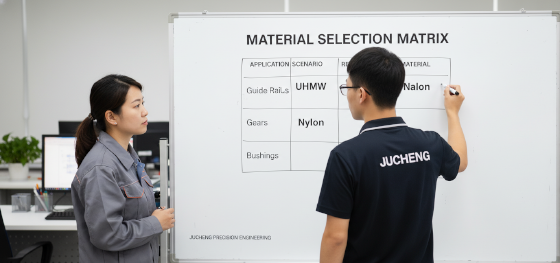
To help you make the final call, Jucheng Precision uses a simple logic tree during our design consultations. We weigh the load, the environment, and the tolerance requirements.
Choose Nylon if:
• The part is a gear, a high-torque bushing, or a structural support.
• You need the highest possible precision and a clean surface finish.
• The part faces abrasive grit or sand (e.g., agricultural equipment).
• The operating temperature is consistently high (up to 120°C).
Choose UHMW if:
• The primary goal is reducing sliding friction (e.g., conveyor guide rails).
• The part will be exposed to moisture, water, or high humidity.
• You need extreme impact resistance at very low temperatures.
• The environment involves aggressive acids or alkalis.
Jucheng Precision stocks both materials in various grades, including glass-filled Nylon and repro-UHMW for cost-sensitive projects. Our 5-axis CNC machines are calibrated for the unique challenges of both materials, ensuring that your wear-resistant parts are delivered within tolerance and ready to perform. Don't let friction ruin your designs. Let JUCHENG help you choose the right polymer and deliver a part that stands the test of time. Contact us today for a full technical review of your next plastic project.

