


The name "Stainless Steel" is a promise of permanence, yet it is one of the most misunderstood materials in the machine shop. Engineers are often shocked to see their high-precision 304 or 316 parts developing orange rust spots just days after leaving the CNC mill. This failure isn't a defect in the metal itself; it is a side effect of the manufacturing process. The reality is that stainless steel is only truly "stainless" when its surface chemistry is perfectly balanced. Achieving this balance requires a critical, often invisible final step: the passivation of stainless steel.
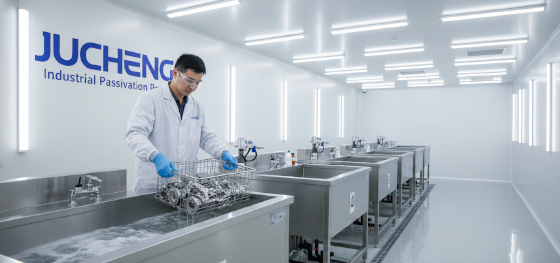
At Jucheng Precision, we consider passivation to be an inseparable extension of CNC machining surface treatment. We understand that the very tools used to shape the part—steel end mills and tungsten carbide cutters—can leave behind a legacy of contamination that triggers corrosion. Passivation is the scientific "detox" that restores the metal's natural defenses. This guide explores the microscopic battle between free iron and chromium, the regulatory demands of ASTM standards, and the rigorous chemical protocols JUCHENG uses to ensure your medical and aerospace components remain pristine in the most aggressive environments.
Success in stainless steel manufacturing is measured by the integrity of the passive layer. You cannot see it with the naked eye, but you will certainly notice its absence when a part fails an audit or a field test. Let us dive into the technical pillars of chemical passivation and how it preserves the functional soul of your CNC designs.
Iron Trap: How Machining Tools Cause Rust
Molecular Rebirth: Rebuilding the Protective Shield
Chemical Philosophies: Nitric vs. Citric Acid Passivation
Validation Rigor: Meeting ASTM A967 and A380 Standards
JUCHENG’s Standard: Integrated Purity Protocol
Iron Trap: How Machining Tools Cause Rust
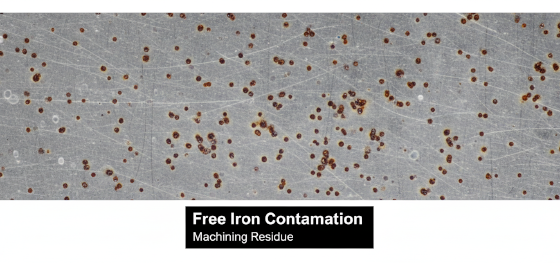
The irony of passivation of stainless steel is that the most dangerous contaminant comes from the machining process itself. During CNC milling or turning, the high-speed contact between the cutting tool and the workpiece causes a microscopic exchange of atoms. Most cutting tools are made of high-speed steel or carbide with iron-based binders. As the tool wears, tiny particles of "free iron" are smeared across the surface of the stainless steel or embedded deep into the machining grooves. This free iron is not part of the stainless alloy's protective matrix; it is a foreign invader.
When these embedded iron particles are exposed to moisture or air, they begin to rust immediately. This rust then acts as a catalyst, attacking the surrounding stainless steel and breaking down its inherent corrosion resistance—a phenomenon known as "pitting corrosion." You could have the highest grade of 316L stainless, but if it is contaminated with free iron from a dull drill bit, it will rust as surely as mild steel. Jucheng Precision identifies this "Iron Trap" as the primary threat to part quality. We don't just hope the material is clean; we assume it is contaminated and use the passivation of stainless steel to surgically remove these metallic impurities, ensuring that the only thing left on the surface is pure, resistant alloy. This is the first and most vital step in preventing the "orange pox" that ruins high-end industrial hardware.
Molecular Rebirth: Rebuilding the Protective Shield
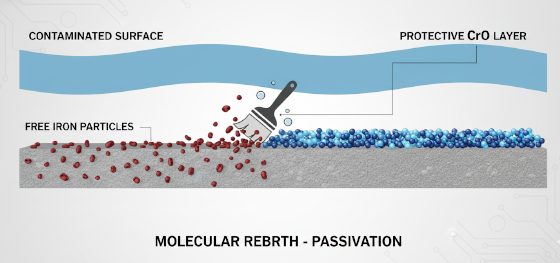
To understand the cure, one must understand how stainless steel protects itself. The "stainless" property comes from Chromium (at least 10.5%). In the presence of oxygen, this chromium reacts to form a transparent, microscopic layer of Chromium Oxide ($Cr_2O_3$) on the surface. This layer is passive, dense, and self-healing. However, the free iron smearing mentioned previously prevents this layer from forming uniformly. The passivation of stainless steel is essentially a two-part chemical miracle: it removes the iron and forces the chromium to react.
During the acid bath, the nitric or citric acid selectively dissolves the free iron and other surface contaminants without attacking the underlying stainless steel. Once the iron is gone, the acid provides an oxygen-rich environment that accelerates the growth of the chromium oxide film. This film is only a few molecules thick, but it is an impenetrable barrier to moisture and salt. At Jucheng Precision, we calibrate our bath concentrations and dwell times based on the specific alloy grade. For example, 303 stainless (which contains sulfur for machinability) requires a vastly different passivation strategy than 316L to avoid "surface frosting" or etching. By managing this molecular rebirth, we transform a vulnerable machined part into a chemically inert component that is ready for the extreme humidity of a subsea assembly or the aggressive sterilization of a surgical suite.
Chemical Philosophies: Nitric vs. Citric Acid Passivation
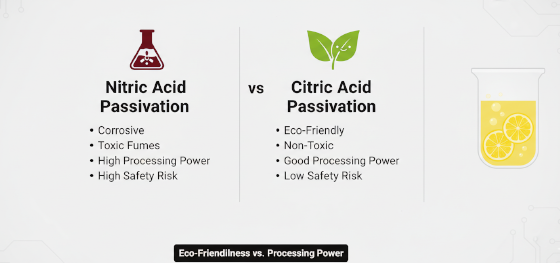
The debate over the passivation of stainless steel usually centers on the choice of the acid agent. For decades, Nitric Acid was the undisputed industrial standard. It is a powerful oxidizer that works quickly and is effective even on the most difficult-to-clean alloys. However, nitric acid is hazardous to work with, releases toxic fumes (NOx), and requires expensive disposal protocols. Furthermore, if the part is not rinsed perfectly, residual nitric acid can actually cause localized corrosion over time.
In recent years, Citric Acid passivation has emerged as a high-performance, eco-friendly alternative. Unlike nitric acid, citric acid is organic and safe to handle. It works through "chelation"—specifically targeting and "grabbing" iron ions while leaving the chromium alone. It is exceptionally effective at producing a deep, rich chromium-to-iron ratio on the surface. Jucheng Precision offers both chemistries to meet our clients' specific needs. We generally recommend citric acid for medical devices and consumer products where biocompatibility and environmental footprint are priorities. For heavy-duty aerospace components where legacy specifications mandate nitric acid, we maintain a fully compliant nitric line with automated atmospheric monitoring. We help you choose the chemical philosophy that balances performance, regulation, and budget.
Validation Rigor: Meeting ASTM A967 and A380 Standards
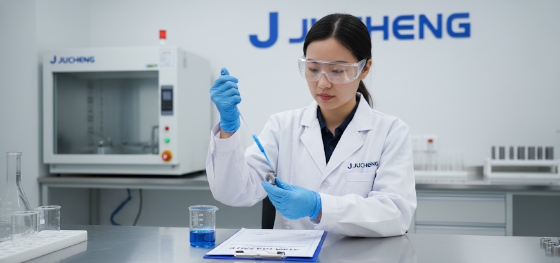
A common mistake in the supply chain is assuming that a part is passivated just because it looks clean. Passivation is an invisible finish; you cannot tell by looking if the free iron has been removed. Therefore, the passivation of stainless steel must be validated through rigorous technical testing and documentation. In the global manufacturing market, the gold standards are ASTM A967 and ASTM A380. These documents dictate the exact temperatures, concentrations, and verification methods required for a compliant finish.
Jucheng Precision utilizes several validation methods to prove the success of our process. The most common is the Copper Sulfate test: we apply a chemical solution to the part's surface; if any free iron remains, the copper will plate out, leaving a visible pink spot. For aerospace and medical clients, we may utilize the High Humidity test or the Salt Spray test (ASTM B117) to simulate years of environmental exposure in a few hundred hours. We provide full certificates of conformance (CofC) with every batch, ensuring that your parts meet the regulatory requirements of your industry. When you receive a passivated part from JUCHENG, you aren't just getting our word; you are getting a documented guarantee of chemical integrity.
JUCHENG’s Standard: Integrated Purity Protocol
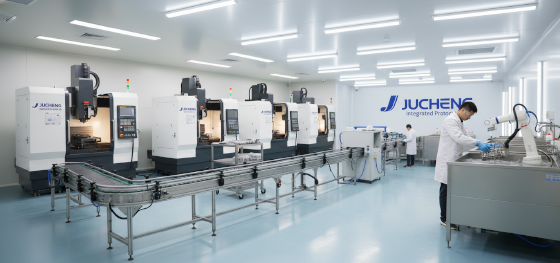
The greatest risk in CNC machining surface treatment is the "hand-off" between the machinist and the finisher. If parts are left in a box covered in cutting oil for two weeks before being sent for passivation, the contaminants can become "baked" into the surface, making them much harder to remove. Jucheng Precision eliminates this gap by offering a fully integrated "Purity Protocol." We don't view passivation as an afterthought; it is the mandatory final stage of our stainless steel workflow.
Immediately after the 5-axis machining cycle is complete, parts are moved to our ultrasonic cleaning line to remove 100% of the machining oils. From there, they move directly into the passivation baths. This "Fast-Track Purity" ensures that the metal never has the chance to oxidize prematurely or trap contaminants in its pores. We also maintain a strict "Metal Isolation" policy in our facility: we never use the same polishing pads or media for stainless steel that have been used for carbon steel, preventing cross-contamination at the source. When you choose Jucheng Precision, you are partnering with a team that respects the delicate science of stainless steel. Whether you need 10,000 surgical screws or a single complex aerospace manifold, we provide the technical rigor to ensure your parts are as resilient as they are precise. Contact our engineering team today for a DFM review and see how our passivation protocols can secure your next mission-critical project.

