


Corrosion is the patient enemy of industrial steel. No matter how precise the machining or how rigid the alloy, exposure to humidity begins the chemical countdown toward ferric oxide. For mass-produced fasteners, brackets, and structural components, engineers need a defense that is as reliable as it is economical. This technical gap is perfectly filled by zinc plating steel. It is the world’s most widely used CNC machining surface treatment, serving as the essential "armor" for carbon steel parts that must survive in real-world environments without the cost of stainless steel.
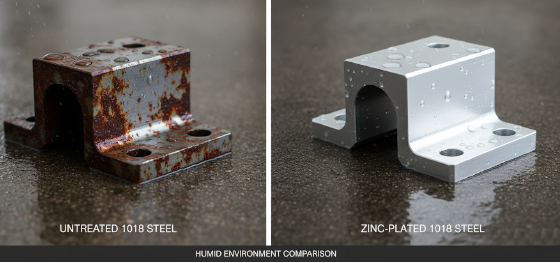
At Jucheng Precision, we recognize that plating is not just a cosmetic layer; it is an engineered barrier. We understand that a 10-micron layer of zinc can be the difference between a part that lasts ten years and one that fails in ten weeks. However, the process is not without risk, especially for high-strength alloys. This guide dives into the electrochemical physics of zinc protection, the strategic selection of chromate conversion colors, and the critical danger of hydrogen embrittlement that JUCHENG manages for every mission-critical project.
Success in rust prevention requires more than just a dip in a tank. It requires a facility that understands the relationship between the steel substrate and the metallic coating. Let us examine the technical pillars that make zinc the gold standard for cost-effective protection.
content:
Chemistry of Sacrifice: How Zinc Shields Steel
Chromate Conversion: From Clear to Yellow and Black
Hidden Killer: Managing Hydrogen Embrittlement
Dimensional Control: Thickness and Thread Tolerances
JUCHENG’s Standard: Integrated Rust Protection
Chemistry of Sacrifice: How Zinc Shields Steel
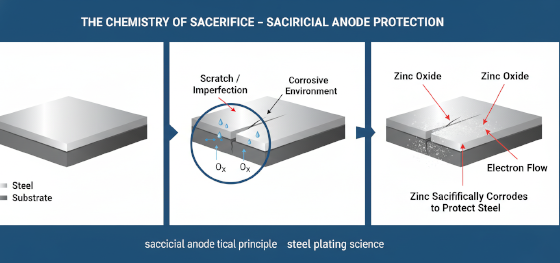
To understand the value of zinc plating steel, one must look at the Galvanic Series of metals. Steel is a relatively "noble" metal, whereas zinc is highly active. When you coat steel in zinc, you aren't just creating a physical wall; you are creating a "Sacrificial Anode." If the zinc layer is scratched and the underlying steel is exposed to moisture, the zinc will chemically react first. It "sacrifices" its own electrons to neutralize the oxygen and moisture before they can attack the iron atoms in the steel.
This is the fundamental reason why zinc is superior to nickel or chrome for basic rust prevention. If you scratch a chrome-plated part, the steel beneath the scratch will rust aggressively, often lifting the rest of the plating off the part. If you scratch a zinc-plated part, the surrounding zinc effectively "heals" the wound through electrochemical current, preventing the rust from spreading. At Jucheng Precision, we explain this logic to our clients daily: you aren't just buying a color; you are buying an active chemical defense system that operates 24/7 without power or maintenance. This galvanic protection is what makes zinc-plated steel the standard for automotive brackets, industrial fasteners, and agricultural equipment that must survive in mud, rain, and humidity.
Chromate Conversion: From Clear to Yellow and Black
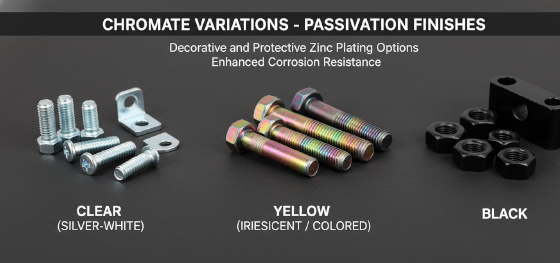
The zinc layer itself is quite soft and prone to a white, powdery corrosion known as "white rust." To prevent this and enhance the visual appeal, we apply a secondary chemical film known as a Chromate Conversion Coating. This film determines both the final aesthetic and the number of hours the part can survive in a salt spray chamber. The choice of chromate is a strategic engineering decision.
Clear (Blue-White) Zinc: This provides a clean, silvery appearance that looks similar to stainless steel. It is the most common finish for electronics and medical components. However, its corrosion resistance is the lowest of the family, usually rated for 12 to 24 hours before white rust appears.
Yellow (Iridescent) Zinc: Often called "Gold Zinc," this finish uses hexavalent or trivalent chromium to provide a significantly thicker and more durable film. It is the industrial workhorse, often rated for 96 to 150 hours of salt spray protection.
Black Zinc: Used primarily for aesthetics and to reduce light reflection in optical or military assemblies. It offers a sleek matte or semi-gloss black finish while providing protection comparable to yellow zinc. JUCHENG technicians manage these chemical baths with strict concentration controls, ensuring that the color you specify today matches the batch we ship next year.
Hidden Killer: Managing Hydrogen Embrittlement
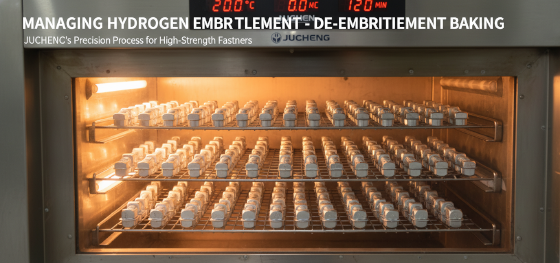
There is a critical danger in zinc plating steel that many inexperienced shops ignore: Hydrogen Embrittlement. During the acid cleaning and electroplating stages, atomic hydrogen is released and can be absorbed into the crystalline structure of the steel. In standard low-carbon steel like 1018, this is not an issue. But in high-strength steels (typically those with a hardness over 31 HRC or a tensile strength over 1000 MPa), these hydrogen atoms act like tiny wedges, causing the metal to become brittle and snap under load without warning.
At Jucheng Precision, we implement a mandatory "De-Embrittlement Baking" protocol for all high-strength alloy parts. Within four hours of leaving the plating tank, parts are placed in a calibrated industrial oven at roughly 190°C to 210°C for up to 24 hours. This thermal energy forces the trapped hydrogen atoms to migrate out of the metal, restoring its original toughness. We understand that for a Grade 8.8 or 12.9 fastener, skipping this step is a recipe for a catastrophic field failure. Our integrated quality system tracks the time between plating and baking, providing our aerospace and automotive clients with the documentation required for mission-critical safety standards. We don't just protect the surface; we preserve the structural soul of the metal.
Dimensional Control: Thickness and Thread Tolerances
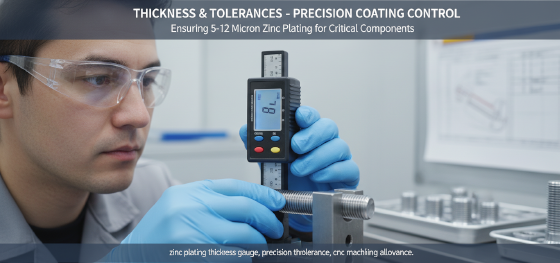
One of the most frequent headaches for a CNC machinist is the "buildup" of the finish. Zinc plating is an additive process. A standard commercial plating adds between 5 to 12 microns (0.0002" to 0.0005") of thickness per surface. While this sounds microscopic, it is effectively doubled on a diameter. A 10-micron plating on a shaft increases the diameter by 20 microns. If your design features tight bearing fits or precision internal threads, this buildup can ruin the assembly.
Jucheng Precision solves this through proactive DFM engineering. We utilize "Pitch Diameter Offsets" for threaded parts. By machining the threads slightly undersized before plating, we ensure that they "grow" into the perfect class-fit after the zinc is applied. For bearing seats, we often suggest masking the bore entirely to maintain the raw machined precision, or we calculate the specific micron-level allowance to ensure the press-fit remains accurate. We utilize non-destructive digital thickness testers on every batch to verify that the coating is exactly where the print demands. This integration of machining and finishing is why JUCHENG is the preferred partner for complex steel assemblies where "it doesn't fit" is not an acceptable answer.
JUCHENG’s Standard: Integrated Rust Protection
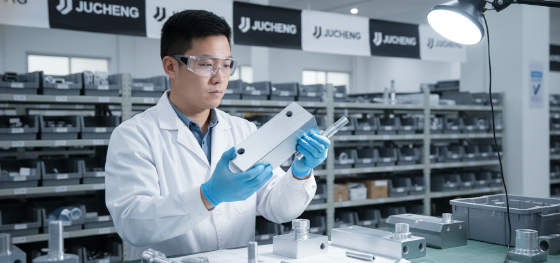
The greatest risk in the supply chain is the "hand-off" between the machine shop and the finisher. If you buy machining from one shop and plating from another, you lose accountability. If the parts rust because the pre-treatment was poor, who pays for the rework? Jucheng Precision eliminates this friction by offering a comprehensive one-stop-shop for CNC machining surface treatment. We manage the material sourcing, the 5-axis milling, and the final zinc chemistry under a single quality umbrella.
Our facility is optimized for the high-volume turnaround needed for industrial components. We perform adhesion testing (the tape test) and salt spray validation to ensure that the "sacrificial shield" we provide is robust enough for your environment. When you receive your order from JUCHENG, the parts are cleaned, plated, verified, and packaged with rust-preventive desiccants. You receive a component that is ready to install the moment you open the crate. Whether you are building 10,000 industrial mounts or a single high-strength gear shaft, Jucheng Precision has the technical rigor to armor your steel against the elements. Contact our engineering team today for a technical review of your next steel project and see how our zinc plating protocols can clarify your supply chain.

