


Stability in manufacturing is often found in the middle ground between extremes. While the 3d printing plastic world is frequently split between the easy-to-use but brittle PLA and the strong but warp-prone ABS, a specific copolymer has quietly become the primary sanctuary for functional hardware. This is the domain of petg 3d printing. Polyethylene Terephthalate Glycol-modified (PETG) represents a technical hybrid that combines the structural toughness of high-performance resins with the chemical immunity needed for medical and food-contact environments. It is a material that refuses to snap under pressure and remains indifferent to the moisture that destroys other filaments. When a design requires a part that is both transparent enough for visual inspection and rugged enough for a factory floor, PETG is the strategic engineer's first choice.
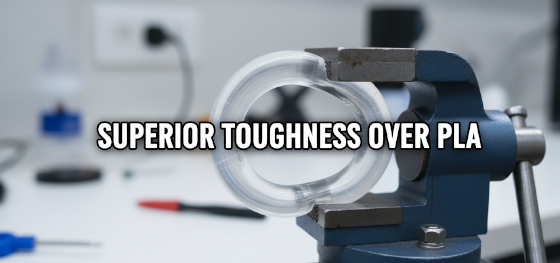
At JUCHENG, we recognize that industrial-tier PETG processing is a struggle against stringing and thermal lag. Unlike hobbyist setups, we treat PETG as a mission-critical resin, utilizing high-precision FDM centers with calibrated cooling systems. We understand that success in petg 3d printing is found in the management of the "Z-axis weld"—the molecular fusion between layers that prevents delamination during impact. By mastering the rheology of this "amorphous titan," we provide our clients with prototypes that can survive the sterilization of a clinic or the vibration of a shipping container. This guide moves past the basic definitions to explore the molecular mechanics of glycol modification, the logic of food-safe compliance, and why JUCHENG’s focus on surface integrity ensures your translucent designs achieve optical clarity, not just fogginess.
Consistency in high-contact hardware is found in the removal of toxicity risks. You aren't just printing a shape; you are engineering a barrier between a product and its user. Whether you are building an innovative heart-pump prototype or a reusable food container, the logic of the polyester bond is your greatest asset. Let us examine the technical pillars of industrial PETG and see how JUCHENG locks the integrity of your most versatile designs into reality.
Molecular Hybridization: The Science of Glycol Modification
Chemical Resilience: Engineering for Food and Medical Safety
Optical Translucency: Navigating Haze and Refraction
Dimensional Stability: Tackling Stringing and Adhesion
JUCHENG’s Functional Standard: Prototyping for Contact
Molecular Hybridization: The Science of Glycol Modification

To understand the value of petg 3d printing, you must first understand its predecessor: PET. Polyethylene Terephthalate is the material of standard water bottles—it is incredibly strong but has a tendency to crystallize and become brittle when subjected to multiple heating cycles. This "brittleness trap" made PET a disaster for additive manufacturing. The solution was the addition of Glycol during the polymerization process. This "G" modification disrupts the symmetrical structure of the polymer chains, preventing the material from crystallizing into a glass-like state as it cools.
This molecular sabotage is actually a manufacturing advantage. It creates an amorphous plastic that maintains a broad "softening range" rather than a sharp melting point. At JUCHENG, we leverage this behavior to achieve superior interlayer adhesion. Because the material stays in a semi-molten state for longer after leaving the nozzle, it has more time to form deep covalent bonds with the previous layer. This results in a part with impressive tensile strength and a ductility that allows it to bend and flex without catastrophic snapping. PETG is essentially a "toughness hybrid," offering the ease of printing found in low-grade materials with the industrial survivability of advanced resins. We treat this chemistry as an engineering baseline, ensuring that your parts possess the mechanical "give" needed for functional testing in automotive and industrial robotics environments.
Chemical Resilience: Engineering for Food and Medical Safety

In the medical and food processing sectors, a material is only as good as its biological neutrality. PETG 3d printing is the gold standard for these high-contact industries because the material is inherently non-toxic and FDA-compliant. Unlike ABS, which can emit harmful VOCs during the build cycle, or certain resins that contain residual photoinitiators, PETG is chemically stable. It is odorless and resists a wide range of aggressive chemicals, including alcohols, weak acids, and alkalis. This makes it an ideal choice for laboratory equipment, pharmaceutical organizers, and components for medical diagnostic tools.
At Jucheng Precision, we use this "Chemical Immunity" to produce functional prototypes that must survive sterilization or food-contact audits. PETG’s low water absorption rate is another critical factor; unlike Nylon, which swells in humid rooms, PETG remains dimensionally stable. This ensures that a medical manifold or a food tray maintains its exact fitment whether it is in a sterilized laboratory or a high-humidity kitchen. We maintain strict lot-traceability for our medical-grade PETG stock, providing our clients with the certificates of conformance needed to clear regulatory hurdles. By choosing PETG, you are designing for a safe user experience, ensuring that your product doesn't just look functional, but meets the stringent health standards of the world’s most regulated markets.
Optical Translucency: Navigating Haze and Refraction
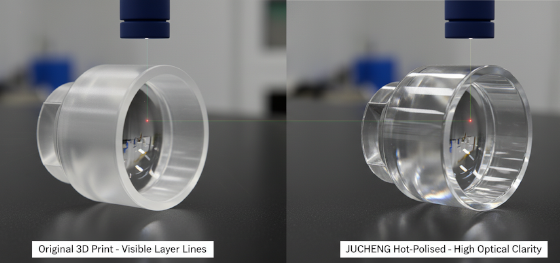
A unique advantage of PETG in the 3d printing materials landscape is its natural translucency. In its raw form, PETG is almost as clear as acrylic or polycarbonate. This provides a functional window into your design, allowing engineers to visually inspect internal mechanisms or liquid flow in a prototype. However, achieving true transparency via extrusion is an optical challenge. Every layer line acts as a microscopic prism, scattering light and creating a "frosted" effect that can obscure internal details.
JUCHENG manages this "Refraction Trap" through precise control of layer height and temperature. By utilizing larger layer heights and higher extrusion temperatures, we can minimize the number of air gaps between layers, creating a more homogeneous solid that allows light to pass through more clearly. For parts requiring even higher clarity, we utilize secondary finishing techniques, including flame polishing and specialized clear coatings that "fill" the microscopic valleys of the layers. While petg 3d printing will never match the glass-like transparency of our Clear SLA Resin line, it provides a rugged, "functional clarity" that is superior to any other FDM material. It is the perfect solution for indicator lights, fluid reservoirs, and protective enclosures where you need to see what is happening inside without sacrificing the impact resistance of the outer skin.
Dimensional Stability: Tackling Stringing and Adhesion
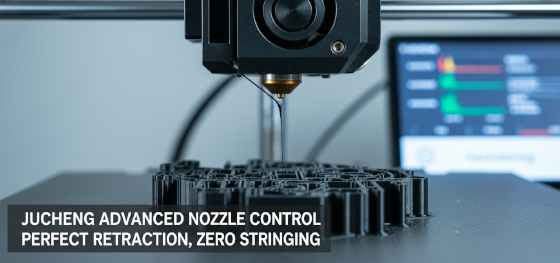
From a machinist's perspective, PETG is a "sticky" material. It has a high melt-strength, which is excellent for layer adhesion but creates the persistent problem of "stringing"—the microscopic threads of plastic that the nozzle leaves behind as it moves between features. If stringing is not managed, it can lead to "blobs" on the part’s surface that ruin tolerances and require extensive manual cleanup. Achieving professional petg 3d printing results requires a sophisticated understanding of nozzle retraction and travel speed.
At Jucheng Precision, we eliminate these defects through optimized G-code and industrial-grade feed mechanisms. We utilize specialized hardened-steel nozzles that prevent material buildup and maintain a constant flow rate. More importantly, we manage the thermal profile of the build plate. While PETG is easier to print than ABS, it still requires a consistent environment to prevent "corner lift" on large-format parts. We utilize actively controlled build chambers to ensure the thermal contraction of the part is uniform across its entire volume. This level of technical oversight is what allows us to deliver PETG components with a flatness and hole-position accuracy that rivals CNC-milled plastics. We don't just follow a CAD file; we engineer the extrusion path to account for the material's viscous nature, ensuring your parts are as precise as they are tough.
JUCHENG’s Functional Standard: Prototyping for Contact

The final hallmark of a world-class manufacturing partner is the ability to validate the part’s final fit and function. PETG is the workhorse for "high-contact" parts—those that will be handled by surgeons, factory workers, or consumers. At Jucheng Precision, we treat petg 3d printing as a production-grade process. Every batch undergoes a rigorous quality audit, including Shore hardness checks and fit-checks against mating metal components. We understand that in an assembly line, a PETG bracket that is 0.2mm out of spec can stall the entire workflow.
Our facility is an integrated hub where 3D printing and CNC Machining work in tandem. For complex PETG parts, we often utilize a hybrid strategy: printing the bulk of the geometry and then using our precision mills to finish critical bearing bores or threaded holes. This ensures you get the toughness of PETG with the sub-micron accuracy of a 5-axis mill. Whether you are building the next generation of food-safe dispensing systems or a ruggedized medical enclosure, JUCHENG’s PETG protocols clarify and elevate your vision. We don't just ship plastic parts; we ship validated engineered solutions that are ready for the field. Contact our engineering team today for a technical DFM review and let our material expertise armor your next breakthrough.
| Performance Metric | Standard PLA | Industrial PETG |
|---|---|---|
| Tensile Strength | ~50 MPa (Brittle) | ~50-55 MPa (Ductile) |
| Impact Resistance | Very Low | High (Absorbs shock) |
| Heat Deflection (HDT) | ~55°C | ~75-80°C |
| Chemical Resistance | Poor | Excellent (Acids/Bases) |
| Transparency | Opaque/Translucent | High (Refractive potential) |

