


Your design requires a plastic part. But this is no ordinary part. It must survive inside a jet engine. It must withstand corrosive chemicals in a lab. It must function flawlessly under thousands of pounds of pressure.
ABS would melt. Nylon would deform. Acrylic would shatter. When you are designing for the most extreme environments, you have reached the limit of conventional plastics.
You need a material from a different league. A superhero in the world of polymers. This is the world of peek plastic material. It is one of the most capable, and most demanding, types of plastics that exist.
content:
The Problem: When All Other Plastics Fail
The Superpowers of PEEK
The Manufacturer's Challenge: A Demanding Material
PEEK vs. Other 'Super' Plastics
Is PEEK the Right Choice for You?
The Problem: When All Other Plastics Fail

Most engineering plastics are great for everyday jobs. But they have a ceiling. Their performance drops sharply when the environment gets tough.
The most common failure point is temperature. Many plastics begin to soften and lose their strength at temperatures above 100°C. They cannot be used in engines, in autoclaves, or in many industrial processes.
Chemical resistance is another major weakness. Strong acids, bases, or organic solvents can cause many plastics to swell, crack, or dissolve completely.
And finally, there is mechanical strength. For parts that are under very high loads or repeated stress, most plastics will eventually creep, deform, or fatigue. When your application pushes past these limits, you enter the world of high-performance polymers.
The Superpowers of PEEK

PEEK, which stands for Polyether Ether Ketone, is the undisputed champion in this elite group. It has an incredible combination of "superpowers."
Its most famous power is extreme temperature resistance. PEEK can operate continuously at temperatures up to 260°C (500°F) without losing its mechanical properties. It melts at an even higher temperature.
It also has phenomenal chemical resistance. It is immune to a huge range of corrosive chemicals, solvents, and even steam. This is why it is used for components inside chemical processing equipment and medical sterilizers.
On top of that, it has incredible mechanical strength and stiffness. Some grades of PEEK, when reinforced with carbon fiber, have a strength-to-weight ratio that rivals some metals. It is also very resistant to wear and creep.
And it is biocompatible. It can be used for medical implants that go inside the human body. This combination of powers makes PEEK a true problem-solver.
The Manufacturer's Challenge: A Demanding Material

All this performance comes at a price. And not just a financial one. PEEK is a very demanding and difficult material to manufacture.
First, the raw material is extremely expensive. It can be 10 to 20 times more expensive than common engineering plastics. This means that any mistake during manufacturing is a very costly one. There is no room for error.
Second, it is difficult to CNC machine. It is a very hard and abrasive material that causes cutting tools to wear out quickly. More importantly, it is very sensitive to heat and stress. If you machine it too aggressively, you can induce internal stresses into the part. These stresses are invisible. But they can cause the part to crack or warp later on.
Machining peek plastic material requires a special set of skills. It needs very sharp, specific cutting tools. It needs a carefully controlled process with the right speeds and feeds. And it often requires a post-machining annealing (a controlled heating and cooling cycle) to relieve any internal stresses. This is a process for experts only.
PEEK vs. Other 'Super' Plastics

PEEK is not the only high-performance plastic. How does it compare to others, like PEI (Ultem) or PFA?
PEI (Ultem) is another great high-temperature plastic. It is often a more cost-effective choice than PEEK. However, PEEK generally has higher impact strength and better wear resistance.
PFA is a fluoropolymer. Its superpower is its ultimate chemical resistance. It can resist even more aggressive chemicals than PEEK. However, PFA is much softer and weaker. It cannot be used in high-stress structural applications where PEEK excels.
PEEK's unique advantage is its mastery of almost all categories. It has elite temperature resistance, elite chemical resistance, and elite mechanical strength, all in one package.
Is PEEK the Right Choice for You?
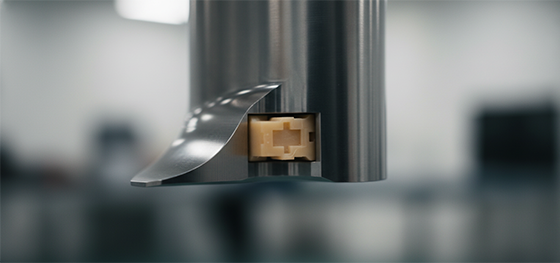
Given its very high cost, PEEK is not a material to be chosen lightly.
You should only choose PEEK when other, more affordable plastics cannot meet your performance requirements. Ask yourself: Will this part be exposed to temperatures above 150°C? Will it be in contact with aggressive chemicals? Is it under extreme mechanical load?
If the answer to any of these is "yes," then PEEK might be the only solution. It is a material for applications where failure is not an option.
Working with PEEK requires a true partnership with your manufacturer. At JUCHENG, we have the advanced 5-axis CNC machines and the engineering expertise to handle this demanding material. We can provide the DFM feedback and the process control needed to turn this superhero plastic into a perfect, reliable part for your most critical project.

