


Some engineering problems cannot be solved with sheer hardness. When a design requires a component to bend a million times without snapping, or to hold aggressive battery acids without dissolving, standard rigid polymers reach a physical dead-end. This is where pp 3d printing enters the manufacturing frontline. Polypropylene (PP) is a semi-crystalline thermoplastic that occupies a unique tactical niche in the 3d printing plastic world. It is a material defined by its paradoxes: it is lightweight enough to float on water, yet tough enough to survive as a structural living hinge. However, machining or printing PP is notoriously difficult due to its low surface energy and its violent reaction to temperature changes.
At JUCHENG, we don't view Polypropylene as an "unstable" material; we view it as a thermodynamic challenge to be engineered. Most additive service bureaus struggle with PP because it has the highest shrinkage rate of any common polymer, leading to warped plates and failed dimensions. We have mastered the art of pp 3d printing by utilizing high-performance industrial FDM and SLS systems that operate within precisely calibrated thermal envelopes. We understand that success in PP manufacturing is not found in the speed of the print, but in the management of the crystalline transition. This guide moves past the surface-level definitions to explore the molecular mechanics of fatigue resistance, the logic of chemical immunity, and why JUCHENG’s integrated approach to semi-crystalline polymers ensures your functional prototypes perform with the same reliability as mass-produced injection molded parts.
Efficiency in polymer engineering is found in the removal of mechanical failure points. When you can print a fully functional enclosure with an integrated hinge in a single cycle, you eliminate assembly labor and risk. Whether you are building a laboratory manifold or an automotive fluid reservoir, the logic of the polyolefin is your greatest engineering ally. Let us examine the technical pillars of industrial Polypropylene and see how JUCHENG locks the integrity of your most resilient designs into physical reality.
Molecular Resilience: The Physics of the Living Hinge
Thermal Hostility: Managing Semi-Crystalline Shrinkage
Process Selection: Filament Extrusion vs. Powder Bed Fusion
Chemical Immunity: Engineering for Laboratories and Fluids
JUCHENG’s Functional Standard: Precision Leak Testing
Molecular Resilience: The Physics of the Living Hinge
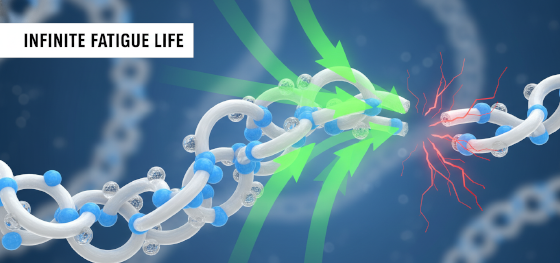
The most powerful move in plastic engineering is the "Living Hinge"—a thin web of material that connects two rigid parts, allowing them to bend repeatedly without failure. While many 3D printing materials like ABS or PLA will snap after just a few flex cycles, Polypropylene thrives in this load case. This is due to its high "fatigue resistance" at the molecular level. In a JUCHENG 3D printed PP part, the polymer chains are long and flexible, acting more like a series of intertwined ropes than a rigid crystal. When the hinge is bent, these chains slide past one another and realign, absorbing the stress rather than fracturing.
To exploit this property in pp 3d printing, we pay obsessive attention to the "Grain Orientation." Much like wood, a 3D printed hinge is strongest when the layers are aligned parallel to the bend axis. We utilize our DFM expertise to suggest orientation tweaks that ensure the "hinge-action" doesn't put stress on the interlayer bonds. When designed correctly, a 3D printed PP hinge can survive tens of thousands of cycles, providing the functional data needed to validate consumer packaging or medical kits. We don't just provide a flexible part; we provide a kinematic system that mimics the performance of an expensive injection-molded component, allowing you to verify the ergonomics and durability of your design before the first tool is ever cut.
Thermal Hostility: Managing Semi-Crystalline Shrinkage
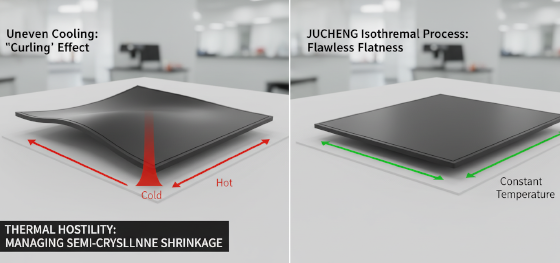
If Polypropylene is a miracle in the field, it is a nightmare in the build chamber. PP is a semi-crystalline material, which means it undergoes a massive volume change as it transitions from a molten liquid to a solid. As the polymer chains organize themselves into crystals, they pull together aggressively. This leads to a shrinkage rate that can exceed 2%, which is four times higher than that of PLA. On an open-frame printer, a large PP part will physically tear itself off the build plate or warp into a useless, curled shape. This "Thermal Hostility" is why many shops refuse to quote PP for high-precision work.
At Jucheng Precision, we solve the warping riddle through absolute environmental control. For FDM-based PP, we utilize high-temperature build chambers and specialized "Polypropylene-native" build surfaces that create a chemical bond with the first layer. For powder-bed sintering (SLS), we manage the "Cool-Down Ramp" with extreme technical rigor. We don't just finish the print and open the door; we allow the parts to sit in a stabilized thermal bath for hours, letting the crystals form slowly and uniformly. This patience prevents the uneven internal stresses that lead to "Potato-Chipping." By controlling the physics of the cooling cycle, we achieve dimensional accuracy that other shops deem impossible for 3d printing plastic in the polyolefin family. We deliver flat plates and round holes in a material that naturally wants to be neither.
Process Selection: Filament Extrusion vs. Powder Bed Fusion
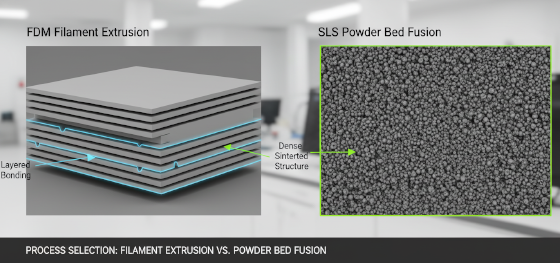
Selecting the right manufacturing path for PP is an exercise in functional logic. At JUCHENG, we offer both FDM (Filament) and SLS (Powder) solutions for Polypropylene, and each serves a different engineering purpose. FDM is the preferred path for large, structural prototypes or simple containers. It allows for the use of "Copoloymer" filaments that are optimized for interlayer adhesion, delivering parts that are extremely tough and impact-resistant. If your part is a large protective cover or a simple fluid tank, FDM provides the best ROI.
However, when the design requires complex internal geometries, airtight seals, or high-definition features, we pivot toward SLS pp 3d printing. Because the part is supported by a bed of powder during the build, we can produce intricate fluid manifolds and thin-walled structures without the need for removable support scaffolding. SLS also produces a denser, more isotropic part, which is essential for components that must hold pressure. Unlike FDM, which can have microscopic gaps between the extruded lines, SLS fuses the powder particles into a cohesive solid. JUCHENG’s engineers evaluate your part’s "Mission Profile" to suggest the process that delivers the necessary air-tightness or flexural strength. We provide a diversified technological hub where the process is matched to the physics of the part, ensuring your 3D printing materials strategy is as precise as your CAD file.
Chemical Immunity: Engineering for Laboratories and Fluids
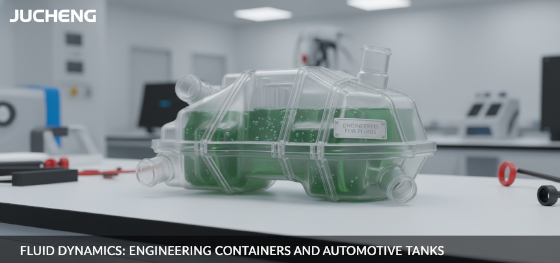
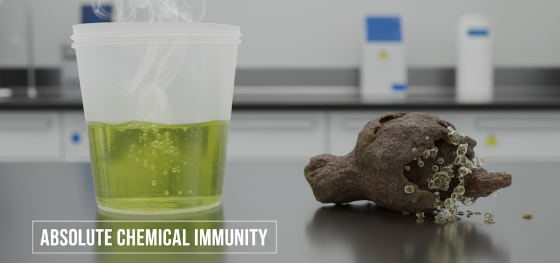
In the chemical processing and medical sectors, a material is only as good as its resistance to solvents. This is where Polypropylene earns its "Immunity" badge. PP is one of the most chemically inert polymers available; it is virtually unaffected by most acids, alkalis, and organic solvents at room temperature. This makes pp 3d printing the gold standard for laboratory equipment prototypes, chemical mixing manifolds, and automotive fluid reservoirs (like washer-fluid tanks or battery housings).
Beyond raw resistance, PP offers excellent moisture barriers. It has one of the lowest water absorption rates of any engineered plastic—far lower than Nylon. This ensures that your parts won't swell or lose their mechanical strength when submerged in water or exposed to high-humidity clinical environments. At JUCHENG, we leverage this stability to build high-performance seals and gaskets. We also offer "Simulation-PP" resins for our SLA lines when the requirement is for high-detail visual models, but for real-world chemical contact, our industrial FDM and SLS PP parts are the only functional survivors. We help you design for the "worst-case chemistry," ensuring your hardware doesn't just pass a lab test, but thrives in the brutal reality of a chemical plant.
JUCHENG’s Functional Standard: Precision Leak Testing
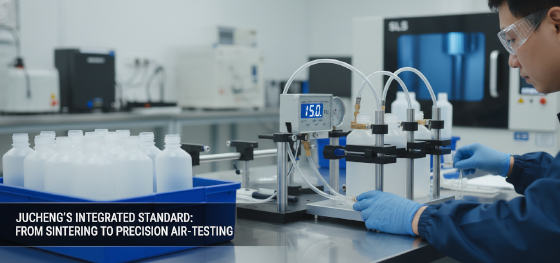
A 3D printed tank that looks perfect is useless if it leaks. The final hallmark of JUCHENG’s industrial protocol is our investment in functional verification. Because Polypropylene is often specified for fluid containment, we don't just perform dimensional checks; we perform pressure audits. Our quality control department utilizes specialized "Leak Detection" stations where 3D printed PP components are subjected to high-pressure air or fluid immersion tests to verify the integrity of the layers and the seals.
| Performance Factor | Standard Nylon 12 | Industrial PP (3D Printed) |
|---|---|---|
| Chemical Resistance | Moderate (Good for oils) | Extreme (Excellent for acids) |
| Moisture Absorption | High (Hygroscopic) | Negligible (Hydrophobic) |
| Flexural Fatigue | Good | Superior (Hinge-grade) |
| Weight (Density) | 1.01 g/cm³ | 0.90 g/cm³ (Floats) |
When you receive a component from JUCHENG, you aren't just receiving a print; you are receiving a validated engineered component. We bridge the gap between design theory and real-world industrial assembly. Whether you are building the next generation of medical diagnostic tubes or a lightweight automotive interior system, our expertise in pp 3d printing ensures your vision is delivered with absolute precision and durability. Contact our engineering team today for a technical DFM review and see how our polyolefin protocols can clarify and secure your next manufacturing breakthrough.

