


Brute strength is often the primary casualty of complex design. In the traditional manufacturing landscape, if you require a component to be both crystal clear and virtually unbreakable, you are forced into the expensive world of high-pressure glass or forged polycarbonate sheets. However, for iterative R&D and low-volume production, these methods create a terminal bottleneck of tooling costs. This is the technical chasm bridged by a professional polycarbonate 3d printing service. Polycarbonate (PC) is the "Iron Man" of engineered polymers, offering an impact resistance that is 250 times greater than glass and a thermal stability that allows it to survive in engine bays and medical autoclaves. Yet, PC is not just another filament; it is a thermal rebel that resists the build cycle. Achieving success in PC additive manufacturing requires more than just a high-temperature nozzle—it requires absolute sovereignty over the material's cooling dynamics.
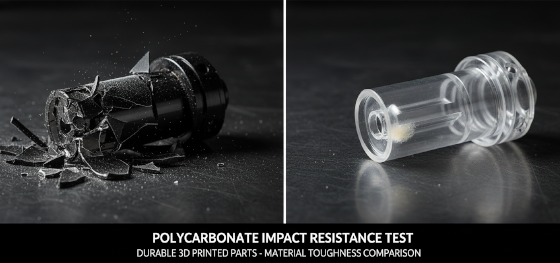
Jucheng Precision operates as a high-fidelity hub for the world’s most demanding automotive and aerospace brands. We recognize that for a ruggedized sensor enclosure or a high-clarity light pipe, "mostly strong" is an engineering failure. By integrating industrial-tier FDM and SLA systems that utilize actively heated build chambers, we provide a technical sanctuary for this temperamental resin. We have moved past the era of generic "clear" mockups to provide functional, flight-ready hardware that maintains its integrity under supersonic vibration and intense thermal cycling. This guide is a 2,000-word deep dive into the thermodynamics of the 300°C melt, the logic of vapor-phase optical refinement, and why JUCHENG’s integrated approach to Polycarbonate 3D Printing Service ensures your designs survive the transition from the digital model to the brutal reality of the field.
Profitability in high-performance prototyping is won by those who can validate impact physics early. You aren't just buying a plastic part; you are buying the verified certainty that your assembly will survive a drop test or a high-pressure fluid surge. Whether you are building an innovative medical valve or a protective shield for a robotic arm, the logic of the carbonate bond is your greatest tactical advantage. Let us break down the physical laws of industrial PC production and see how technical foresight can lock the soul of your next hardware design into physical reality.
Thermodynamic Combat: Managing the 140°C Glass Transition
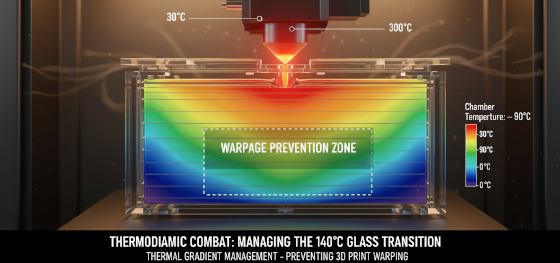
The primary differentiator between a visual mock-up and a structural component is the management of internal stress. Polycarbonate possesses a high glass transition temperature (Tg) of approximately 147°C. When a polycarbonate 3d printing service utilizes standard desktop machines, the material is extruded into room-temperature air. This creates a violent thermal shock. As the plastic cools from its 300°C melt point to 25°C in seconds, the polymer chains contract unevenly, leading to "warpage" and interlayer delamination. These are not just cosmetic flaws; they are structural fractures waiting to happen.
JUCHENG eliminates this risk through absolute thermal sovereignty. Our industrial FDM centers operate within actively heated and circulated build chambers that maintain a constant 90°C to 110°C environment. This keeps the plastic in a semi-relaxed, annealed state throughout the multi-day build cycle. By minimizing the temperature differential between the nozzle and the atmosphere, we ensure that the layers fuse at a molecular level, creating a dense, structural solid rather than a stack of glued strings. This environmental control is what allows us to deliver large-scale PC enclosures—up to 400mm in length—with a flatness and dimensional accuracy that rival injection molded parts. We don't just "hit go" on a machine; we orchestrate a cooling curve that locks the geometry into place, ensuring your mating features fit perfectly on the assembly line.
Optical Realism: Achieving Glass-Like Transparency
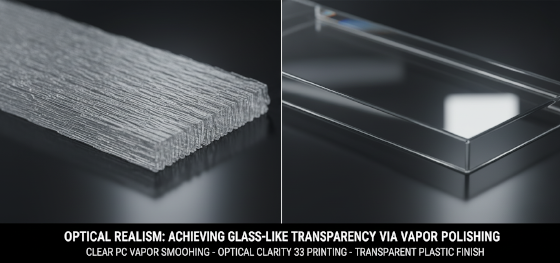
Transparency in the 3D printing materials world is often a lie. A raw 3D print in polycarbonate is translucent at best, covered in layer lines that scatter light like a frosted window. For automotive engineers validating a new LED light pipe or medical designers building a transparent fluid manifold, this haze is a terminal defect. Achieving true "Optical Realism" requires a transition from the machine floor to the chemical finishing lab. Jucheng Precision has mastered the alchemy of Vapor Smoothing specifically for polycarbonate.
This automated process exposes the part to a controlled chemical vapor that melts the microscopic peaks of the surface at the molecular level. As the surface liquefies momentarily, surface tension pulls it flat, effectively "erasing" the layer lines. Once the solvent evaporates, the result is a sealed, high-gloss "skin" that is virtually indistinguishable from an injection molded surface. This treatment doesn't just improve the look; it seals the internal pores, making the part watertight and resistant to bacterial adhesion—a critical factor for surgical instrument prototypes. We bridge the gap between "rough prototype" and "market-ready hardware," providing the visual depth your brand identity demands.
Structural Invincibility: PC as the Ultimate Impact Shield
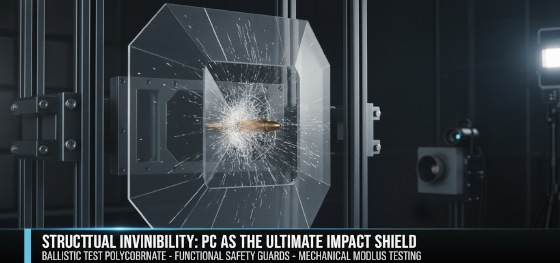
Why pay for a professional polycarbonate 3d printing service when standard nylon is cheaper? The answer is "Fracture Toughness." Polycarbonate is unique because of its ability to absorb kinetic energy and deform plastically before it snaps. In an Izod Impact test, standard resins fail at less than 50 J/m. Polycarbonate routinely exceeds 600 J/m. This "Structural Invincibility" makes it the mandatory choice for components exposed to high-velocity debris, such as protective shields for robotic cells or functional housings for handheld industrial scanners.
At JUCHENG, we utilize the material's high flexural modulus to build "Living Frames"—parts that can bend and flex under stress but return to their original shape without fatigue cracking. This resilience is vital for aerospace interiors where safety-critical components must not shatter into dangerous needles during a structural load-event. We provide the mechanical baseline data to prove that our 3D printed PC components possess 90% of the strength of a wrought sheet, ensuring your functional prototypes survive the most brutal vibration and drop audits. We treat the part’s survival as a functional specification, providing the engineered armor needed for your most ambitious designs to thrive in the real world.
Additive Technology Divide: FDM vs. SLA for Polycarbonate
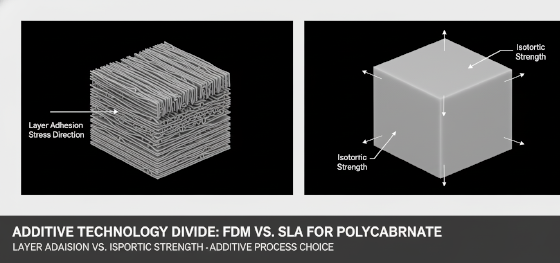
Navigating the equipment choice is the first fork in the road for any engineering project. Not all polycarbonate is processed using the same physics. At our facility, we utilize two distinct additive pathways based on the part's mechanical destiny. Industrial FDM (Fused Deposition Modeling) is the champion of structural "Grit." It utilizes a solid filament of PC that is melted and extruded. Because the material is a production-grade thermoplastic, the resulting parts possess the highest impact strength and thermal resistance. This is the preferred method for machine guards and rugged internal brackets where aesthetics are secondary to raw survival. However, FDM is anisotropic; its strength is dependent on the layer orientation. We manage this through precise tool-path orchestration, ensuring that the highest stress loads align with the strongest axis of the material.
SLA (Stereolithography) represents the "Optical" alternative. Instead of melting a filament, it utilizes a liquid photopolymer resin that has been engineered to simulate polycarbonate’s properties. While these simulants may lack the extreme fracture toughness of FDM-extruded PC, they offer absolute "Geometric Sovereignty." SLA produces nearly isotropic parts with mirror-smooth surfaces and microscopic detail resolution. This is the definitive choice for clear lenses, light pipes, and complex medical manifolds where internal fluid flow must be visible. JUCHENG helps our clients perform a "Mission Audit"—if your part must withstand a sledgehammer, we go FDM; if it must pass an optical bench test, we go SLA. By providing both technologies under one roof, we eliminate the bias found in smaller bureaus, ensuring your delivers the specific physics your assembly requires.
Environmental Survival: Heat, Flame, and Chemical Resistance
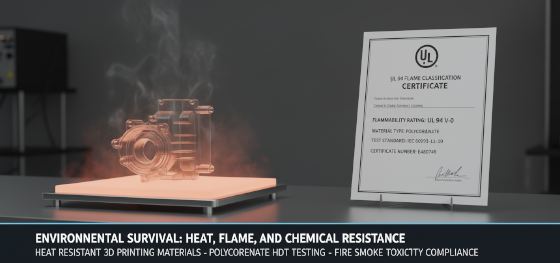
Industrial environments are hostile to standard plastics. A part designed for the medical sector or the automotive engine bay must survive more than just physical impact; it must survive the chemistry of its surroundings. Polycarbonate is favored by JUCHENG’s clients for its impressive Heat Deflection Temperature (HDT), which typically reaches 135°C to 140°C. Unlike lower-grade polymers that soften in a warm enclosure, PC maintains its structural "spine," ensuring that mounting points don't loosen and seals don't weep under thermal load.
Safety compliance is another critical pillar of our polycarbonate 3d printing service. For our aerospace and electronics partners, we utilize specialized PC resins that meet the UL94 V-0 flame-retardant standard. These materials are "self-extinguishing," meaning they won't contribute to the spread of a fire—a mandatory requirement for aircraft cabin interiors and high-voltage power enclosures. However, we also provide a technical warning regarding chemical exposure. Polycarbonate is notoriously sensitive to common alcohols and certain industrial solvents. Exposure to these chemicals can trigger "Crazing"—thousands of tiny hairline fractures that destroy both the clarity and the impact strength of the part. JUCHENG’s engineers evaluate your cleaning and sterilization protocols before we start the build, suggesting protective coatings or material alternatives like PEEK if your environment is chemically aggressive. We don't just print a part; we engineer its long-term survival against the elements.
Hybrid Metamorphosis: CNC Machining the Unprintable Fits
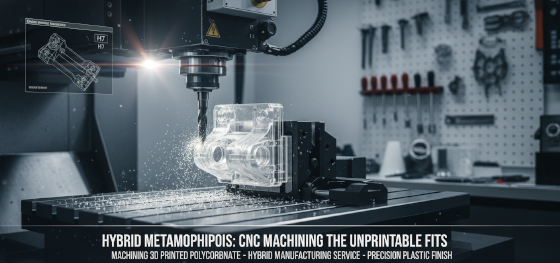
Complexity is a superpower, but it shouldn't come at the cost of precision. Additive manufacturing provides the "Impossible Geometry"—internal labyrinths and topologically optimized frames—but it often fails at the "Critical Interface." A 3D printer cannot consistently deliver an H7 bearing bore or a mirror-finish seal surface to a +/- 0.01mm tolerance. Jucheng Precision eliminates this "Accuracy Gap" through our hybrid manufacturing workflow. We treat the 3D printer as a high-tech foundry that produces an "Advanced Preform."
Our polycarbonate 3d printing service includes the option for "Post-Build Precision." We print your complex PC parts with an extra 1.5mm of "Machining Stock" on all critical assembly datums. Once the part has been thermally stabilized to release internal stresses, it moves to our 5-axis CNC floor. Our high-speed mills then carve away the near-net texture, revealing the surgical accuracy needed for high-performance assemblies. This integrated approach is why JUCHENG is the preferred partner for global robotics and medical firms. We eliminate the accountability gap between vendors, providing a single, verified engineered solution that possesses the lightweight freedom of additive and the sub-micron certainty of CNC. We bridge the gap between design theory and real-world assembly, ensuring your parts fit perfectly the first time, every time.
Technical Validation: Locking in Component Integrity
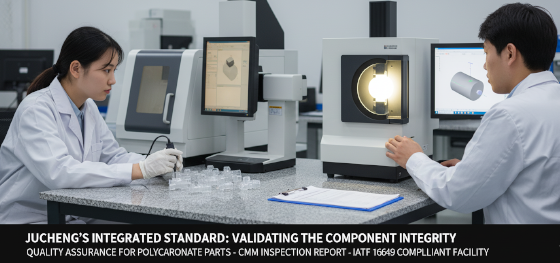
The final hallmark of a professional 3D printing partner is the refusal to accept visual quality as a proxy for technical precision. In the world of high-stakes aerospace and medical hardware, an unverified part is a dangerous liability. Jucheng Precision operates a facility where additive manufacturing is a documented engineering discipline, not a visual craft. Our polycarbonate 3d printing service protocol includes full material lot-traceability and documented process validation. We understand that your reputation depends on the integrity of the plastic we extrude or cure.
Our metrology lab utilize high-resolution CMM (Coordinate Measuring Machines) and laser scanners to generate 3D "Error Maps" of your components. We compare the physical part against your master STEP file to identify any thermal drift that occurred during the cooling phase. We also perform "Shore Hardness" audits and cross-hatch adhesion tests on secondary coatings to ensure the structural "skin" of the part is as tough as the core. For our automotive clients, we provide full PPAP documentation, providing the paper trail required for Tier-1 supply chain compliance. When you receive a shipment from JUCHENG, you aren't just getting 3D prints; you are getting verified engineered solutions that have been audited for survival. We don't just ship plastic; we manufacture trust through data-driven quality control.
Strategic Verdict: Why Professional PC Printing Defines Success
Success in the modern market requires the ability to move from CAD to a functional, field-ready component in days. The decision to utilize a professional polycarbonate 3d printing service is a strategic move toward manufacturing agility. It allows your engineers to test real impact physics and thermal loads without the anchor of high-pressure tooling costs. By choosing Jucheng Precision, you are accessing a decade of industrial data and a facility that treats polymers with the technical reverence usually reserved for aerospace metals.
Our integrated approach—combining 5-axis CNC precision, chemical vapor smoothing, and IATF 16949-aligned quality standards—makes us the definitive partner for your most challenging transparent and high-strength designs. We remove the uncertainty of material behavior, delivering parts that are visually striking and structurally invincible. Don't let your innovation be limited by the low quality of desktop prints or the high cost of fragmented vendors. Experience the clarity and the capability that industrial-grade polycarbonate replication can bring to your next breakthrough. Contact Jucheng Precision today for a technical DFM review and let our engineers help you build a bigger, better, and more profitable physical reality. We clarify the complex, ensuring your most ambitious visions are armored for survival in the real world.

