prototype injection molding: Solving the Fragile 3D Print Crisis
Views: 2 Author: Allen Xiao Publish Time: 2026-03-17


Engineering validation is often a hostage to material ambiguity. Hardware designers frequently spend weeks perfecting a CAD model only to rely on a "Fragile Fiction" for physical testing—a 3D print that shares the shape of the part but none of its mechanical soul. In the uncompromising environment of functional hardware development, a prototype that cannot survive a drop test or pass a UL flammability audit is a liability that provides zero actionable data. Navigating this integrity gap requires the strategic deployment of prototype injection molding. This technology bridges the dangerous void between digital intent and physical reality, utilizing rapid, low-cost tooling to inject the actual end-use resins specified in your production BOM. At Jucheng Precision, we recognize that a prototype is a technical contract; if the material lacks the correct molecular orientation or shrinkage profile, the validation is worthless. Our facility provides the "Structural Truth" required for Low Volume Injection Molding, ensuring your hardware is armored with real-world material properties before you commit to the financial ransom of a mass-production steel mold.

Establishing a high-fidelity validation roadmap begins with a dispassionate rejection of chemical surrogates. Amateurs often settle for "ABS-like" or "PC-like" 3D resins, failing to realize that these photo-curable polymers degrade rapidly under UV exposure and lack the impact resistance of real thermoplastics. Jucheng Precision eliminates this "Validation Blind Spot" by delivering T1 sample parts in as fast as seven days. We utilize high-strength 7075 aluminum and unhardened P20 steel to bypass the months of lead time associated with traditional tool shops. This guide deconstructs the mechanical superiority of molded prototypes, the physics of rapid tooling, and why JUCHENG’s "T1-to-Market" protocol is the mandatory insurance policy for hardware innovators in the automotive, medical, and consumer technology sectors.
content:
Structural Fiction: Why 3D Printing Fails the Engineering Audit
Material Purity: The Imperative for Safety Certification
Mechanical Velocity: T1 Samples in Under 10 Days
Pre-production Forensics: Debugging Before the Million-Shot Run
JUCHENG Protocol: Zero-Risk Transition to Mass Production
Structural Fiction: Why 3D Printing Fails the Engineering Audit

Anisotropy remains the silent saboteur of additive prototypes. When you build a part layer-by-layer, the strength of the component is fundamentally compromised along the Z-axis. A 3D printed snap-fit or living hinge will inevitably delaminate under repeated mechanical cycles. prototype injection molding solves this by introducing isotropic molecular integrity. Because the resin is injected as a high-pressure molten mass, it forms a monolithic polymer matrix that possesses uniform strength in every direction. Furthermore, molded parts exhibit the "Skin-to-Core" morphology that dictates real-world flexural modulus. To assist engineers in understanding this performance delta, Jucheng Precision provides the following technical comparison:
| Property | 3D Printed (SLA/MJF) | Molded Prototype (JUCHENG) |
|---|---|---|
| Mechanical Strength | Anisotropic (Z-axis weak) | Isotropic (Uniform) |
| Material Choice | Limited Photopolymers | Unlimited Production Resins |
| Shrinkage Behavior | Random / Low Fidelity | Predictable (Match Mass-Mfg) |
| Internal Porosity | High (Prone to Leaks) | Zero (Watertight/Hermetic) |
Material Purity: The Imperative for Safety Certification

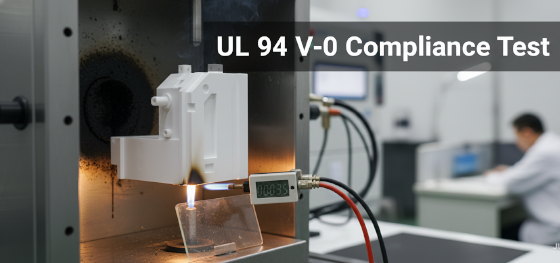
Regulatory certifiers like UL, FDA, and CE do not recognize 3D printed surrogates as valid for final safety audits. If your medical device enclosure must meet UL 94 V-0 fire safety standards, you cannot submit a piece of MJF nylon and hope the certifier accepts it. You must provide parts manufactured in the exact production resin, with the exact wall thickness intended for the final SKU. prototype injection molding is the only method to secure these "Certification Units" rapidly. Jucheng Precision provides the material lot traceability and Spectrometer validation required to satisfy the most stringent compliance audits. We allow you to "front-load" your regulatory risks—identifying if your design fails a flammability test in a 10-unit prototype run before you spend fifty thousand dollars on a hardened production tool. We turn a high-risk regulatory hurdle into a documented manufacturing advantage, ensuring your path to market is legally and structurally sound.
Mechanical Velocity: T1 Samples in Under 10 Days

Throughput speed is the primary driver of JUCHENG's prototype bay. The historical bottleneck of prototype injection molding was the mold-making phase. Traditional shops treat every tool like a permanent asset, over-engineering the steel and adding weeks of delay. Jucheng Precision utilizes a "Rapid Tooling" mindset. By utilizing our fleet of 150+ CNC machines to carve mold cavities directly from Aluminum 7075 or pre-hardened P20 steel, we slash lead times by 70%. These tools are designed for 500 to 10,000 cycles, perfectly aligning with the needs of engineering validation. This velocity allows for a "Recursive Iteration" cycle: you receive T1 samples, identify a mounting boss interference, update the CAD, and we modify the aluminum tool in 48 hours. This agility is impossible with hardened H13 production molds. We don't just provide parts; we provide an iterative engine that allows you to fail fast and succeed faster.
Pre-production Forensics: Debugging Before the Million-Shot Run
Manufacturing "Ghost Defects" often hide within complex 3D digital geometries. Moldflow simulations are accurate, but they cannot account for the subtle physics of "Gate Blush," "Jetting," or "Gas Traps" in a specific tool setup. Utilizing prototype injection molding acts as a physical forensic audit for your upcoming mass production run. By molding 50 units in a prototype tool, you discover exactly where the weld lines meet and whether the chosen gate location ruins the cosmetic "A-side" of your part. Jucheng Precision engineers use the data gathered from the prototype run to "Armor" your future production mold. We might suggest shifting a parting line or increasing a draft angle based on how the T1 parts ejected from the aluminum tool. This pre-production debugging prevents the catastrophic expense of modifying a $40,000 hardened steel mold later in the cycle, saving you weeks of market downtime and thousands in rework fees.
JUCHENG Protocol: Zero-Risk Transition to Mass Production

Manufacturing excellence at Jucheng Precision is built on the foundation of single-source accountability. We don't believe in "throwing a design over the wall." Our integrated facility allows us to manage your part's entire evolution—from the first 10-piece prototype run to a 10,000-unit Low Volume Injection Molding launch, and finally to full mass production. We utilize the same master metrology standards for our prototypes as we do for our automotive and medical production runs, providing CMM inspection reports that prove your geometry is stable. Stop gambling with fragile 3D prints that cloud your testing data. Leverage our decade of chemical replication and rapid tooling mastery to validate safely and launch profitably. Contact our technical team today for a free DFM review and see how we can turn your digital intent into a structurally sound, physical reality.