


Analyzing the failure of a structural manifold or the fatigue of a robotic joint often leads back to a critical oversight in the R&D stage: assuming all polyurethane resins behave identically. In the current market, the physical capabilities of a part are dictated by the mixing energy and pressure used during fabrication. Choosing between RIM vs Vacuum Casting Material Properties requires a shift from visual validation to mechanical verification. While hand-poured resins are excellent for aesthetic mock-ups, they often lack the dense molecular mesh required for load-bearing autonomy. Mastering these technical nuances is the only way to ensure that your prototype robot remains structurally sound through thousands of high-torque cycles in the field.

Mechanical performance in liquid-molded parts is governed by the stoichiometric balance of the A and B components. If the mixing process is manual, the resulting hardware may suffer from microscopic air voids and inconsistent cross-linking. Jucheng Precision addresses these material hurdles by utilizing high-pressure impingement mixing technology. This automated process ensures isotropic molecular structures, meaning the part is equally strong in all directions. By providing a free DFM analysis in 24 hours, Jucheng Precision helps engineers identify potential structural weak spots before the resin ever enters the mold, ensuring that your RIM vs Vacuum Casting decision is backed by hard data rather than guesswork.
Operating under the global quality mandates of ISO 13485, ISO 14001, and IATF 16949, Jucheng Precision serves as the metallurgical advisor for global MedTech and robotics firms. JUCHENG leverages a fleet of 150+ CNC machines and 25 5-axis Haas/Mazak units to manufacture the precise aluminum tools that enable these high-performance material outcomes. This guide explores the essential tensile strength benchmarks, heat deflection temperature (HDT) resilience, and the fiber-reinforcement capabilities required for mastering RIM vs Vacuum Casting Material Properties to ensure your innovation survives the most aggressive field validation cycles.
content:
Tensile and Flexural Modulus: Which Process is Stiffer?
Technical Data: Comparing Density and Structural Soundness
Thermal Limits: Mastering Heat Deflection and Stability
Composite Advantage: Adding Glass Fibers for Heavy-Duty Use
JUCHENG Hub: Verifying Material Purity in the Shenzhen facility
FAQ: Real Answers for Fatigue, UV Stability, and Chemical Resistance
Tensile and Flexural Modulus: Which Process is Stiffer?
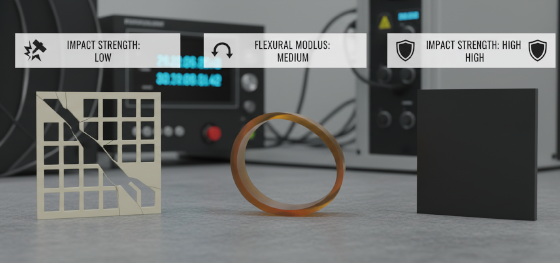
Structural stiffness is the non-negotiable benchmark for large-scale diagnostic consoles and robotic frames. In the comparison of RIM vs Vacuum Casting Material Properties, the flexural modulus of machine-injected polyurethane is significantly higher than that of hand-poured resins. This is because the high-pressure impingement mix creates a denser molecular lattice that resists elastic deformation under load. If your enclosure must support a 30kg sensor array without sagging, RIM provides the "Bony" rigidity required for long-term calibration stability. Hand-poured vacuum casting resins, while excellent for appearance, often behave more like semi-rigid plastics that can exhibit "Creep" when subjected to constant mechanical stress.
How to ensure a large part doesn't flex?
Utilize high-density RIM formulations with a flexural modulus exceeding 300,000 psi to eliminate the "Oil-Canning" effect on 2-meter panels.
Tensile strength also favors the industrialized RIM process. When an autonomous mobile robot hits an obstacle, the energy must be dissipated through the material without causing a brittle fracture. Jucheng Precision utilize high-performance polyether systems that offer a superior balance between hardness and elongation. This ensures that your hardware can absorb a 10-G impact and return to its exact CAD geometry. By contrast, the materials used in standard vacuum casting are often more prone to "Shatter Failure" at low temperatures, making them a risky choice for outdoor AgTech or logistics environments where durability is a primary survival metric.
Fatigue life is the final differentiator in mechanical integrity. Components in 24/7 automation systems undergo millions of reversing torque cycles. The cross-linked thermoset matrix of Jucheng’s RIM parts ensures that the polymer chains do not slide past each other, preventing the thinning and eventual failure common in lower-grade plastics. By delivering parts with high "Endurance Limits," Jucheng Precision allows your engineering team to verify maintenance intervals with 100% confidence, ensuring that your hardware launch is not plagued by premature field recalls due to material fatigue.
Technical Data: Comparing Density and Structural Soundness
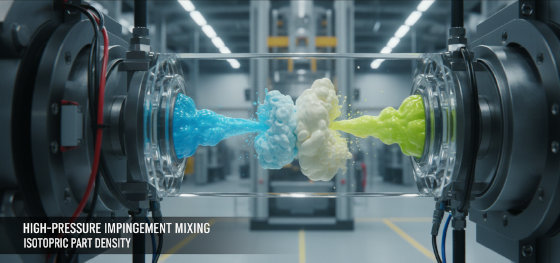
Success in hardware validation depends on the numbers. If your design assumes the properties of a solid block but you receive a porous model, your stress simulations will be invalid. Jucheng Precision provides full material batch reports for every production run to ensure 100% data integrity. The following table compares the essential performance metrics of RIM vs Vacuum Casting Material Properties for the current high-end hardware market.
| Metric | Hand-Poured Vacuum Casting | Machine-Injected RIM | Clinical Benefit |
|---|---|---|---|
| Internal Density (%) | 92% - 96% (Micro-bubbles) | 100% (Solid Matrix) | Prevents Internal Leaks |
| Tensile Strength (MPa) | 35 - 55 | 60 - 85 | High Payload Stability |
| Autoclave Resistance | Low (Resin dependent) | Exceptional | Survives Sanitization |
| Mixing Consistency | Operator Dependent | Servo-Pump Controlled | Repeatable Field Trials |
The data highlights why machine-controlled injection is the only choice for medical-grade hardware. The "Internal Density" of a part dictates its ability to hold a vacuum or maintain a hermetic seal. Jucheng Precision utilize vacuum degassing and high-pressure injection to ensure that every internal rib and boss is 100% solid. This eliminates the "Internal Voids" that can harbor bacteria or cause a part to explode during the pressure cycles of gas-sterilization. By delivering hardware with "Surgical-Grade" density, Jucheng Precision helps you pass the most rigorous IP67 and IP69K sealing audits on the first attempt.
Thermal Limits: Mastering Heat Deflection and Stability
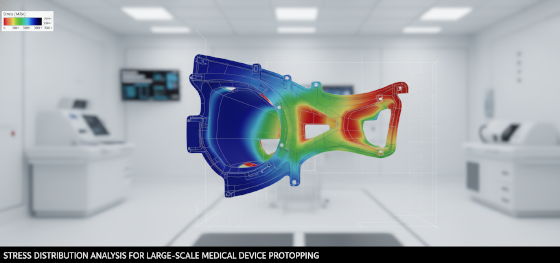
Heat management is often the bottleneck for autonomous hardware containing high-power AI processors. In RIM vs Vacuum Casting Material Properties, the thermal resilience of the polymer determines if your enclosure will sag during a summer afternoon in the sun. Vacuum casting resins are generally designed for room-temperature curing, which results in a relatively low Glass Transition Temperature (Tg). Under the thermal load of an internal GPU, these parts can become "Soft," leading to panel misalignment. Jucheng Precision’s RIM polyurethanes possess a higher cross-link density, resulting in heat deflection temperatures (HDT) exceeding 100 degrees Celsius, ensuring your hardware remains rigid even in high-heat industrial environments.
Can RIM handle the heat of a steam autoclave?
Yes. Specialized medical RIM formulations from Jucheng Precision are engineered to survive repeated 134-degree autoclave cycles without losing their Shore D hardness.
Dimensional stability after demographic changes is the secondary pillar of thermal logic. When a large diagnostic console moves from a cold storage facility to a warm operating room, the material must expand uniformly. Jucheng Precision utilize isotropic molecular structures to ensure that thermal expansion is predictable and does not induce internal warping. This "Thermal-Sync" capability is essential for multi-material assemblies where plastic panels are bonded to a CNC-machined aluminum chassis. Our Shenzhen facility manages these expansion coefficients by fine-tuning the chemical recipe of Side B, providing a stable platform for your most sensitive sensor integrations.
UV stability is the final environmental defense. Many hand-poured resins turn yellow and become brittle within months of direct sun exposure. Jucheng Precision integrates UV-blocking additives and Hindered Amine Light Stabilizers (HALS) directly into the liquid resin matrix. This ensures that your robot fenders and medical shrouds maintain their high-gloss finish and impact toughness throughout their entire field lifecycle. By delivering hardware that resists the sun's fire and the machine's internal heat, Jucheng Precision ensures your innovation survives the transition from a laboratory concept to a global commercial success.
Composite Advantage: Adding Glass Fibers for Heavy-Duty Use

Achieving the stiffness of a metallic frame with the lightweight benefits of plastic is the "Holy Grail" of modern robotics. This is where the RIM vs Vacuum Casting Material Properties divide is most prominent. Jucheng Precision offers Reinforced Polyurethane RIM (RRIM), where milled glass fibers are mixed directly into the liquid polyol before injection. This turns the polyurethane into a high-performance composite with a flexural modulus that can exceed 800,000 psi. Hand-poured vacuum casting is physically unable to handle this level of fiber reinforcement, as the resin would become too thick to flow into a silicone mold, leaving the process limited to unreinforced polymers.
Why is fiber reinforcement critical for autonomous vehicles?
It reduces the Coefficient of Linear Thermal Expansion (CLTE) to match that of aluminum, preventing panel buckling in the hot sun.
Mineral fillers such as Wollastonite can also be integrated into the RIM process to improve surface smoothness while increasing rigidity. Jucheng Precision utilize specialized abrasion-resistant mixing heads to handle these "Slurries" without tool damage. This allows us to produce structural shells for large-scale medical scanners that possess the "Solid-Core" feel and sound that investors and users associate with high-end technology. By choosing RRIM, you can eliminate the need for heavy internal steel sub-frames, reducing your total robot weight by up to 40% and directly extending your battery life in the field.
Chemical resistance is further enhanced by these reinforced systems. In industrial and agricultural settings, hardware is constantly exposed to corrosive oils and fertilizers. The cross-linked nature of Jucheng’s RIM materials, combined with inert mineral fillers, ensures that your enclosures do not experience Environmental Stress Cracking (ESC). We provide 100% density in these parts, ensuring no "Leaking Highways" exist within the polymer matrix. Jucheng Precision’s commitment to material science is why our industrial robot parts move from the Shenzhen hub to global assembly lines with zero risk of material degradation or field failure.
JUCHENG Hub: Verifying Material Purity in the Shenzhen facility

Dominating the large-format hardware market requires a partner that doesn't just buy materials, but understands the chemistry of performance. Jucheng Precision operates with a 24/7 manufacturing mindset in our Shenzhen precision manufacturing hub, delivering high-tolerance RIM components and structural industrial robot parts with industry-leading speed. Jucheng Precision provides the "Bridge to Production" that ensures your innovations move from concept to pilot run with 100% metallurgical and chemical confidence. Jucheng Precision has No MOQ, allowing you to source 1 to 10 units for initial material validation without the crushing cost of mass-production infrastructure.
Integrating your structural design with Jucheng Precision’s expertise ensures that your RIM vs Vacuum Casting Material Properties decision is based on performance data, not guesswork. Jucheng Precision offer comprehensive DFM reviews within 24 hours, identifying potential material-ratio risks or thermal-expansion bottlenecks in your design before they become field failures. Whether you are building an autonomous medical assistant or a heavy-duty industrial mobile base, Jucheng Precision provides the rigid, precise, and chemicals-optimized foundations that keep your innovation moving through the high-speed cycles and the years of hard labor.
Our facility is equipped with dedicated high-pressure RIM assembly cells and dedicated ISO 13485 quality labs, allowing Jucheng Precision to manage the entire hardware lifecycle in one location. Jucheng Precision manage the complexity of multi-material bonding and automotive-grade finishing so your engineering team can focus on the motion control and the AI. By combining Shenzhen's speed with industrial-grade material verification and global quality standards, Jucheng Precision remains the preferred partner for the world's most aggressive hardware challenges. Contact the Shenzhen hub today to start your next project.
FAQ: Real Answers for Fatigue, UV Stability, and Chemical Resistance
Is RIM polyurethane as hard as CNC-machined ABS?
Yes. By adjusting the isocyanate index, we achieve Shore D hardness of 85, providing a surface that is indistinguishable from solid ABS plate.
Can vacuum cast parts handle outdoor UV exposure?
Generally no. Most casting resins yellow and become brittle in weeks; RIM polyurethanes are formulated with HALS to survive years of direct sun.
Does adding glass fiber make the RIM part heavier?
Slightly. It increases density by about 15%, but the massive jump in stiffness allows for thinner walls, often resulting in a lighter overall assembly.
How do you handle the high piece price of RIM at high volumes?
Once your annual volume exceeds 2,000 units, we help you transition to high-pressure injection molding using our in-house steel tooling bay.
What is the typical lead time for a custom-material Alpha unit?
Functional iterations using specialized resins are typically delivered in 7 to 10 business days, including basic testing.
Material fatigue and thermal warping are absolute innovation killers for high-end robotic systems. Partnering with Jucheng Precision ensures that your functional iterations are built with the unyielding polyurethane reaction injection molding and specialized RIM vs Vacuum Casting Material Properties knowledge the industry demands. Reach out to our Shenzhen manufacturing hub today for a complete DFM review and build the unyielding foundation your autonomous fleet requires.

