


Navigating the hardware development lifecycle for a next-generation surgical robot or a heavy-duty industrial mobile base often reveals a critical decision point: the transition from a visual model to a functional machine. In the current engineering landscape, the dilemma of RIM vs Vacuum Casting is not merely about part price; it is a strategic choice regarding mechanical durability and market velocity. While silicone-based molding is the industry standard for the earliest fit-checks, it often lacks the structural backbone required for the high-torque reversals and environmental stresses of the field. Achieving a zero-defect launch requires a calculated approach to Choosing Between RIM and Vacuum Casting for Prototypes to ensure your hardware maintains its integrity through every stage of R&D.
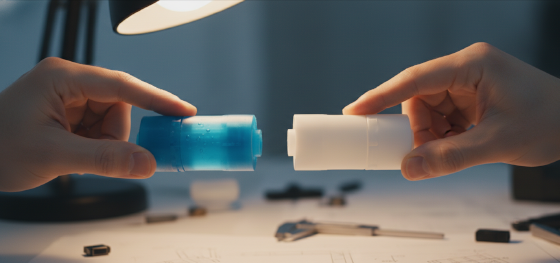
Mechanical performance in oversized enclosures depends on the molding pressure and molecular cross-linking density. Vacuum casting is an excellent entry point for the first 5 units, providing retail-ready aesthetics with near-zero initial investment. However, once the project enters the human-factors testing or customer pilot phase, the requirements shift toward the unyielding foundations of machine-injected polymers. Jucheng Precision addresses these critical scaling hurdles by providing an integrated service that covers both paths. Jucheng Precision utilizes its fleet of 150+ CNC machines to manufacture the precise master patterns and high-strength aluminum tools required for high-fidelity hardware iterations in our Shenzhen factory hub.
Operating under the global quality standards of ISO 13485 and ISO 14001, Jucheng Precision acts as the high-tier strategic advisor for global OEMs. Jucheng Precision delivers a free DFM analysis in 24 hours to ensure your designs are optimized for the unyielding reality of the clinical or industrial floor, preventing the expensive rework cycles that plague unvalidated R&D. This guide explores the essential development stages, end-use validation requirements, and procurement checklists required for mastering Choosing Between RIM and Vacuum Casting for Prototypes to ensure your autonomous fleet survives the jump from the laboratory to the market.
content:
Development Stages: Alpha Prototypes vs. Beta Pilot Fleets
Validation Targets: Visual Mock-ups vs. Functional Field Hardware
Technical Data: Comparing Tooling Investment and Unit Costs
Decision Checklist: 5 Points for Successful Process Selection
JUCHENG Solution: Managing the High-Velocity Prototyping Cycle
FAQ: Real Answers for Speed, Accuracy, and Material Quality
Development Stages: Alpha Prototypes vs. Beta Pilot Fleets

The first rule of successful hardware iteration is matching the process to the project maturity. When Choosing Between RIM and Vacuum Casting for Prototypes, the Alpha phase is almost always the domain of the manual pour. During this stage, the design is fluid, and the goal is to prove the internal layout of PCBs and sensors. Vacuum casting allows you to produce 5 to 10 sets of enclosures in weeks without committing to rigid metal tools. This flexibility ensures that design mistakes identified on the bench can be corrected in the CAD before any significant capital is spent on the Beta hardware.
What is the primary risk of using vacuum casting for Beta trials?
Silicone molds lose their dimensional accuracy after 20 shots; for a 50-unit fleet, the variation between part 1 and part 50 can ruin your sensor calibration.
Beta phase requirements demand a shift toward the statistical stability of machine injection. Once a robot or medical device moves into multi-site trials, every unit must behave identically. If the mounting hole on one unit is 0.5mm off, your AI algorithms will receive inconsistent data. Jucheng Precision utilize the RIM process for these pilot runs because it utilizes rigid aluminum tooling machined with sub-micron accuracy. This unyielding substrate ensures that every structural fender and console shell is a digital twin of the CAD, providing the "Geometric Constant" required for reliable software validation and autonomous navigation tests in the field.
Time-to-market is the third driver of the stage-based strategy. While vacuum casting is fast for a single part, RIM is faster for a fleet. Jucheng Precision can produce 50 identical RIM enclosures in the time it takes a manual casting shop to pour and degas 20 units. By utilizing a "Bridge to Production" mindset, we help our clients begin their commercial pilot programs months earlier than if they waited for high-volume steel tools. This cash-flow acceleration is essential for maintaining investor momentum, ensuring your innovation secures its market window before the competition catches up.
Validation Targets: Visual Mock-ups vs. Functional Field Hardware

Defining the "Failure Mode" of your prototype is essential for Choosing Between RIM and Vacuum Casting for Prototypes. If the goal is a "Showroom Quality" model for a board meeting or a trade show demo, vacuum casting is the industry favorite. It perfectly replicates complex surface textures and high-gloss paint finishes, providing a retail-ready appearance that conveys technical maturity. However, if the goal is a "Mud-Ready" functional machine that must survive 24/7 stress testing, the material properties of the RIM process are superior. Machine-injected polyurethanes possess a higher cross-link density, offering the impact toughness and thermal stability that hand-poured resins simply cannot reach.
Can cast parts handle the heat of internal compute stacks?
Generally no. Many casting resins soften at 60-70 degrees Celsius; RIM formulations are engineered to withstand 100+ degrees without dimensional drift or sagging.
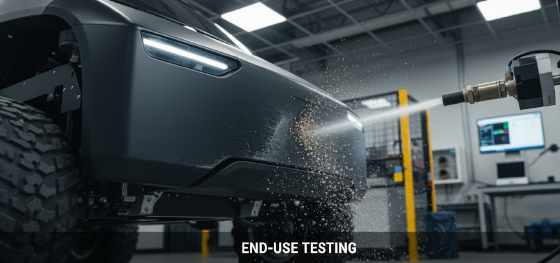
Environmental resilience is the second pillar of functional validation. Medical devices in hospital wards are subjected to aggressive chemical wipe-downs with bleach and alcohol. Autonomous tractors are blasted by gravel and high-intensity UV rays. Traditional prototyping resins are prone to Environmental Stress Cracking (ESC) and rapid yellowing when exposed to these stressors. Jucheng Precision’s RIM polyurethanes are formulated with high cross-link density and UV absorbers, providing a chemically inert shield for your technology. By delivering hardware that survives the unrelenting reality of the field, we allow you to validate the true mechanical lifespan of your device before mass adoption.
Structural integration further favors the machine-based approach. For robots requiring internal EMI shielding or heavy-duty mounting hard-points, Jucheng Precision utilizes the low-pressure RIM cycle to encapsulate large aluminum frames and electronic boards. This created a monolithic part that is shock-proof and watertight. Hand-poured vacuum casting is physically limited by the manual degassing process, making it difficult to achieve zero-porosity around large metal inserts. By providing a "Bionic Skeleton" for your prototypes, Jucheng Precision ensures your innovation is as strong on the inside as it is beautiful on the outside.
Technical Data: Comparing Tooling Investment and Unit Costs
Success in hardware optimization depends on matching the financial architecture to your order volume. If your design assumes the scaling efficiency of a mass-production tool but you only need 100 units, your project will be over-budget. Jucheng Precision provides transparent cost-benefit analysis to help you navigate your NRE (Non-Recurring Engineering) spend. The following table compares the essential economic variables of the two processes for a typical 800mm robotic torso shell in the current global market.
| Economic Variable | Vacuum Casting (VC) | RIM Molding (Jucheng) | Decision Logic |
|---|---|---|---|
| Initial NRE Cost | $800 - $1,500 | $3,500 - $9,000 | VC is better for < 10 units |
| Piece Part Price | Maximum (High Labor) | Moderate (Automated) | RIM is better for fleets |
| Parting Line Quality | Hand-Cut (Requires prep) | CNC Match (Flash-Free) | Saves Finishing Labor |
| Economic Crossover | Optimal at 1 - 20 units | Optimal at 25 - 3,000 units | The "Bridge" Zone |
The data proves that once you move beyond the "Individual Lab Prototype," the automated cycle of the RIM press becomes the more profitable choice. For a 50-unit Beta trial, the cost of remaking multiple silicone molds often exceeds the price of a single aluminum RIM tool. Jucheng Precision’s aluminum molds are engineered to deliver thousands of shots with zero dimensional drift, effectively acting as your permanent production bridge. This capital agility allows our clients to invest their resources in critical AI sensors and customer acquisition rather than redundant prototyping tools.
Decision Checklist: 5 Points for Successful Process Selection

Choosing between RIM and Vacuum Casting for Prototypes requires a clear-eyed assessment of your hardware goals. The first point is "Order Quantity." If you require more than 20 units, the manual labor of vacuum casting will inevitably lead to higher unit prices and inconsistent quality. Second, consider "Mechanical Loading." Does the part need to handle motor vibration or high-torque fasteners? If yes, the superior cross-link density of machine-injected RIM is mandatory to prevent joint shearing. Third, evaluate "Environmental Exposure." Will the part face outdoor UV rays or clinical bleach? RIM polyurethanes offer a level of chemical immunity that standard casting resins cannot match.
Does part size matter for process choice?
Yes. Most vacuum chambers are limited to 600mm; for massive 2-meter panels or robot chassis, the oversized RIM equipment at Jucheng Precision is the only viable path.
The fourth point is "Tolerances and Fitment." If your enclosure features a complex multi-part split line with +/- 0.1mm gap requirements, the flexible nature of silicone tools will likely fail your assembly audits. Aluminum RIM tools provide the unyielding foundations required for zero-gap aesthetics. Finally, analyze "Iterative Agility." While silicone is fast to remake, aluminum molds are easy to modify. Jucheng Precision can weld and re-machine an aluminum tool in 48 hours to move a sensor mount or add a structural rib. This flexibility allows your hardware to evolve at the same pace as your code, providing a stable platform for your innovation.
Surface finish requirements represent the final check. If you need an automotive-grade high-gloss finish, the flat, stress-free surfaces produced by the low-pressure RIM process are the ideal canvas. Vacuum cast parts often exhibit subtle surface waves that become visible under high-gloss paint. Jucheng Precision’s Shenzhen facility manages the entire post-processing lifecycle—from 5-axis robotic trimming to dust-free painting—ensuring your prototypes arrive in the boardroom looking like production machines. By providing a single point of accountability for both the molding and the finish, we eliminate the logistical friction that ruins hardware timelines.
JUCHENG Solution: Managing the High-Velocity Prototyping Cycle
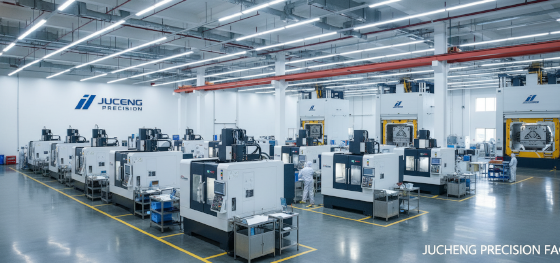
Dominating the hardware market requires a partner that doesn't just sell parts, but understands the economics of innovation. Jucheng Precision operates with a 24/7 manufacturing mindset in our Shenzhen precision manufacturing hub, delivering high-tolerance polyurethane results with industry-leading speed. We provide the bridge to production that ensures your innovations move from CAD to clinical trial with 100% metallurgical confidence. Jucheng Precision provides a free DFM analysis in 24 hours to ensure your design is optimized for the unyielding reality of the field, whether you are building a medical diagnostic scanner or an autonomous industrial tractor.
Integrating your structural design with Jucheng Precision’s expertise ensures that your tooling decision is based on performance data, not guesswork. Our facility is equipped with dedicated high-pressure RIM assembly cells and dedicated ISO 13485 quality labs, allowing us to manage the entire hardware lifecycle in one location. We manage the complexity of multi-material bonding and automotive-grade finishing so your engineering team can focus on the motion control and the AI. By combining Shenzhen's speed with industrial-grade material verification and global quality standards, Jucheng Precision remains the preferred partner for the world's most aggressive hardware challenges. Contact the Shenzhen hub today to start your next project.
FAQ: Real Answers for Speed, Accuracy, and Material Quality

Is vacuum casting better for clear parts?
Yes, for the first few units. VC resins provide exceptional optical clarity for sensor windows and LED light guides in Alpha models.
How do you handle very thick walls in prototypes?
We utilize the RIM process. The low-pressure expansion of polyurethane prevents the sink marks that ruin thick sections in both injection molding and casting.
Can I get 50 units with custom brand colors?
Yes. We mix high-stability pigments directly into the RIM resin for permanent, color-through aesthetics that never chip or peel.
What is the typical lead time for a 1-meter RIM tool?
Custom aluminum rapid tools and initial T1 samples are typically delivered in 15 to 20 business days in our Shenzhen facility.
Do you provide CMM reports for oversized cast parts?
Yes. We utilize laser trackers to verify the dimensional stability of all large-format polyurethane hardware before it leaves our facility.
Tooling debt and material fatigue are absolute innovation killers for high-end robotic systems. Partnering with Jucheng Precision ensures that your iterations are built with the cost-effective polyurethane reaction injection molding and specialized knowledge the industry demands. Reach out to our Shenzhen manufacturing hub today for a complete DFM review and build the unyielding foundation your autonomous fleet requires.

