


Visual authority dictates the commercial viability of autonomous bipeds in consumer and industrial spaces. While the internal skeletal frames require aerospace-grade metallurgy, the exterior skins—the chest plates, thigh covers, and head units—serve a dual purpose: they must protect highly sensitive internal electronics from environmental damage while projecting a sleek, futuristic, and approachable aesthetic. If a robot looks like a chaotic assembly of exposed wires and blocky sheet metal, it fails the "Trust Audit" of the human user. Navigating this requirement for massive, complex, and beautiful protective shells requires the strategic deployment of Humanoid robot enclosure manufacturing. This specialized discipline bridges the gap between fragile 3D-printed mockups and prohibitively expensive high-volume steel tooling. Jucheng Precision operates as a high-fidelity cosmetic sanctuary in the Shenzhen precision manufacturing hub, providing the thermodynamic control required to execute these oversized geometries. As a defining element of our humanoid robot parts development for the 2026 market, we engineer bionic armor that delivers absolute impact resistance, ensuring your machines can withstand the violent realities of the real world without sacrificing their showroom perfection.
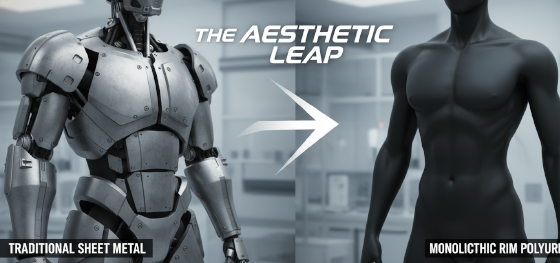
Establishing a resilient launch for oversized bionic skins demands the absolute rejection of traditional injection molding dogmas. Amateurs frequently attempt to mold a one-meter backplate using standard ABS, unaware that the immense injection pressure will warp the part and the tool itself will cost upwards of $80,000. Jucheng Precision eliminates these "Financial and Geometric Disasters" by transitioning large-format projects to low-pressure liquid chemistry. Whether you are developing a monolithic chest carapace or interlocking calf guards, our facility provides the material science and finishing rigor required for global market entry. This guide deconstructs the physics of low-pressure filling, the critical selection of elastomeric resins for crash survival, and why our integrated painting lines are the mandatory foundation for anyone developing bionic exteriors.
The Size Challenge: Why are chest plates too expensive for traditional injection molding?
The Hero: Why is Reaction Injection Molding (RIM) the perfect solution for massive covers?
Impact Resistance: How do RIM elastomers protect the robot when it falls?
The JUCHENG Angle: How do large-format RIM and automotive painting deliver showroom-ready armor?
Frequently Asked Questions: Humanoid Enclosures
The Size Challenge: Why are chest plates too expensive for traditional injection molding?
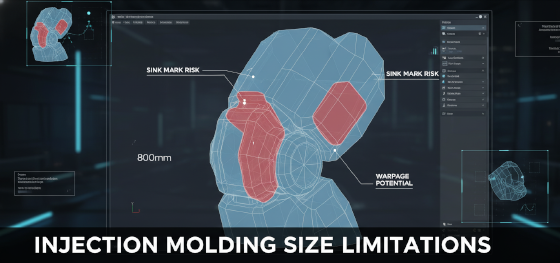
Physical dimensions dictate the financial gravity of a tooling program. In traditional injection molding, a resin must be forced through a cavity at pressures exceeding 20,000 psi before the material freezes. For small parts, this is trivial. However, for a humanoid chest plate that spans 800mm, the "Projected Area" exposed to that pressure is massive. To keep the mold from violently blowing open, the factory must use a 1,500-ton or 2,000-ton press. The steel mold required to withstand this crushing force must be carved from multi-ton blocks of H13 or P20 steel. The raw material cost of the steel alone can reach $30,000, and the months of multi-axis CNC machining required to cut the cavity drive the total tooling cost to six figures. For a robotics startup that only needs 500 units for a beta launch, amortizing a $100,000 tool across 500 parts adds $200 of pure "Tooling Debt" to the price of every single plastic cover. This economic structure is fatal for early-stage commercialization, forcing engineers to either abandon their sleek designs or burn through vital venture capital just to secure their exterior skins.
The Hero: Why is Reaction Injection Molding (RIM) the perfect solution for massive covers?
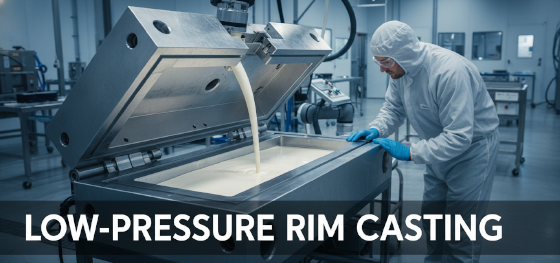
Low-pressure fluid dynamics represents the "unfair advantage" of the RIM process. Reaction Injection Molding sidesteps the brute-force physics of traditional molding by utilizing a chemical reaction between two low-viscosity liquid components—Polyol and Isocyanate. These liquids are mixed at high speed and poured into the cavity at near room temperature and at pressures typically under 100 psi. This "Gentle Fill" means the mold does not need to be a massive block of hardened steel; Jucheng Precision can utilize lightweight, highly thermally conductive aluminum or even epoxy tooling. This transition in physics slashes your initial tooling CapEx by 70% to 85%. Furthermore, because the material "grows" inside the mold via an exothermic reaction rather than being forced in under duress, the resulting part possesses virtually zero internal residual stress. This is why RIM is the undisputed king of oversized components: it allows engineers to mold massive, complex geometries with varying wall thicknesses (e.g., a 10mm mounting boss behind a 3mm cosmetic wall) without triggering the catastrophic "Sink Marks" and warping that plague high-pressure thermoplastics.
Impact Resistance: How do RIM elastomers protect the robot when it falls?
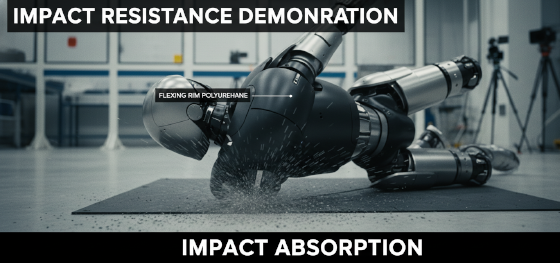
Kinetic survival is a mandatory requirement for untethered bipeds. During the development and early deployment phases, a humanoid robot will inevitably lose its balance and fall. If the exterior armor is made from brittle 3D-printed SLA resin or standard acrylic, the impact will shatter the panels, sending sharp shards into the internal wiring and destroying thousands of dollars in sensors. Jucheng Precision engineers utilize specialized "Elastomeric RIM" polyurethane formulations to prevent this. These materials possess a high elongation-at-break and exceptional tear strength, acting as a structural shock absorber. When the robot's shoulder or hip strikes the concrete, the elastomeric RIM panel flexes, absorbs the kinetic energy through its molecular matrix, and instantly rebounds to its original shape. This "Ductile Sovereignty" protects the delicate harmonic drives and internal LiDAR systems hidden beneath the skin. We don't just "cover" the robot; we provide an active kinetic defense mechanism that ensures a simple fall doesn't end the mission.
The JUCHENG Angle: How do large-format RIM and automotive painting deliver showroom-ready armor?
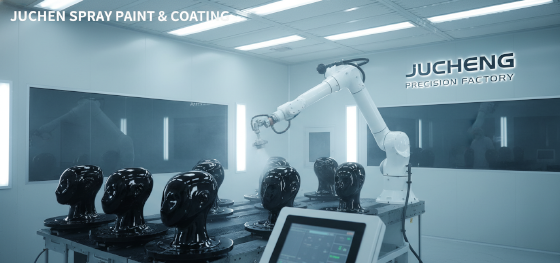
Visual authority on a large scale is won in the finishing cleanroom. A one-meter bionic thigh panel acts as a giant canvas; a single dust inclusion or paint sag is magnified ten-fold. Jucheng Precision operates an integrated finishing department optimized specifically for oversized RIM parts. Because RIM polyurethanes possess high surface energy, they provide a superior "Chemical Handshake" for automotive-grade 2K (Two-Component) polyurethane paints and UV-resistant clear coats. We perform a surgical surface audit, sanding any minor parting line marks to ensure the large canvas is perfectly level. We then apply multi-layer coatings in our dust-free, robotic spray booths, delivering a depth of color—from "Piano Black" gloss to "Pearl White" matte—that rivals the exterior of a luxury vehicle. Stop gambling your robot's visual identity on shops that treat finishing as an afterthought. Leverage our decade of large-scale replication mastery to validate rapidly and launch with an armor that looks as advanced as the intelligence driving it. Contact our technical team today for a free DFM review.
Frequently Asked Questions: Humanoid Enclosures
Question: How long does it take to manufacture the aluminum molds for a complete humanoid enclosure set?
Answer: Utilizing our 150+ CNC machines, Jucheng Precision can cut the aluminum RIM tools and deliver the first complete set of T1 exterior panels in approximately 3 to 4 weeks.
Question: Can RIM enclosures be made flame retardant?
Answer: Yes. If your robot operates in environments with strict fire codes, we utilize specialized halogen-free RIM polyurethanes that meet UL94 V-0 standards, ensuring the panels self-extinguish within 10 seconds.
Question: How are these large plastic panels attached to the robot's metal skeleton?
Answer: During the RIM molding process, we can "Insert Mold" threaded brass nuts or steel mounting brackets directly into the polyurethane. This provides a permanent, high-torque anchor point for bolting the armor securely to the internal chassis.

