


Consolidating your manufacturing chain under a single, unified service provider is the most effective method to eliminate assembly conflicts, logistical delays, and high shipping bills. Specifying integrated sheet metal fabrication and assembly provides your product lines with a seamless transition from raw, flat plate profiling to fully integrated box-build configurations. This unified process represents a critical milestone in custom sheet metal fabrication, ensuring that every pressed flange, tapped mounting thread, and welded corner fits perfectly during the final mechanical build.
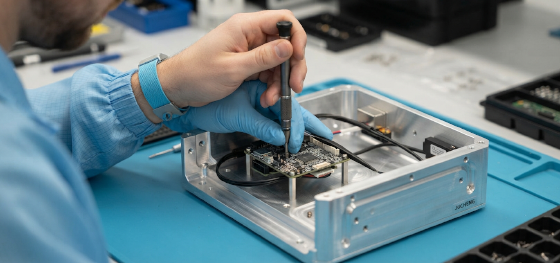
Sourcing single brackets from fabricator A, shipping them to anodizer B, and sending them to assembler C is a major supply chain bottleneck. Any minor angle drift of half a degree on a press brake flange can cause a severe tolerance stack-up when assembling a multi-panel box, making it impossible to install standard PCB boards or card guides. Moving to an in-house partner completely resolves these transit damages and assembly mismatches.
Let's explore the key advantages of combining fabrication and assembly under one roof, analyze our end-to-end factory workflow from laser profiling to final integration, and review our dual-stage quality control checks.
The Advantage of Combining Fabrication and Assembly

Why is consolidating your sheet metal fabrication and assembly under a single vendor highly cost-effective?
Consolidating these steps localizes the risk of part mismatches, completely eliminating double-handling shipping bills, custom packaging overhead, and supplier finger-pointing.
When you consolidate your sheet metal fabrication and assembly under a single vendor, you actively minimize the risk of error propagation. In fragmented supply chains, minor dimensional variations accumulate across multiple suppliers. We define this physical compounding of errors as a tolerance stack-up. If the fabricator is not responsible for the final assembly, they may cut and fold parts right at the outer edge of standard commercial tolerances, making it impossible to assemble them cleanly.
By executing both fabrication and assembly in our unified facility, our engineers actively manage these variations. We design custom, high-precision assembly fixtures and alignment jigs to secure the separate panels during welding or hardware pressing. If a bent flange exhibits minor angular springback on the press brake, our assembly team identifies and corrects it instantly before the parts move to the clean integration lines, ensuring 100% fitment matching.
Our End-to-End Fabrication Workflow

What is the standard step-by-step routing of an integrated custom hardware assembly?
Our integrated workflow transitions flat plates through automated laser blanking, multi-axis press brake bending, surface preparation, protective coating, and final hardware integration.
To ensure high-precision delivery, Jucheng Precision operates a fully synchronized, end-to-end manufacturing floor. We do not treat cutting, bending, painting, and assembly as separate processes; they are routed under a single, unified ERP scheduling system. This digital tracking allows us to monitor part progression in real time, preventing lead-time bottlenecks:
Laser Blanking & Punching: High-power fiber lasers slice out flat patterns while CNC turret presses punch precise holes.
Multi-Axis Bending: Programmable press brakes fold the flat blanks into exact three-dimensional structures.
Surface Pre-treatment: Parts undergo alkaline degreasing and acid pickling to remove mill oils.
Protective Coating: Electrostatic powder coating or anodizing is applied to seal the metal from environmental corrosion.
Turnkey Assembly: Integration technicians mount gaskets, hinges, latches, and self-clinching PEM fasteners.
Quality Control Across the Entire Process
How do dual-stage quality checkpoints guarantee error-free custom assemblies?
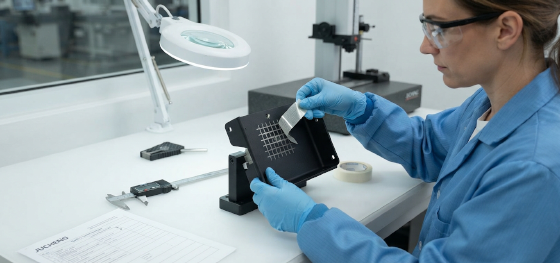
We implement strict quality gates at the end of both the individual part fabrication and the final mechanical assembly stages, utilizing coordinate measuring machines.
We execute rigorous quality control gates across our production lines. Our operators conduct a first-article inspection (FAI) during flat-pattern laser blanking and bending to verify that the linear dimensions and bend angles meet tolerances before moving to finishing. This prevents defective single parts from propagating through our lines.
Once the parts are coated and routed to our clean assembly bays, our integration technicians execute a secondary quality check. This includes conducting standard cross-hatch adhesion testing (ASTM D3359) to confirm the paint bond strength, running thread-go/no-go plug gauge checks, and performing full fitment validations. This dual-stage QC process guarantees that every completed box-build complies with your strict mechanical limits before shipping.
Seamless In-House Production at Jucheng Precision

How does Jucheng Precision deliver reliable, high-precision custom assemblies globally?
We operate high-power fiber lasers, advanced CNC press brakes, and automated assembly bays under a unified quality system, checking all tolerances.
Integrating these protective prep steps, precise bends, and joint setups into your early sheet metal design cycle is the single most effective way to eliminate assembly bottlenecks. Jucheng Precision houses these advanced automated benders, laser cutters, and assembly lines inside our 8000-square-meter facility, ensuring that your parts are cut, folded, painted, and completely integrated under one roof with extreme quality control.
We process a wide range of materials, including lightweight aluminum, high-yield stainless steel, and easily formable carbon steel during high-precision sheet metal fabrication cycles. Our technical department provides a 24-hour free DFM analysis to check your CAD models, checking tolerances and hinge clearances before production. Supported by our no MOQ policy and rapid delivery guarantee, we manage your project from initial flat pattern cutting to final, high-durability powder coating and assembly.
FAQ: Critical Questions About Sheet Metal Fabrication and Assembly

Our engineering team has compiled professional solutions to the most common quality and cost challenges faced by product developers:
Does combining sheet metal fabrication and assembly save money?
Yes, absolutely. For a typical B2B hardware run, outsourcing the fabrication and assembly to separate vendors adds 20% to 30% of unnecessary costs due to double-handling shipping fees, custom export packaging overhead, and multiple administrative receiving inspections. Consolidating these processes under a single, unified manufacturer completely eliminates these logistical markups.How do you protect delicate pre-painted panels from scratching during final assembly?
To protect pristine cosmetic finishes during final hardware integration, our assembly technicians wear anti-static gloves, assemble parts on padded felt worktables, and utilize high-density protective vinyl masking films. This completely prevents metal-on-metal friction and hand-oil staining, delivering clean, ready-to-use enclosures.Why is it difficult to tap threads directly into thin aluminum sheets?
Aluminum is soft and lacks the structural thickness to support enough thread engagements, causing tapped threads to strip easily under minimal torque. To provide high-strength, reusable machine threads on sheets under 1.5mm thickness, we recommend utilizing automated hardware presses to install self-clinching PEM nuts or standoffs rather than tapping directly.How does Jucheng Precision ensure that the sheet metal fabrication and assembly process remains highly consistent?
We bypass cumulative tolerance variations by utilizing advanced 3D unfolding software to calculate exact material elongation parameters, and by utilizing high-precision assembly fixtures to secure parts during welding or riveting. Our quality control team conducts full coordinate measuring machine (CMM) dimensional checks on completed assemblies before final packaging, ensuring every box-build matches your strict specifications.

