


Designing a complex industrial chassis or medical enclosure is an exercise in balancing structural stability against actual assembly speeds. Implementing robust design for sheet metal assembly (DFA) principles during the modeling phase is the single most effective way to eliminate mechanical stack-up errors, simplify shop floor integration, and slash your overall labor costs. This advanced design philosophy focuses on optimizing the collective interaction of multiple components, ensuring that your parts slide together cleanly during the final mechanical build.

Suffer from loose enclosure doors, misaligned mounting screw holes, or weak seams that require tedious manual correction during final box-build integration? When assemblies are modeled without planning for process tolerances, hardware spacing, or joint accessibility, it leads to slow, labor-intensive production lines and high reject rates. Proactively integrating self-aligning features, part consolidation, and fastener standardization is the best way to secure your product quality.
Let's examine how DFA differs from standard DFM guidelines, analyze how self-fixturing tab-and-slot details eliminate expensive jigs, and review the cost-saving benefits of part consolidation.
What is DFA vs. DFM in Sheet Metal?
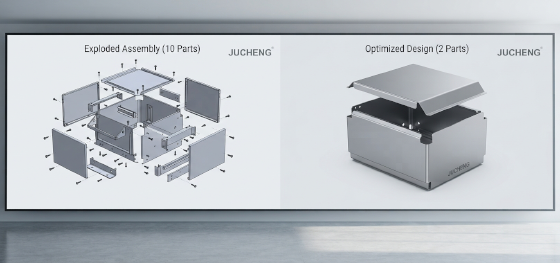
What is the fundamental difference between DFM and DFA in sheet metal engineering?
DFM (Design for Manufacturability) focuses on optimizing individual parts to simplify cutting and bending, while DFA (Design for Assembly) focuses on simplifying the physical joining of multiple parts.
To optimize your manufacturing budget, understanding these two complementary design disciplines is vital. While Design for Manufacturability (DFM) guidelines check for physical limitations like minimum bend radii or hole-to-edge clearances, DFA analyzes the broader supply chain assembly. It evaluates how easily different panels can be held, aligned, and fastened on the assembly floor.
An assembly modeled with perfect individual DFM parts can still fail in production if the joints require complex, slow welding or are physically inaccessible to standard riveting tools. Applying DFA principles ensures that the overall cabinet structure is easy to handle, weld, and rivet, reducing manual labor times and preventing cumulative tolerance stack-up errors.
Designing Self-Fixturing Features: Tabs and Slots
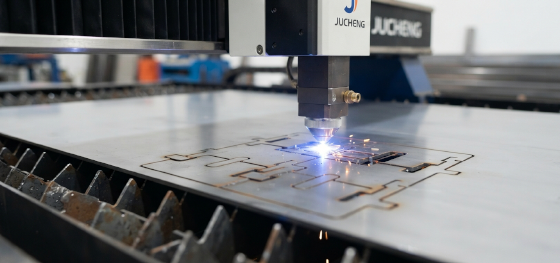
How do self-fixturing tab-and-slot features eliminate the need for expensive assembly jigs?
Designing interlocking tabs and slots directly on adjacent flanges allows parts to self-align during assembly, holding flat panels flush before welding or hardware pressing.
Manual alignment of multiple loose panels during welding is a major cost driver, requiring expensive custom fixtures to prevent structural twisting. To bypass these tooling costs, designers utilize tab-and-slot features. By cutting flat tabs on one panel and matching slots on the other, the parts physically interlock, ensuring 100% perpendicularity with zero external tooling.
Additionally, designing these self-aligning features acting as physical Poka-Yoke (mistake-proofing) guides is highly recommended. By making the tabs asymmetric or off-center, we prevent operators from accidentally assembling panels backward or upside down. This built-in mistake-proofing ensures high assembly precision, even during rapid, high-volume production runs.
Reducing Part Count and Standardizing Hardware
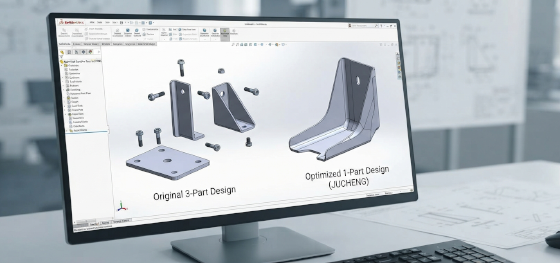
How does part count reduction and hardware standardization slash overall assembly expenses?
Reducing the total number of parts minimizes the required joint seams and processing steps, while standardizing hardware sizes eliminates frequent tool changes.
The ultimate goal of design for assembly is to minimize the total part count. If your chassis utilizes separate brackets bolted onto the main walls, you are paying for multiple laser-cutting, bending, and hardware insertion steps. Implementing a cohesive sheet metal design strategy allows us to execute part consolidation, combining multiple separate brackets into a single, folded sheet profile.
For the remaining joints, standardizing the required hardware is vital. If your design utilizes four different thread sizes (M3, M4, M5, and M6) on a single box-build, the operator must stop the insertion presses to reload different tooling sets for each specific thread. Standardizing on a single thread size allows us to press all fasteners in a single machine setup, slashing manual labor costs.
PEM Hardware Integration at Jucheng Precision
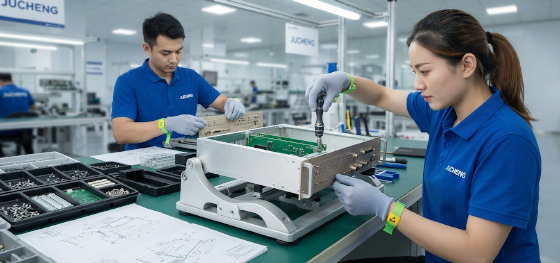
Sourcing high-precision custom enclosures requires a seamless transition from virtual CAD files to physical parts. Jucheng Precision operates multiple multi-axis lasers, automated press brakes, and clean assembly bays, allowing us to manage your entire project under a unified quality system certified to ISO 9001 and IATF 16949 standards. This integrated capability ensures that your complex box-builds are fabricated, coated, and assembled with extreme consistency and zero dimensional drift.
Our experienced engineering department provides a comprehensive manufacturability review, checking your drawings for weld accessibility and fastener clearances before we cut metal. We help you implement the principles of design for sheet metal assembly (DFA), ensuring that your parts align perfectly with our standard press tooling to prevent structural warping. Supported by our no MOQ policy and rapid delivery guarantee, we manage your project from initial flat pattern cutting to final, high-durability packaging during high-precision sheet metal fabrication cycles.
FAQ: Critical Questions About Design for Sheet Metal Assembly (DFA)
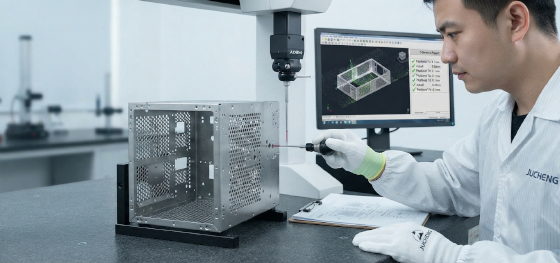
Our engineering team has compiled professional, concise solutions to the most common quality challenges faced during mechanical assembly runs:
What is the difference between DFM and DFA in sheet metal?
DFM (Design for Manufacturability) optimizes individual parts for easy cutting and bending, while DFA focuses on simplifying the physical assembly of multiple parts.How does a tab-and-slot design improve assembly precision?
It acts as an integrated alignment guide (Poka-Yoke), physically interlocking adjacent sheets before welding or riveting to prevent cumulative dimensional drift.Why is fastener standardization critical for reducing assembly labor?
Standardizing on a single screw thread size (such as M3 or M4) allows operators to use a single tool, eliminating time-consuming tool changes during assembly.How does Jucheng Precision help customers implement design for sheet metal assembly (DFA) rules?
Our technical team conducts full CAD DFM and DFA reviews, suggesting part consolidations and self-fixturing details to cut your actual manufacturing costs, backed by complete coordinate measuring machine (CMM) dimensional checks on every batch.

