


Your 3D printer has just finished a 12-hour print. The part looks perfect. You take it off the build plate. You apply a small amount of force to test it. And snap. It breaks cleanly in two, right along the layer lines.
This is the nightmare of every engineer who uses 3D printing for functional parts. It is a moment of deep frustration. It makes you question the value of the technology itself.
The problem is often not your design. The problem is a fundamental misunderstanding of what makes a 3D print strong. The search for the strongest 3d printer filament is not about a single material. It is about understanding the science of adhesion.
content:
The Engineer's Nightmare: A Snap in the Wrong Direction
The Real Secret to Strength: It's Not Just the Material
The Contenders: A Tour of Tough Filaments
The King of the Hill: Carbon Fiber Composites
Why Your Machine Matters More Than You Think
The Engineer's Nightmare: A Snap in the Wrong Direction
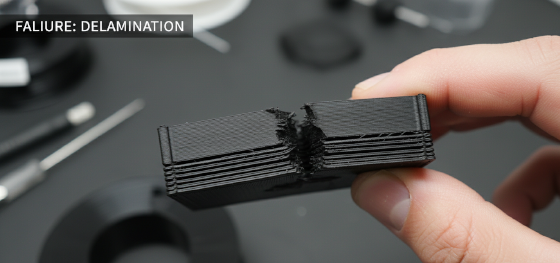
A 3D printed part has an inherent weakness. It is anisotropic. This means it has different strengths in different directions.
It is very strong along the direction of the printed lines (the X and Y axes). But it is much, much weaker between the layers (the Z axis). The bond between each layer is the weak link in the chain.
When a part snaps cleanly along the layer lines, this is called delamination. It means the layers did not fuse together properly. This is the most common failure mode. A truly "strong" filament is one that fights this weakness.
The Real Secret to Strength: It's Not Just the Material
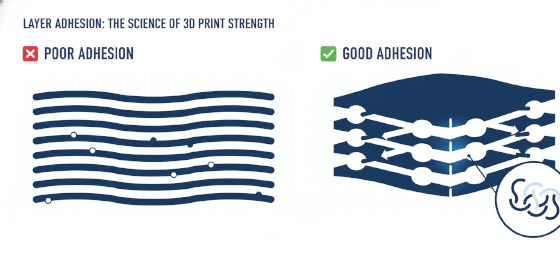
The secret to a strong print is "layer adhesion." This is a measure of how well each new layer of molten plastic melts and fuses with the layer below it.
Good layer adhesion creates a part that is more isotropic. More like a solid, injection-molded part. The layers are so well bonded that they almost disappear.
Poor layer adhesion creates a part that is like a stack of loose papers. It has no strength in the Z-axis.
So, the search for the strongest filament is actually a search for a filament with the best layer adhesion. It is also a search for the right process to unlock that adhesion.
The Contenders: A Tour of Tough Filaments

If we move beyond the common hobbyist plastics like PLA, we enter the world of engineering filaments.
PETG is a great starting point. It is a modified version of the same plastic used in water bottles. It has much better layer adhesion and is far tougher than standard PLA.
Nylon (PA) is another step up. It is an incredibly tough and durable material with excellent layer bonding. It creates parts that can bend and flex without breaking. However, it is very difficult to print. It absorbs moisture from the air and needs to be printed at very high temperatures.
Polycarbonate (PC) is even stronger and stiffer than Nylon. It can create very rigid, structural parts. But it is even more difficult to print, requiring extremely high temperatures and a heated enclosure.
At the very top are materials like PEEK and PEI (Ultem). These are ultra-performance polymers with incredible strength and heat resistance. They are among the strongest printable materials, but they require very expensive, specialized industrial machines.
The King of the Hill: Carbon Fiber Composites
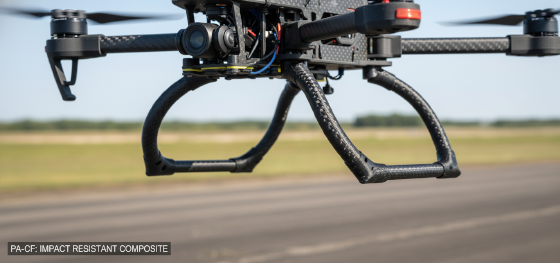
So what is the single strongest 3d printer filament for most functional applications? The answer is usually a composite.
These are special filaments where a tough base plastic, like Nylon, is filled with tiny, chopped carbon fibers. This creates a magical combination.
The Nylon provides the excellent layer adhesion and toughness. The carbon fibers provide incredible stiffness and strength. The fibers act like a rebar in concrete, reinforcing the part in all directions.
A part printed in Carbon Fiber Nylon (PA-CF) is extremely strong, very stiff, and surprisingly lightweight. It also has a beautiful, professional-looking matte black finish. This makes it the top choice for functional prototypes, jigs, fixtures, and even end-use parts in robotics, drones, and motorsports.
Why Your Machine Matters More Than You Think
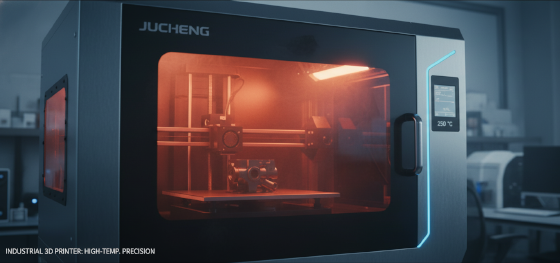
Choosing a strong filament is only half the battle. To unlock its strength, you need the right process.
All these engineering filaments need to be printed at very high temperatures. This is required to get a good melt and good layer fusion. A cheap, hobbyist printer cannot reach or maintain these temperatures reliably.
They also need a heated build chamber. This keeps the entire part warm during the printing process. It prevents the part from cooling down too quickly, which can cause warping and, most importantly, bad layer adhesion.
This is why working with a professional 3D printing service is so important for functional parts. At JUCHENG, we use industrial-grade machines. They have hardened steel nozzles for abrasive composite filaments. They have actively heated chambers for perfect layer bonding. We have the right tools and the right expertise to turn the strongest filaments into truly strong parts.

