


When a customer buys your product, they are not just buying an object. They are buying a promise. A promise that the product is safe. A promise that it is reliable. A promise that it will perform as expected, not just today, but for years to come.
For any product that generates heat, or operates in a hot environment, a huge part of that promise is held within its plastic components.
Choosing a heat resistant plastic material is not just a technical specification. It is a direct reflection of your brand's commitment to quality and safety. This guide explores the world of these critical polymers.
content:
The Promise You Make to Your Customer
Decoding 'Heat Resistance': More Than One Number
The Elite Group: High-Performance Polymers
The Manufacturing Challenge: A World of High Heat
Choosing a Partner, Not Just a Material
The Promise You Make to Your Customer
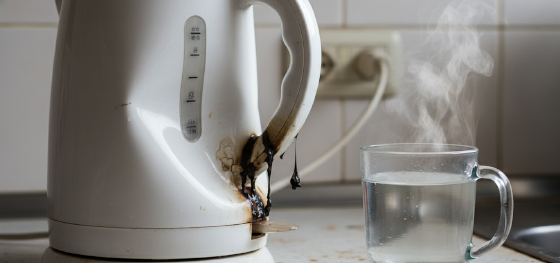
Imagine a high-end coffee machine. It is brewing coffee at nearly 100°C. The internal components are surrounded by hot water and steam.
If the internal structural parts are made from a standard plastic, like ABS, they will slowly soften, deform, and fail. A valve might stop sealing properly. A bracket might warp, causing a critical misalignment. The product fails. The brand's promise is broken.
In a worse-case scenario, like an electrical appliance, a failing plastic part can lead to a short circuit or even a fire. The consequences of choosing the wrong material can be catastrophic. Using a certified heat resistant plastic material is your first line of defense.
Decoding 'Heat Resistance': More Than One Number

When you look at a datasheet, "heat resistance" is not a single number. There are two key properties of plastic to understand.
The first is the Heat Deflection Temperature (HDT). This number tells you the temperature at which a plastic sample will start to deform under a specific load. It is a measure of short-term, structural performance at high temperatures.
The second, and often more important, number is the Continuous Use Temperature (CUT) or Relative Thermal Index (RTI). This number is determined by Underwriters Laboratories (UL). It tells you the maximum temperature the plastic can endure for its entire lifetime (often thousands of hours) without losing a significant amount of its properties.
A plastic's HDT might be 150°C, but its RTI might only be 120°C. For any product that is expected to last, the RTI is the number you must design to.
The Elite Group: High-Performance Polymers
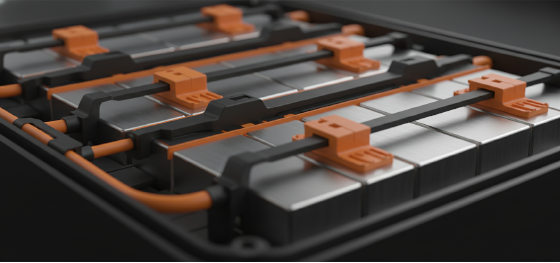
The world of heat resistant plastics is populated by an elite group of "super" polymers.
For very high-heat applications, materials like PEEK, PEI (Ultem), and PPS are the top choices. They can have continuous use temperatures well above 150°C, with some grades exceeding 220°C. They are incredibly strong and stable.
These are the materials you will find in the most demanding places. Inside an electric vehicle's battery pack, they are used to make high-voltage connectors and busbar holders. These parts must provide electrical insulation and maintain their structural integrity even if the battery overheats. Safety is the only priority.
Other materials, like glass-filled Nylon or high-temperature Polycarbonate, offer a good balance of heat resistance and cost for less extreme applications.
The Manufacturing Challenge: A World of High Heat
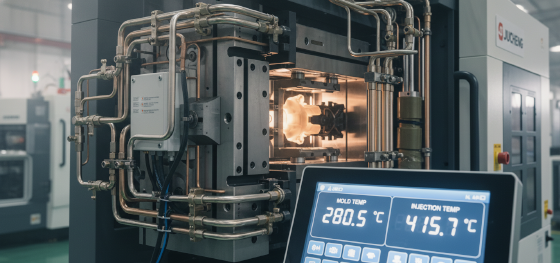
A plastic that can resist heat is also a plastic that is difficult to manufacture. This is a fundamental challenge.
To injection mold a heat resistant plastic material, you need to melt it. This requires very high processing temperatures. A standard molding machine cannot reach these temperatures.
More importantly, the mold itself must be heated to a very high temperature. This prevents the plastic from cooling too quickly as it is injected. This requires a specialized mold with complex heating channels, and a sophisticated temperature control system.
This is a highly specialized area of manufacturing. It requires the right equipment and deep process knowledge. Many manufacturers are simply not equipped to handle these materials.
Choosing a Partner, Not Just a Material

Choosing a heat resistant plastic is a critical first step. But it is only half the solution. You also need to choose a manufacturing partner who has proven expertise in working with these demanding materials.
How can you verify this expertise?
Ask them about their experience. Ask to see examples of high-temperature parts they have made. Ask them about their process control and their mold heating capabilities.
A true expert partner, like JUCHENG, can do more. We can help you navigate the complex world of material datasheets and UL certifications. We can help you select the most cost-effective material that meets your project's specific temperature requirements.
This partnership is your ultimate guarantee. It ensures that the promise of safety and reliability you make to your customers is built on a foundation of expert material selection and world-class manufacturing.

