


Scars are the unwritten history of a 3D build. In the professional arena of 3D printing post processing, the moment a component emerges from the machine is not the finish line—it is the start of a high-stakes surgical intervention. Whether it is a web of resin pins or a solid block of titanium anchors, support structure removal is the invisible phase that dictates the final utility of your hardware. A poorly executed extraction can turn a five-thousand-dollar aerospace housing into a piece of textured scrap. It is a process that demands a balance between raw force and microscopic delicacy, ensuring that the structural foundation that allowed the part to grow doesn't become the flaw that destroys its performance.
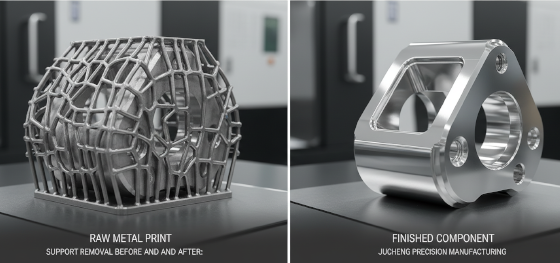
Jucheng Precision has re-engineered the post-processing lab to operate with the technical rigor of a cleanroom. we understand that for a medical implant or an automotive light pipe, the "support artifacts"—those tiny nubs and pitting marks left behind—are more than aesthetic issues; they are potential fatigue points and optical failures. By integrating specialized removal technologies like high-frequency Wire EDM and chemical dissolution baths into our production floor, we eliminate the variability of the human hand. This guide moves beyond the basics of "snapping off plastic" to explore the thermodynamic and mechanical realities of support extraction across the industrial spectrum, ensuring your designs transition from the build plate to the field with zero manufacturing fingerprints.
Profitability in additive manufacturing is often hidden in the labor hours of the finishing room. You can print a part in hours, but if it takes two days to clean, your ROI is dead. Let us break down the physical laws of material extraction and see how JUCHENG’s integrated finishing protocols protect the structural soul of your next-generation components.
Resin Removal: The Surgical Act of SLA and DLP Protocols
Breaking the Polymer Bond: FDM Breakaway vs. Soluble Options
Metal Gauntlet: Why DMLS Support is a Structural Challenge
Scars and Artifacts: Managing the Mechanical Contact Point
Hybrid Integration: Using CNC to Obliterate Support Footprints
Validation: Ensuring Surface Integrity and Dimensional Lock
Resin Removal: The Surgical Act of SLA and DLP Protocols
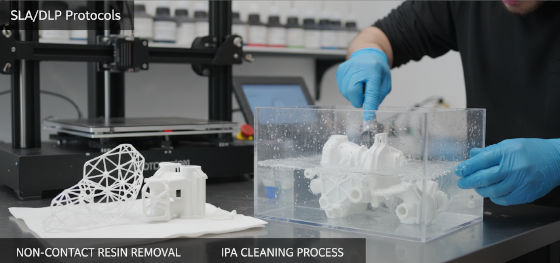
In the realm of light-cured photopolymers, support structure removal is a race against the "green state" window. When a part completes its build in an SLA vat, it is not yet fully cured. In this semi-solid state, the supports are designed to be thin and easily severed. However, the contact points are often mere microns in diameter. If a technician uses too much force, they can "crater" the part's skin, leaving a hole that no amount of sanding can repair.
JUCHENG technicians utilize a "Pre-Cure Extraction" protocol. We remove the supports while the resin is still malleable, using specialized micro-snips designed for jewelers. This minimizes the energy transfer into the main body of the part. Following the removal, the part undergoes an ultrasonic IPA bath to dissolve residual liquid, and then moves to a UV-curing chamber. This sequence is vital for optical clarity; if you cure the part with the supports still attached, the contact points will "bake" into the surface, creating permanent visual defects. By treating resin removal as a surgical procedure rather than a cleaning task, we ensure your clear lenses and high-detail housings maintain a surface integrity that is ready for high-end automotive or medical displays.
Breaking the Polymer Bond: FDM Breakaway vs. Soluble Options
FDM technology presents a dual-pathway for managing overhanging mass. The first is "Breakaway Support"—using the same material as the part but with a lower density infill. This is the fastest method, but it leaves the most aggressive artifacts. When you rip a PEEK or Ultem support away from a part, the "weld" between the scaffold and the skin must be physically broken. At JUCHENG, we utilize proprietary tool-path offsets to create a "Weakened Interface Layer," allowing the supports to snap off cleanly without the need for heavy prying.
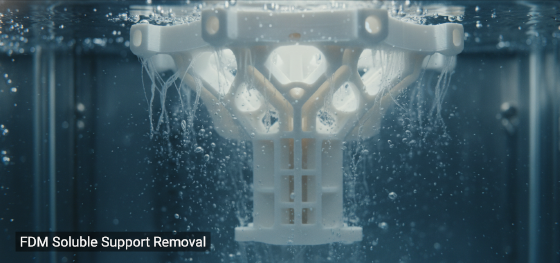
The second, and more advanced, pathway is "Soluble Support." By utilizing a dual-nozzle system, we can print the part in an industrial polymer like ASA and the scaffolding in a water-soluble or chemical-soluble resin. Support structure removal in this context is a passive event. The part is placed in a heated circulation tank where the solvent attacks the support material while leaving the part untouched. This is the only reliable way to clean internal labyrinths or intricate fluid manifolds that no mechanical tool can reach. We manage the chemical concentration and temperature of these baths with extreme rigor, ensuring that the part’s skin is never compromised by the dissolution process. This "Hands-Off" approach is the definitive solution for functional 3D printing post processing, delivering internal cavities that are as clean as they were in the CAD model.
Metal Gauntlet: Why DMLS Support is a Structural Challenge
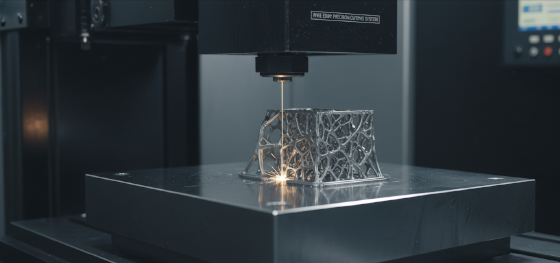
The most violent phase of 3D printing is found in the metal powder bed. In DMLS (Direct Metal Laser Sintering), the supports are not just propping up the part—they are acting as massive heat sinks that anchor the part to a thick steel build plate. These supports are 100% dense metal. Removing them is not a matter of a hand-tool; it is a matter of industrial equipment. Support structure removal for titanium or stainless steel is a technical gauntlet that separates job shops from integrated manufacturing centers.
At Jucheng Precision, we solve the metal extraction riddle through the integration of Wire EDM Machining. We utilize a high-precision molybdenum wire to saw the part off the build plate with zero mechanical stress. This prevents the "spring-back" warping that occurs when a part is hacked off with a manual band-saw. For the intricate supports inside a manifold, we utilize specialized internal grinding tools and 5-axis milling to "bore out" the metal scaffolding. We treat the removal of metal supports as a primary machining operation, ensuring that the thermal integrity of the alloy is maintained and the dimensional tolerances are locked in before the part enters the final inspection lab.
Scars and Artifacts: Managing the Mechanical Contact Point
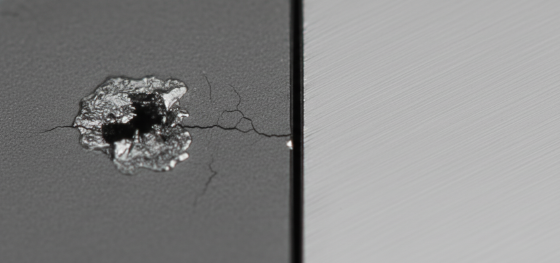
Every support point leaves a "witness mark." In high-fidelity manufacturing, managing these marks is where the artistry of the technician meets the precision of the machine. If a nub is left too high, the part won't fit; if it's sanded too low, the part is undersized. JUCHENG implements a "Staged Refinement" protocol. We don't just sand the surface; we re-engineer it.
First, we use automated bead-blasting to homogenize the surface texture, making the support zones less visible. For parts requiring aesthetic perfection, we move to a five-stage mechanical sanding process, progressing from 400 to 2000 grit. This eliminates the "artifact ghosting" that often plagues 3D printed parts. For industrial components, we utilize vibratory finishing to "break" the sharp edges where the supports were removed, ensuring every part is safe to the touch. By managing the contact point as a micron-scale feature, we deliver components that look and feel like they were cast or molded, providing the professional finish your brand identity requires.
Hybrid Integration: Using CNC to Obliterate Support Footprints
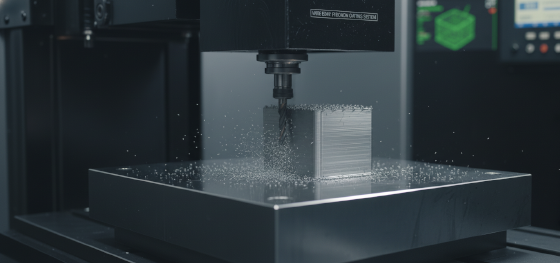
The ultimate strategy for eliminating support artifacts is the "Hybrid approach." Why sand a surface by hand for an hour when a 5-axis mill can refine it in five minutes? Jucheng Precision has optimized its 3D printing design logic to include "Post-Machining Allowances." We intentionally print an extra 1.0mm of material over the support zones of critical mating surfaces.
After the primary support structure removal, the part moves directly to our CNC department. We utilize our 5-axis centers to mill away the support footprints entirely, revealing a mirror-smooth surface with H7-level tolerances. This synergy between additive complexity and subtractive certainty is the definitive solution for aerospace flanges, medical mating plates, and high-performance automotive housings. We don't just "clean" the part; we machine it into a final engineered state. This integration removes the most expensive and variable part of the 3D printing cycle—the manual labor—replacing it with the predictable, documented accuracy of CNC technology.
Validation: Ensuring Surface Integrity and Dimensional Lock
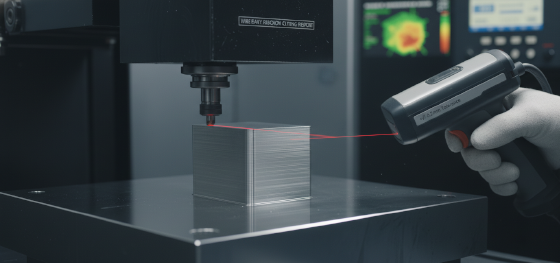
The final hallmark of a professional manufacturing partner is the audit of the extraction. You cannot manage what you do not verify. JUCHENG’s quality protocol includes a full "Surface Integrity Audit" after the supports are removed. We use non-contact 3D scanners to compare the finished part against the original STEP file, ensuring that the removal process hasn't induced any localized bowing or stress warping.
We also utilize surface roughness testers (Ra) to verify that the sanding or milling has reached the required finish level. For medical implants, we perform microscopic inspection at 40x magnification to ensure that zero support fragments or metallic dust remain in the crevices. This transparency is the cornerstone of our service to the global robotics and defense sectors. When you receive a shipment from JUCHENG, you aren't just getting 3D prints; you are getting verified engineered solutions that have been surgically refined for performance. We bridge the gap between a raw build and a functional masterpiece. Contact Jucheng Precision today for a technical DFM review and see how our support extraction protocols can stabilize and elevate your next manufacturing breakthrough.

