


The box arrives. Inside are the beautiful, complex parts from your 3D printing service. You take the two main components of your new robotic gripper. You try to assemble them. And they do not fit.
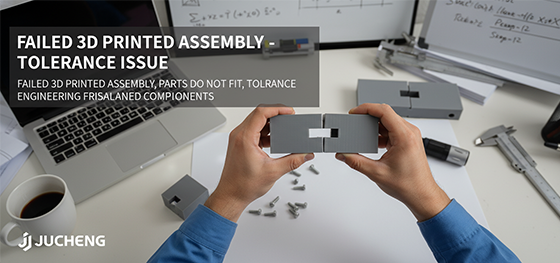
The pin is 0.1 millimeters too big for the hole. The two halves will not close properly. Your entire project comes to a halt. This is a failure of precision. This is a failure of tolerance.
Understanding 3D printing tolerances is one of the most critical and most misunderstood topics in modern manufacturing. This guide will act as your detective, investigating what tolerances are, what influences them, and how to design for a perfect fit.
Answering the Core Questions
Investigating the Variables: Why Tolerances Differ
Designing for a Perfect Fit
Proof of Precision: The Manufacturer's Role
Answering the Core Questions

Before we dive deep, let's answer the two most common questions engineers ask.
First, how much tolerance for 3d printing can be expected? For professional, Industrial 3D Printing, a typical tolerance is in the range of +/- 0.1mm to +/- 0.3mm for the first 25mm (1 inch). There is usually a smaller additional tolerance for each subsequent inch. This is a general rule, but it is a good starting point.
Second, what is a good tolerance for 3d printing? This is a trick question. The "best" tolerance is not always the tightest. The "best" tolerance is the one that is suitable for your part's function, and is achievable and affordable. For a high-precision SLA part, +/- 0.1mm is a very good and achievable tolerance. For a large FDM part, a wider tolerance might be perfectly acceptable.
A good design does not demand the tightest possible tolerance everywhere. It demands the right tolerance in the right places.
Investigating the Variables: Why Tolerances Differ

Why is there not one single number for 3D printing tolerance? Because it is not a fixed property. It is the result of many different variables.
The technology itself is the biggest variable. A process like SLA that uses a precise laser on a liquid is inherently more accurate than a process like FDM that extrudes a thick strand of molten plastic.
Heat is another major variable. Processes that use a lot of heat, like SLS, MJF, or metal printing, are subject to thermal expansion and contraction. As the part cools, it can shrink or warp slightly. An experienced manufacturer knows how to predict and compensate for this, but it still affects the final tolerance.
The part's design and orientation also play a huge role. A tall, thin wall is more likely to warp than a short, thick block. How the part is oriented on the build platform can affect the accuracy of its different features.
Finally, post-processing can affect tolerances. Heavy sanding or bead blasting can remove a small amount of material and slightly change dimensions.
Designing for a Perfect Fit

A smart engineer does not fight against these variables. They design with them in mind.
The most important technique is designing for clearance. This means deliberately leaving a small, calculated gap between parts that need to fit together.
For example, if you have a 10mm pin that needs to fit into a 10mm hole, it will be a very tight fit. If either part is off by just a tiny amount, it will not assemble. But if you design the hole to be 10.2mm, you have created a 0.2mm clearance. This small gap can absorb any minor inaccuracies from the printing process. It guarantees your parts will fit together.
Knowing how much clearance to design for is a key piece of engineering knowledge. It depends on the printing technology and the size of the part. This is where a good manufacturing partner can provide invaluable advice.
Proof of Precision: The Manufacturer's Role

How can you be sure the parts you receive meet the tolerances you need? You need a partner who treats precision as a science, not a guess.
A professional manufacturer does not just print your part. They have a rigorous quality control process. At JUCHENG, our process starts with DFM feedback to help you optimize your design for the best possible accuracy.
After the part is printed, our quality team gets to work. They use calibrated, high-precision tools like digital calipers, micrometers, and advanced CMMs to measure your part's critical features.
We can provide you with a full dimensional inspection report. This document shows your required dimension and our actual measured dimension, side-by-side. It is your objective proof that the part is made to spec.
This commitment to data-driven quality is what transforms 3D printing from a simple prototyping method into a true industrial manufacturing process. It is how we ensure that the parts you receive will always fit.

