


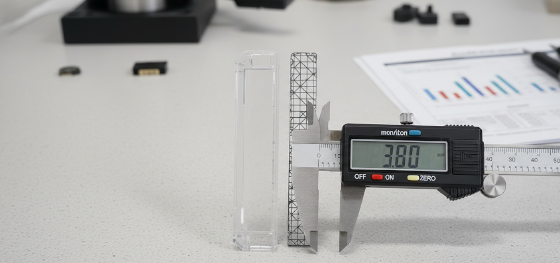
Miniaturization trends in consumer electronics and medical diagnostics represent a violent assault on traditional manufacturing limits. When a design engineer finalizes a CAD model for a high-performance drone frame or a wearable surgical sensor, the primary adversary is not structural failure, but the physics of solidification. In the high-velocity world of precision hardware, the thin wall injection molding process is a race against the "Thermal Clock." When wall thicknesses dip below 1.0mm, the molten polymer—acting as a thermal insulator—loses its energy almost instantly upon touching the chilled steel of the mold. If the cavity is not filled within a fraction of a second, the melt "freezes off," resulting in short shot injection molding and catastrophic batch rejection. Navigating this bottleneck requires more than just high pressure; it requires a specialized infrastructure of high-speed injection presses and surgical mold venting. Jucheng Precision operates as a high-fidelity manufacturing hub, providing the technical depth and specialized Injection molding process control needed to ensure your ultra-thin enclosures possess the mechanical spine and aesthetic soul required for market entry.
Establishing a stable thin-wall production run demands the rejection of "General Purpose" molding logic. Standard injection machines lack the acceleration and hydraulic response time to fill a 0.5mm wall before the polymer chains lock. Jucheng Precision eliminates these "Flow Hesitation" disasters by utilizing all-electric and hybrid presses equipped with nitrogen accumulators—high-pressure reservoirs that provide a momentary surge of energy to blast the melt into the cavity. This guide deconstructs the physics of the L/t ratio, the necessity of high-MFI resins, and why our "Flash-Free" tooling is the mandatory insurance policy for hardware innovators in the 2026 electronics market. We don't just "fill cavities"; we manage a thermodynamic event that occurs in the blink of an eye.
Flow Dynamics: Mastering the L/t Ratio Paradox
Mechanical Velocity: The Role of Nitrogen Accumulators
Atmospheric Integrity: Surgical Venting for High-Speed Air
Material Sovereignty: Choosing High-MFI Polymers
JUCHENG Protocol: Zero-Defect Thin-Wall Execution
Flow Dynamics: Mastering the L/t Ratio Paradox
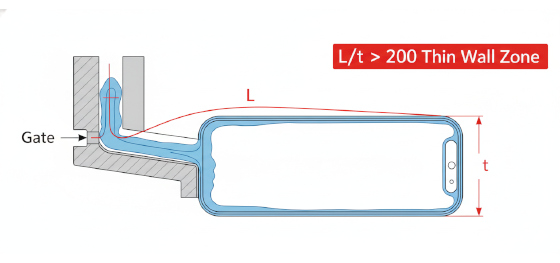
Mechanical feasibility in thin-wall design is governed by the "Length-to-Thickness" (L/t) ratio. This metric defines the maximum distance a molten polymer can travel (L) relative to the nominal wall thickness (t) before the pressure drop becomes insurmountable. In a standard Injection molding design, an L/t ratio under 150 is considered safe. However, the thin wall injection molding process frequently pushes this ratio beyond 250. When you design a 0.8mm wall that must span 200mm, you are essentially asking the plastic to behave like water under extreme stress. Jucheng Precision engineers utilize Moldflow simulation to map these "Flow Paths." If the L/t ratio exceeds the material’s physical limit, the melt front will stall, creating weak weld lines and air traps. We solve this through "Flow Leader" strategies and multi-gate configurations, effectively breaking down a long, impossible flow path into several smaller, manageable segments. We treat your geometry as a fluid dynamics puzzle, ensuring every corner of the part reaches 100% density before the first molecular bond freezes.
Mechanical Velocity: The Role of Nitrogen Accumulators
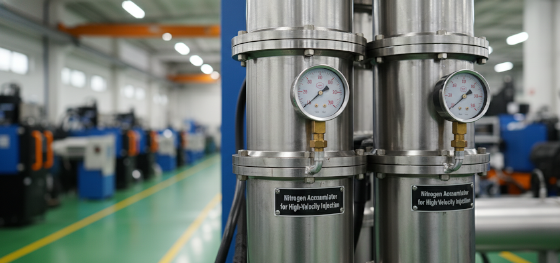
Injection velocity is the primary defense against premature solidification. In a thin wall injection molding process, the "Fill Time" is often measured in milliseconds. Standard hydraulic machines, which rely on the slow response of a pump, cannot reach peak velocity fast enough to outrun the cooling cycle. Jucheng Precision utilizes specialized high-speed presses equipped with hydraulic accumulators. These nitrogen-charged cylinders act as a "Shot of Adrenaline" for the machine, releasing a massive burst of energy that propels the injection screw at speeds exceeding 600mm/s. This allows us to fill a complex medical housing before the "Frozen Layer" of the plastic can choke off the flow. Below is the technical performance delta we observe when comparing standard molding to thin-wall molding:
| Process Variable | Standard Molding | Thin-Wall Molding (JUCHENG) |
|---|---|---|
| Injection Velocity | 50 - 150 mm/s | 300 - 800+ mm/s |
| Injection Pressure | 10,000 - 15,000 PSI | 22,000 - 35,000+ PSI |
| Fill Time | 1.0 - 3.0 Seconds | 0.1 - 0.5 Seconds |
Atmospheric Integrity: Surgical Venting for High-Speed Air
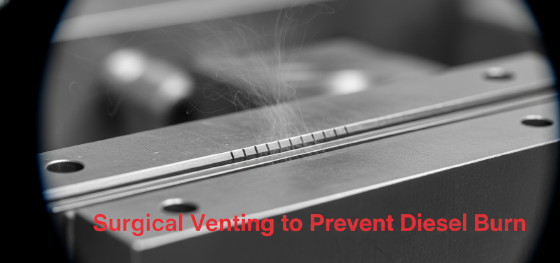
Atmospheric resistance becomes an explosive force at high velocities. When molten plastic enters a mold in 0.2 seconds, the air inside the cavity must be evacuated at the speed of sound. If the venting is insufficient, the air is compressed so violently that it ignites, resulting in injection molding burn marks—a phenomenon known as the "Diesel Effect." In a thin-walled enclosure, these burn marks are more than cosmetic; they represent a carbonized weak point that will crack under stress. Jucheng Precision toolmakers utilize "Surgical Venting" protocols, cutting micro-channels (often 0.015mm deep) at the end of every flow path and around every internal mounting boss. We utilize vacuum-assist venting for the most punishing geometries, physically sucking the air out of the cavity mere milliseconds before the plastic arrives. We don't just "inject resin"; we manage the atmosphere inside the steel to ensure your parts arrive pristine and structurally sovereign.
Material Sovereignty: Choosing High-MFI Polymers
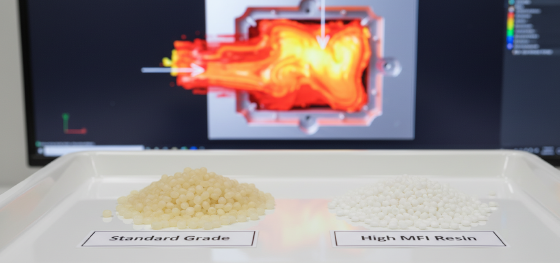
Rheology dictates the "Success Ceiling" of the thin wall injection molding process. Standard Injection molding materials often possess a molecular weight that is too high for thin-section travel. Jucheng Precision engineers act as your "Resin Navigators," steering projects toward materials with a high Melt Flow Index (MFI). For example, a standard ABS might have an MFI of 10, whereas a thin-wall grade ABS can reach 40 or higher. This lower viscosity reduces the internal pressure required to fill the part, effectively lowering the tonnage requirement and preventing Injection molding flash. We also analyze the "Crystallization Speed" of the resin; for thin walls, we need polymers that remain fluid long enough to pack out the features, but solidify instantly once the pressure is held. By matching the polymer chemistry to the high-velocity cycle, we ensure your prototypes possess the flexural modulus needed for ruggedized electronics without the manufacturing fragility of standard mockups.
JUCHENG Protocol: Zero-Defect Thin-Wall Execution

Engineering excellence at Jucheng Precision is built on the foundation of predictive metrology and rigid tooling. Because thin-wall molding requires extreme pressures (exceeding 25,000 PSI), the mold itself must be a fortress. Our facility, housing over 150 CNC machines and 25 high-precision 5-axis centers, is optimized for the aggressive machining of hardened H13 and S136 tool steels. We utilize extra-large support pillars and thicker mold plates to prevent "Mold Flex," which is the primary cause of dimensional drift in thin-walled components. When you upload a CAD file to our facility, our veteran engineers perform a comprehensive "L/t Audit" and Moldflow analysis. We identify the "Hot Spots" and "Pressure Gaps" that threaten your part's integrity before a single chip of steel is cut. Stop gambling your R&D budget on vendors who "hope" their machines are fast enough. Leverage our decade of high-velocity mastery to validate rapidly and scale profitably. Contact our technical team today for a free DFM review and see how we can turn your digital miniaturization intent into a structurally indestructible, thin-walled reality.

