


Hydrostatic crushing force represents the ultimate judge of deep-sea hardware integrity. When an autonomous underwater robot transitions from shallow-water monitoring to the "Abyssal Frontier"—depths exceeding four thousand meters—traditional alloys reach their physical breaking point. Standard 6061 aluminum collapses under the relentless pressure of six hundred atmospheres, while heavy stainless steel hulls become massive anchors that sacrifice mission endurance for structural survival. Navigating this requirement for extreme strength-to-weight ratios and absolute corrosion immunity requires the strategic deployment of Titanium CNC machining for subsea equipment. Jucheng Precision operates as a high-fidelity metallurgical sanctuary in the Shenzhen precision manufacturing hub, providing the 5-axis CNC depth needed to conquer the most challenging titanium alloys. Within the broader framework of AGV and AMR Parts and maritime robotics, we bridge the gap between "prototype exploration" and "abyssal sovereignty," ensuring your pressure hulls and thruster mounts survive where standard hardware implodes.
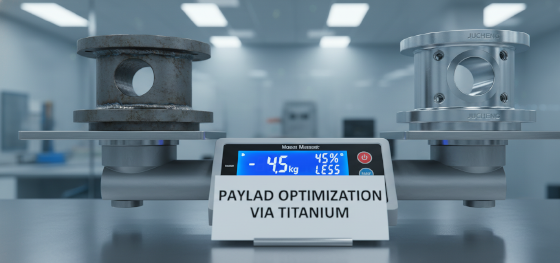
Establishing a resilient deep-sea supply chain in 2026 demands the rejection of "standard-speed" machining logic. Amateurs often treat titanium like a generic metal, unaware that its exceptionally low thermal conductivity acts as a heat-trap, instantly melting carbide cutters and work-hardening the part surface into a brittle, unusable mess. Jucheng Precision eliminates these "Metallurgical Disasters" by enforcing a strict "Cold-Cut" protocol across our 150+ CNC machine campus. Whether you are developing an ultra-deep sea ROV camera housing or a titanium battery pod, our facility provides the material science and metrological rigor required for global market entry. This guide deconstructs the necessity of Grade 5 alloy selection, the physics of thermal isolation during the cut, and why JUCHENG’s "Pressure Protocol" is the mandatory foundation for anyone developing Titanium CNC machining for subsea equipment projects for the abyss.
Grade 5 vs. Grade 2: Selecting alloys for structural pressure
Thermal Warfare: Managing heat in non-conductive alloys
Hermetic Glands: Machining seal faces to +/- 0.005mm
Zero-Coating Sovereignty: Why titanium ignores saltwater attack
JUCHENG Protocol: Tiodize and High-Pressure Metrology
Grade 5 vs. Grade 2: Selecting alloys for structural pressure
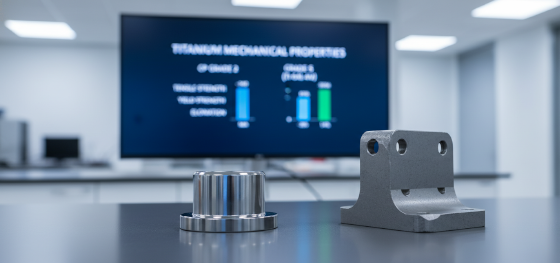
Molecular purity dictates the failure mode of your subsea hardware. For Titanium CNC machining for subsea equipment, the choice usually narrows to Commercially Pure (CP) Grade 2 or Titanium Grade 5 (Ti-6Al-4V). Grade 2 offers the absolute highest biocompatibility and corrosion resistance, making it ideal for non-structural sensor mounts and camera viewports. However, its yield strength (around 340 MPa) is insufficient for deep-sea pressure vessels. Jucheng Precision engineers mandate Titanium Grade 5 for all structural ROV frames and hulls. This "Alpha-Beta" alloy, infused with 6% Aluminum and 4% Vanadium, pushes the yield strength to an astonishing 880+ MPa. It provides the mechanical spine needed to resist the crushing force of the water column while slashing the part's weight by 45% compared to stainless steel. We navigate the "Strength-to-Purity" matrix to ensure your hardware is both light enough for neutral buoyancy and strong enough for abyssal survival.
Thermal Warfare: Managing heat in non-conductive alloys
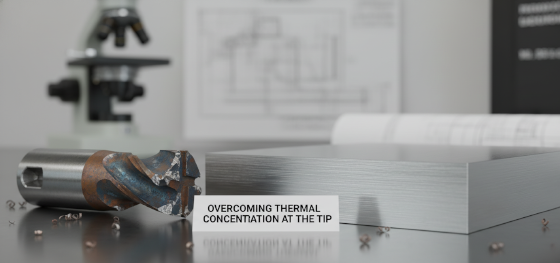
Mechanical friction becomes an explosive thermal risk when cutting titanium. Most metals are thermal conductors; they dissipate the heat of the CNC cut into the surrounding metal block. Titanium is a thermal insulator. It stubbornly concentrates 80% of the cutting heat directly at the tip of the tool. If an amateur shop runs the spindle at aluminum speeds, the temperature at the interface exceeds 800°C, instantly melting the carbide cutter and work-hardening the titanium surface. Titanium CNC machining for subsea equipment at Jucheng Precision is managed with "Thermodynamic Rigor." We utilize specialized positive-rake cutters and program high-feed toolpaths that physically "Peel" the metal away before the heat can accumulate. We turn "gummy material" into "surgical precision," ensuring your bearing seats and mounting flanges are machined with zero thermal distortion, maintaining the tight tolerances required for subsea actuators.
Hermetic Glands: Machining seal faces to +/- 0.005mm
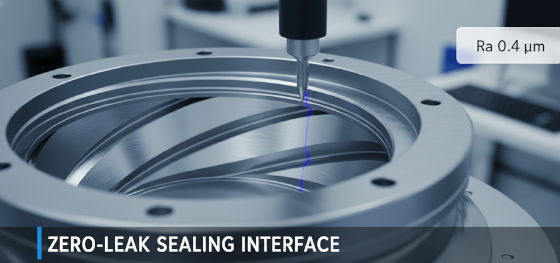
Manufacturing "Seam Discipline" remains the hallmark of the master ROV toolmaker. In deep-sea environments, the O-ring groove is the only boundary between operational success and an imploding robot. Titanium CNC machining for subsea equipment demands sub-micron accuracy on gland depth and width. If the titanium surface is too rough (Ra > 0.8 µm), the rubber O-ring cannot achieve 100% molecular contact, allowing water to "weep" into the vessel under extreme pressure. Jucheng Precision utilizes specialized burnishing passes to achieve an SPI B-1 or mirror finish (Ra < 0.4 µm) on all sealing faces. By maintaining tolerances of +/- 0.005mm on concentricity, we ensure your pressure hull remains a mathematically perfect arch, distributing the hydrostatic load evenly and effectively eradicating the risk of seal failure at depths exceeding 6,000 meters.
Zero-Coating Sovereignty: Why titanium ignores saltwater attack
Chemical indifference dictates the lifecycle ROI of subsea hardware. Stainless steel relies on a thin chromium-oxide layer for defense, but it can still suffer from crevice corrosion in tight assembly gaps. Titanium possesses a "Self-Healing" oxide skin that is far more stable in chloride-rich environments. For Titanium CNC machining for subsea equipment, this means zero secondary painting or galvanizing is required. Jucheng Precision advocates for titanium in high-stakes maritime projects because it eliminates the risk of "Coating Failure"—where a scratch in a painted surface leads to rapid local corrosion. Your titanium ROV frame can stay in the water for years with zero maintenance. We turn "high initial material cost" into "zero lifelong maintenance debt," providing the financial insurance needed for multi-year oceanic deployments.
JUCHENG Protocol: Tiodize and High-Pressure Metrology
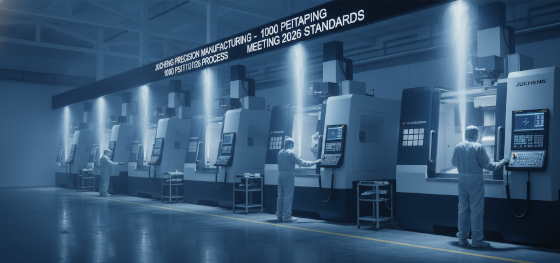
Manufacturing excellence at Jucheng Precision is built on the foundation of specialized industrial equipment. We house elite 5-axis CNC centers equipped with 1,000 PSI high-pressure through-spindle coolant (TSC) systems specifically for Titanium CNC machining for subsea equipment. This hydraulic force shatters the vapor barrier at the tool tip, instantly quenching the cut and flushing away hot chips to prevent surface galling. We provide full material lot traceability and CMM inspection reports for every batch, providing the "Paper Trail of Quality" required for naval and high-stakes research contracts. Stop gambling your abyssal mission on vendors who treat titanium like standard steel. Leverage our decade of high-performance metallurgical mastery to validate rapidly and launch profitably. Contact our technical team today for a free DFM review.
FAQ
Q: Why is Grade 5 titanium used for underwater robot hulls?
A: Grade 5 offers a yield strength (880 MPa) comparable to high-strength steels but at 45% less weight, providing the buoyancy advantage required for deep-sea ROVs.
Q: How does JUCHENG prevent "Galling" in titanium threads?
A: We offer specialized Tiodize (Type II Anodize) surface treatments and dry-film lubricants that increase surface lubricity, ensuring titanium screws and mounting ports don't weld together during assembly.
Q: What is the lead time for a titanium pressure pod?
A: Utilizing our expedited 5-axis CNC workflow, Jucheng Precision can deliver fully machined and tested titanium ROV enclosures in as fast as 12 to 15 business days.

