


Hermetic integrity represents the final frontier of mechanical failure in subsea engineering. When an autonomous underwater robot descends past one thousand meters, the physical interface between its internal electronics and the crushing weight of the ocean is reduced to a single microscopic boundary: the O-ring seal. If the geometry of the gland is even slightly off-center or if the surface finish allows for a hair-thin leak path, the resulting ingress of saltwater will instantly incinerate the logic boards of a $200,000 ROV. Navigating this requirement for zero-leak performance requires the strategic deployment of Machining O-ring grooves for watertight seals. Jucheng Precision operates as a high-fidelity subtractive sanctuary in the Shenzhen precision manufacturing hub, providing the technical depth to deliver glands and ports that possess the mechanical spine to survive where standard hardware collapses. We don't just "cut grooves"; we engineer atmospheric barriers that ensure your maritime fleet maintains its structural sovereignty through years of service in the abyss.
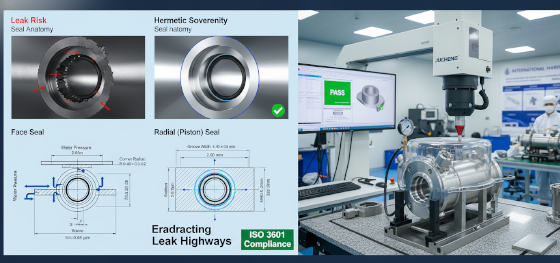
Establishing a resilient deep-sea supply chain in 2026 demands the absolute rejection of "visual-only" inspection. Amateurs often treat an O-ring groove as a simple aesthetic feature, unaware that microscopic tool marks (rhythmic ridges left by a CNC cutter) act as "Leak Highways" for high-pressure water molecules. Jucheng Precision eliminates these "System Failures" by enforcing a strict "Metrology-First" protocol for every sealing surface. We utilize specialized diamond-tipped tooling and multi-stage polishing to achieve the mirror-like finishes required by ISO and Parker Hannifin standards. Whether you are developing a micro-AUV for environmental monitoring or a work-class ROV for subsea cable repair, our integrated facility provides the material science and metrological rigor required for global market entry. This guide deconstructs the anatomy of face and radial seals, the physics of Ra 0.4 surface energy, and why JUCHENG’s "Zero-Scratch" protocol is the mandatory foundation for anyone developing Machining O-ring grooves for watertight seals.
Seal Anatomy: Face Seals vs. Radial Gland Logic
ISO Standards: Mastering Critical Gland Tolerances
Surface Energy: The Mandatory Ra 0.4 Finish
JUCHENG Protocol: Proving the Seal via Profilometry
FAQ
Seal Anatomy: Face Seals vs. Radial Gland Logic

Mechanical sealing logic is dictated by the direction of the hydrostatic load. In Machining O-ring grooves for watertight seals, engineers must first decide between a "Face Seal" and a "Radial Seal." A Face Seal occurs when the O-ring is compressed between two flat plates, such as an ROV end-cap and the main pressure hull. This configuration is easier to machine but requires high-torque fasteners to maintain compression. A Radial Seal, conversely, occurs when the O-ring is compressed between the inner and outer diameters of two concentric cylinders. Jucheng Precision engineers prioritize radial seals for deep-sea applications because the water pressure itself assists the seal; as the robot descends, the external pressure forces the rubber O-ring deeper into the corner of the gland, increasing the sealing force. We don't just "cut pockets"; we engineer the pressure-response of the polymer, ensuring your underwater robot remains watertight through the most aggressive thermal and pressure cycles.
ISO Standards: Mastering Critical Gland Tolerances

Dimensional sovereignty in gland design is governed by "Percent Compression." If an O-ring is under-compressed, it will leak; if over-compressed, the rubber will "extrude" and tear under pressure. Successful Machining O-ring grooves for watertight seals requires strict adherence to ISO 3601 or Parker Hannifin aerospace standards. Jucheng Precision achieves +/- 0.01mm tolerances on groove depth and width, ensuring the O-ring has sufficient "Void Space" (typically 75% to 90% gland fill) to expand as it absorbs thermal energy or internal fluids. We pay obsessive attention to the "Corner Radii" at the base of the groove. If these corners are too sharp, they act as stress-risers that can trigger a hull implosion. If they are too large, they prevent the O-ring from seating correctly. We turn "simple grooves" into "certified mechanical joints," documented for survival in the harshest Low Volume Injection Molding and CNC environments.
Surface Energy: The Mandatory Ra 0.4 Finish

Molecular pathways for water ingress are eradicated through surface energy management. Even a perfectly sized groove will fail if the surface roughness (Ra) is too high. Microscopic peaks and valleys left by the CNC cutter create a "rhythmic leakage" path where water molecules can migrate past the rubber barrier under the extreme pressure of the abyss. For Machining O-ring grooves for watertight seals, Jucheng Precision mandates a surface finish of Ra 0.4 µm (16 µin) to 0.8 µm (32 µin) on all sealing faces. We achieve this by utilizing specialized "burnishing" tools and precision multi-axis CNC passes. We don't just "polish metal"; we flatten the topography of the tool steel or aluminum to a level where the rubber O-ring can achieve 100% molecular contact. This surgical care is what prevents the "slow weep" that destroys expensive internal inertial navigation systems over months of multi-mission deployment.
JUCHENG Protocol: Proving the Seal via Profilometry

Manufacturing excellence at Jucheng Precision is built on the foundation of the documented audit. We don't believe a seal is "good enough" until we prove it with spectral data. Our quality control lab utilize digital profilometers to scan the bottom and side walls of every critical O-ring gland. We provide full material lot traceability and dimensional inspection reports for every ROV pressure vessel machining batch, ensuring your project meets the strict requirements of naval and research auditors. Stop gambling your mission’s success on uncertified shops that treat sealing faces like standard hardware. Leverage our decade of high-performance replication mastery to validate rapidly and launch profitably. Contact our technical team today for a free DFM review and see how we can turn your digital underwater intent into a structurally sovereign, zero-leak physical reality.
FAQ
Q: What is the best material for watertight O-ring grooves?
A: For permanent subsea use, 316L Stainless Steel or Titanium are best as they resist the corrosion that could pit the sealing surface. Aluminum 7075 is a high-strength alternative for prototype robot programs.
Q: Can JUCHENG machine grooves on curved 3D surfaces?
A: Yes. Utilizing simultaneous 5-axis CNC machining, we can carve precision O-ring grooves that wind across complex 3D contours while maintaining a constant depth and Ra finish relative to the surface.
Q: How do you verify the seal before shipping?
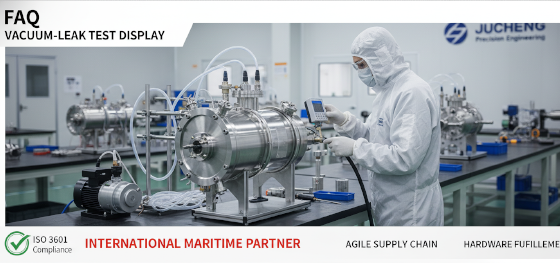
A: We offer in-house vacuum decay testing and hydrostatic pressure testing to verify that the machining o-ring grooves for watertight seals has resulted in a zero-leak assembly.

