


Molecular survival in the open ocean is a battle against the relentless assault of chloride ions. For subsea engineers in 2026, the transition from a digital CAD file to an operational underwater robot frame represents a high-stakes choice between industrial longevity and rapid corrosion failure. While standard 304 stainless steel is sufficient for domestic environments, it quickly succumbs to "Pitting Corrosion"—microscopic caverns of rust that compromise structural integrity—when exposed to the chemical hostility of saltwater. Navigating this requirement for rust-proof, high-mass hardware requires the strategic deployment of Marine grade 316L stainless steel machining. Jucheng Precision operates as a high-fidelity metallurgical sanctuary in the Shenzhen precision manufacturing hub, providing the technical depth to deliver frames, connectors, and thruster housings that possess the chemical spine needed for multi-year subsea service. We don't just "cut steel"; we engineer a molecular defense system that ensures your maritime fleet maintain its dimensional and aesthetic sovereignty throughout its entire mission lifecycle.
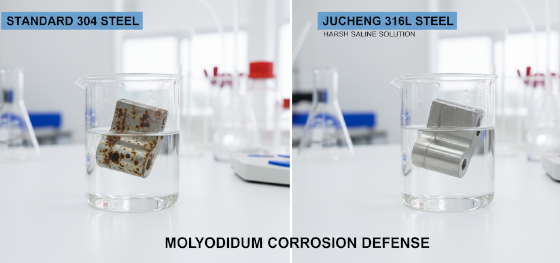
Establishing a resilient deep-sea supply chain demands the absolute rejection of "commodity" machining protocols. Amateurs often treat 316L like standard carbon steel, unaware that its high ductility leads to aggressive "Work-Hardening" ahead of the cutting tool, resulting in snapped end-mills and distorted geometries. Jucheng Precision eliminates these "Mechanical Disasters" by enforcing a strict "Heavy-Chip" machining philosophy across our 150+ CNC machine campus. Whether you are developing a micro-ROV for environmental monitoring or a heavy-duty subsea winch, our facility provides the material science and metrological rigor required for 2026 market entry. This guide deconstructs the necessity of Molybdenum integration, the physics of work-hardening management, and why JUCHENG’s "Passivation Protocol" is the mandatory foundation for anyone developing Marine grade 316L stainless steel machining projects for the global abyss.
Why is Molybdenum the secret to saltwater corrosion defense?
How to overcome the work-hardening effect in 316L CNC milling?
Why is passivation a mandatory step for subsea stainless parts?
The JUCHENG Angle: Delivering turnkey, dive-ready 316L components.
FAQ
Why is Molybdenum the secret to saltwater corrosion defense?
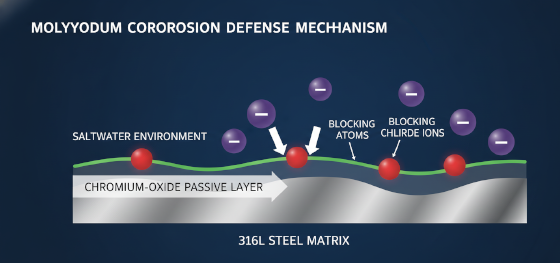
Chemical sovereignty in a brine environment is earned through a 2% metallurgical addition. The "L" in 316L indicates "Low Carbon" (maximum 0.03%), which prevents carbide precipitation during welding and reduces intergranular corrosion. However, the primary advantage for underwater robot hardware is the inclusion of Molybdenum. In standard 304 steel, chloride ions from the ocean attack the protective chromium-oxide layer, leading to localized "pitting"—deep, vertical holes that can penetrate a pressure hull. Molybdenum acts as a molecular stabilizer, reinforcing the passive film and making it exponentially more resilient to chloride-induced breakdown. Jucheng Precision engineers mandate 316L for all structural subsea frames and connector shells. We don't just "cut metal"; we provide the chemical armor needed to ensure your fluidic manifolds and sensor ports remain permanently inert, preventing the structural degradation that kills long-term maritime deployments.
How to overcome the work-hardening effect in 316L CNC milling?

Subtractive perfection in austenitic stainless steel requires the mastery of chip load and heat evacuation. 316L is notoriously "sticky" and heat-retaining. As a CNC tool engages the metal, the localized pressure and friction instantly alter the crystal structure of the steel surface, making it significantly harder than the virgin material below. If the cutter "rubs" or dwells even for a millisecond, the next pass will strike this work-hardened zone, leading to tool chatter, dimension drift, and catastrophic cutter fracture. Jucheng Precision eliminates this "Mechanical Rebellion" by utilizing high-torque, rigid 5-axis machines and specialized positive-rake carbide tooling. We program toolpaths that maintain a heavy, constant chip load—ensuring the cutter physically bites *underneath* the work-hardened skin from the previous pass. We couple this with 1,000 PSI through-spindle coolant to instantly quench the cutting zone, delivering sub-micron concentricity for your Marine grade 316L stainless steel machining projects.
Why is passivation a mandatory step for subsea stainless parts?

Manufacturing inherently compromises the natural rust-defense of the alloy. As the carbide tool cuts the 316L billet, it invariably deposits microscopic particles of "free iron" from the tool or the coolant system onto the surface of the part. In a saltwater environment, this free iron acts as a corrosion initiator, causing the "stainless" steel to develop unsightly brown rust spots within days. Professional Marine grade 316L stainless steel machining at Jucheng Precision is never complete without an in-house chemical passivation cycle. Following ASTM A967 standards, we submerge your parts in a controlled nitric or citric acid bath. This acid dissolves the free iron without attacking the base metal, while simultaneously accelerating the formation of an impenetrable chromium-molybdenum oxide layer. We turn "machined components" into "dive-ready assets," providing the documented proof of chemical stability your naval or research clients demand.
The JUCHENG Angle: Delivering turnkey, dive-ready 316L components.
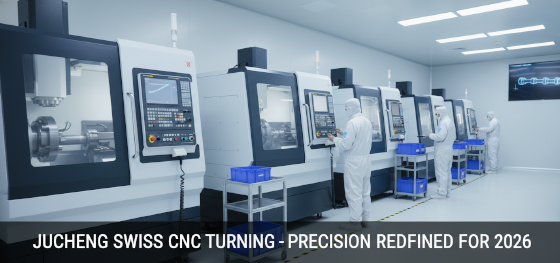
Engineering excellence at Jucheng Precision is built on the foundation of single-source accountability. We don't believe you should manage one vendor for your 316L machining and another for the critical chemical finishing. Our facility, housing elite 5-axis CNC centers and specialized passivation labs, is optimized for the high-requirement maritime sector. When you upload a CAD file to our facility, our veteran engineers perform a comprehensive "Saline Defense Audit." We suggest material switch-outs and suggest Ra 0.4 µm polishing on all sealing surfaces to prevent the "slow weep" that destroys internal sensors. We provide full material lot traceability and CMM dimensional inspection reports for every batch, providing the "Paper Trail of Quality" required for deep-sea research and offshore contracts. Stop gambling your mission’s success on uncertified job shops that ignore the chemistry of the cut. Leverage our decade of Marine grade 316L stainless steel machining mastery to validate rapidly and launch profitably.
FAQ
Q: Is 316L better than 304 for underwater robotics?
A: Yes. 316L contains 2-3% Molybdenum, which provides critical resistance to pitting and crevice corrosion in chloride-rich environments like seawater, whereas 304 will rust rapidly.
Q: Can JUCHENG achieve mirror finishes on 316L parts?
A: Absolutely. Utilizing multi-stage abrasive polishing and electropolishing, we can achieve surface roughness levels of Ra 0.2 µm or better, which is vital for O-ring sealing and biofouling resistance.
Q: What is the lead time for a prototype 316L ROV frame?
A: Utilizing our expedited 5-axis CNC workflow and in-house passivation, Jucheng Precision can deliver a fully finished 316L structural frame in as fast as 10 to 14 business days.
Q: Does JUCHENG provide Material Test Reports (MTR)?
A: Yes. Every batch of Marine grade 316L stainless steel machining is accompanied by a full MTR documenting the heat lot number and chemical composition of the raw steel used.

