


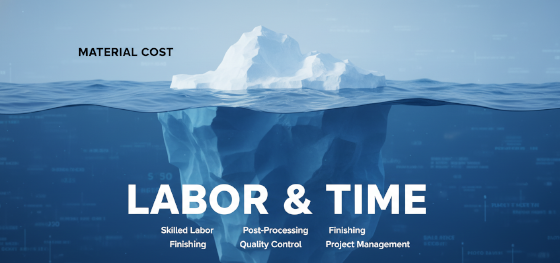
Procurement teams often scrutinize the urethane casting part price with a skepticism born from mass production logic. If an injection-molded ABS housing costs $1.50, why does the exact same geometry cast in polyurethane cost $45.00? This disparity exists because vacuum casting is not a manufacturing commodity; it is a time-intensive service. When you purchase a cast part, you are not merely paying for the petrochemicals; you are renting the hands of a skilled artisan and the operational time of a vacuum chamber. Unlike 3D printing, which runs unattended overnight, casting requires constant human intervention. From the moment the silicone mold is preheated to the final extraction of the cured unit, a technician is actively managing the physics of the process. Understanding this "Labor-to-Material Ratio" is the only way to accurately forecast your prototyping budget.
Resin Economics: Liquid Engineering vs Pellets
Manual Craftsmanship: Why Casting isn't Automated
Finishing Premium: The Cost of Aesthetics
Batch Efficiency: Optimizing the Oven Cycle
JUCHENG Value: Pricing for Performance
Resin Economics: Liquid Engineering vs Pellets
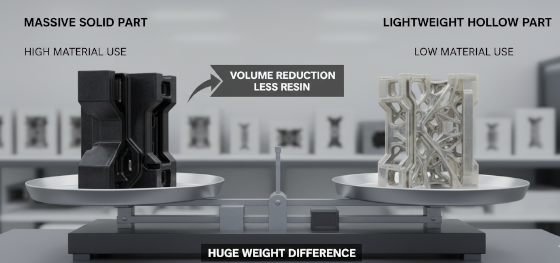
Raw material costs in vacuum casting are significantly higher than in injection molding. Thermoplastic pellets used in steel molds are produced by the ton and cost pennies. Specialized polyurethane resins, such as Hei-Cast or Axson, are engineered two-part chemical systems sold in small batches. These liquids are formulated to simulate specific mechanical properties—high heat deflection, optical clarity, or rubber-like elasticity—without the need for high pressure. Consequently, the base price per gram of a high-performance casting resin can be twenty times higher than generic ABS pellets.
Volume dictates the baseline. A heavy, solid block component consumes a massive amount of this expensive liquid, driving the unit price up purely on material weight. Smart engineers reduce costs here by "coring out" thick sections or designing hollow parts, which minimizes resin consumption. However, for small precision parts, the material cost is negligible compared to the labor required to process it.
Manual Craftsmanship: Why Casting isn't Automated

Automation is virtually non-existent in the casting room. Every single unit requires a technician to manually tape the mold, mix the A and B components in a vacuum chamber, control the degassing cycle, and pour the liquid into the funnel. Once poured, the mold must be moved to a heating oven to cure for 45 minutes to 4 hours, depending on the resin chemistry.
Demolding is equally labor-intensive. The technician must carefully pry open the silicone block, extract the part without tearing the delicate mold features, and manually trim the feed gates and vents. This is not a "push button" operation; it is a sequence of skilled manual tasks. The urethane casting part price reflects these billable hours. Complex parts with multiple inserts or delicate undercuts require even more care, further increasing the labor component of the final price.
Finishing Premium: The Cost of Aesthetics
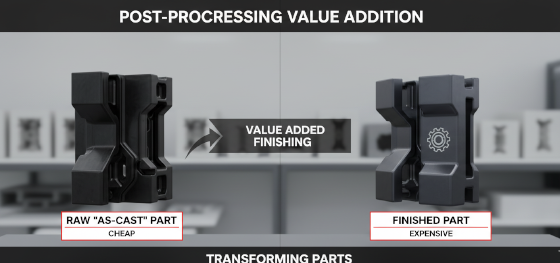
"As-cast" parts are rarely the final deliverable. Most clients demand a cosmetic appearance that mimics a production unit. This introduces the "Finishing Premium." If your specification calls for a specific Pantone color match, we must mix custom pigments or apply a high-quality spray paint in our booth. If you need a "Soft-Touch" rubberized feel or a heavy texture, we apply specialized coatings.
Logos and branding add another layer. Silk-screening a company logo or laser-etching a serial number are separate manual operations that occur after the part is cast. Installing brass threaded inserts for assembly requires heat-staking them one by one. Each of these value-added steps increases the unit price but saves you the immense cost of setting up a dedicated finishing line in your own facility.
Batch Efficiency: Optimizing the Oven Cycle

Quantity is the lever that controls cost. Ordering a single cast part is the most expensive way to buy. We have to set up the vacuum machine, mix the resin, and run the heating oven for just one unit. However, if you order twenty units, we can optimize the workflow. We can pour multiple molds simultaneously and cure them in the same oven cycle. The technician's setup time is amortized across the entire batch.
This "Batch Efficiency" explains why the first part might cost $100, but the twentieth part only costs $30. Jucheng Precision actively encourages batch ordering. By consolidating your prototype needs into a single run of 20-50 units, you unlock significant labor efficiencies that drive the per-unit price down closer to production levels.
JUCHENG Value: Pricing for Performance
We do not offer the cheapest plastic on the market; we offer the most accurate simulation of your final product. Jucheng Precision prices our casting services based on a transparent calculation of material volume, labor hours, and finishing requirements. We employ veteran technicians who minimize scrap rates and maximize mold life, passing those savings directly to you. When you see our quote, understand that you are investing in a process that guarantees your prototype will function, fit, and feel exactly like the mass-produced version, de-risking your entire product launch.

