


Budget meetings for hardware projects often end with a directive to "slash twenty percent" without reducing the feature set. When staring at a quote for fifty polyurethane prototypes, the sticker price can feel immovable. However, the price of a vacuum casting project is not fixed; it is a direct reflection of your design's complexity and your ordering strategy. Most engineers unknowingly inflate their own vacuum casting cost by requesting unnecessary cosmetic finishes, ignoring the lifespan limits of silicone tooling, or designing features that require hours of manual mold surgery. Reducing this cost does not require switching to a cheaper, inferior vendor. It requires applying "Financial DFM" (Design for Manufacturing). By understanding the physical limitations of the casting process, you can make minor adjustments to your CAD file and your procurement schedule that instantly strip away wasted capital. Here are five proven strategies to lower your invoice while keeping the quality high.
Strategy 1: The 'Bring Your Own Master' Approach
Strategy 2: The "20-Shot" Ordering Rule
Strategy 3: Eliminating Expensive Undercuts
Strategy 4: Standardizing Cosmetic Requirements
JUCHENG Advisory: We Engineer the Savings
Strategy 1: The 'Bring Your Own Master' Approach
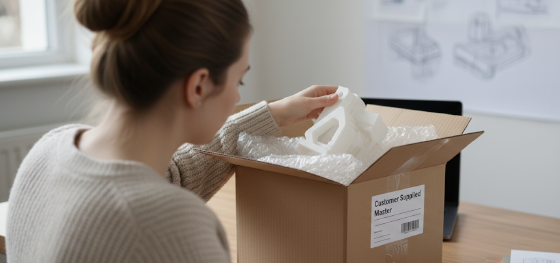
A significant portion of your NRE (Non-Recurring Engineering) fee goes toward creating the master pattern. If your facility already owns a high-resolution SLA 3D printer (like a Formlabs or 3D Systems machine), you are sitting on a cost-saving asset. Instead of paying Jucheng Precision to CNC machine or print the master, you can fabricate it yourself.
This requires strict discipline. The master you ship to us must be polished to the exact surface finish you desire on the final parts, as the silicone will copy every layer line you fail to sand. However, if you have the internal labor to prep the part, shipping us a "Ready-to-Pour" master can instantly shave $200 to $500 off your total project cost. This is the single most effective way to learn how to reduce vacuum casting cost without altering the design itself.
Strategy 2: The "20-Shot" Ordering Rule
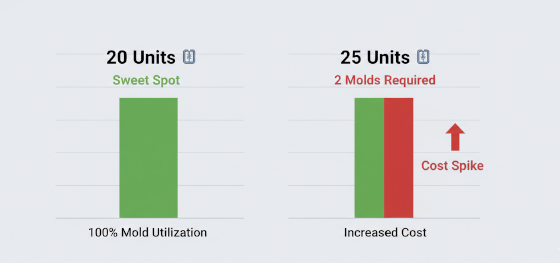
Silicone molds have a biological clock. A standard mold is viable for approximately 20 to 25 shots before the surface degrades. Understanding this lifespan allows you to game the system. If you order 25 parts, you are maximizing the utility of a single mold. Your amortization is perfect.
However, if you order 30 parts, you trigger a financial penalty. That extra 5 parts forces us to build a *second* silicone mold, which we will only use for 5 shots before discarding. You are paying full price for a tool that is 80% wasted. Smart procurement managers align their quantities with the mold life. If you need 30, consider ordering 25 now and waiting, or pushing the order to 50 to justify the second mold. Always ask your JUCHENG engineer: "What is the max shot count for this geometry?" and adjust your PO quantity to match that number exactly.
Strategy 3: Eliminating Expensive Undercuts
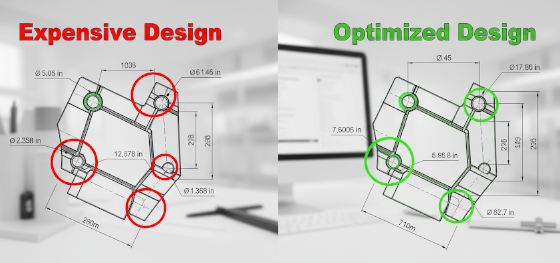
Complexity is billable hours. In silicone molding, deep undercuts and side-actions require the mold maker to hand-cut complex, zigzagging parting lines or create loose cores that must be manually inserted for every cycle. This increases the labor time for demolding from five minutes to twenty minutes, drastically raising the unit price.
Review your CAD file for "Lazy Geometry." Can that side-hole be moved to the top face? Can that deep snap-fit be redesigned as a simple rib? By modifying the design to allow for a simple "Open-and-Shut" mold pull, you eliminate hours of skilled manual labor. Simplification does not mean making the part look cheap; it means making the part smart. A simpler mold is a cheaper mold, and often a more durable one.
Strategy 4: Standardizing Cosmetic Requirements
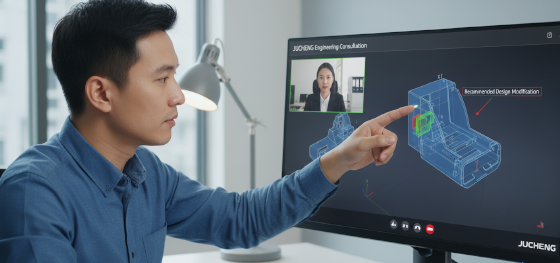
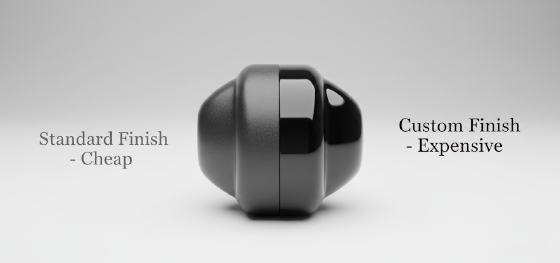
Over-specification is a budget killer. Engineers often copy-paste "SPI A2 Gloss" or "VDI 34 Texture" onto every surface of the drawing, including internal ribs and hidden mounting bosses. Achieving a high gloss requires hours of hand-polishing the master pattern. Achieving a specific texture requires bead blasting or applying expensive mold-tech skins.
Be ruthless with your cosmetic callouts. Mark all non-visible internal surfaces as "As-Cast" or "Standard Machine Finish." Only pay for premium finishing on the "A-Side" surfaces that the customer will actually touch and see. Furthermore, unless a specific Pantone color is critical for brand identity, choosing a standard "Black" or "Natural" resin eliminates the labor of color matching and painting, dropping your unit cost by another 10-15%.
JUCHENG Advisory: We Engineer the Savings
We do not simply quote your files; we interrogate them. When you upload a design to Jucheng Precision, our engineering team actively looks for opportunities to save you money. We will flag the undercut that is costing you an extra $200. We will alert you that your quantity of 26 is inefficient. We act as your manufacturing consultants, helping you trim the fat from your project without cutting into the muscle of your design intent. Upload your files today for a free DFM review, and let us show you how affordable high-fidelity prototyping can actually be.

