


Budgeting for a prototype run often feels like navigating a minefield without a map. Friday afternoon arrives, the engineering team has frozen the CAD design for a new handheld medical device, and management demands a precise financial forecast by Monday morning. The problem is that custom manufacturing lacks a sticker price. There is no Amazon page for "50 Custom Polyurethane Housings." To generate an accurate estimate without waiting days for a vendor quote, you need to understand the logic of a professional Vacuum Casting Cost Calculator. This is not a simple multiplication of "price per pound." It is a complex algorithmic stack involving CNC machining time, liquid silicone volume, resin specific gravity, and skilled manual labor. Mastering this formula allows you to predict your total vacuum casting cost with surprising accuracy, ensuring you never face an awkward budget variance meeting. Jucheng Precision believes in "Open-Book Pricing." We don't hide our math; we teach it to you.

The Master Formula: Deconstructing the Quote
Variable 1: Master Pattern Fabrication
Variable 2: Silicone Mold Volume and Labor
Variable 3: Resin Consumption and Cycle Time
Real World Math: Calculating a Sample Housing
JUCHENG Engine: Automating the Calculation
The Master Formula: Deconstructing the Quote
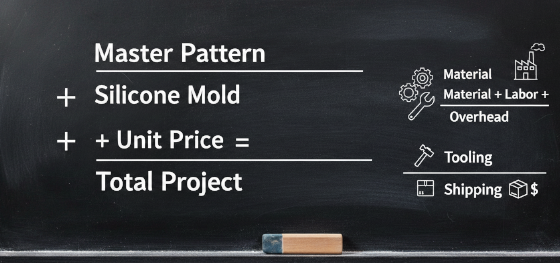
Every valid estimate begins with the "Tripartite Equation." Unlike 3D printing, which is often a single line item, vacuum casting is an assembly of three distinct cost centers. If you build your own internal spreadsheet or use a Vacuum Casting Cost Calculator, it must follow this structure:
Total Project Cost = [Master Pattern Cost] + [Silicone Tooling Cost] + ([Unit Price] × [Quantity])
Notice that the first two variables are "Fixed Setup Costs" (NRE), while the third is a "Variable Marginal Cost." This structure is why unit price drops drastically as volume increases. If you order one part, you pay for the entire Master and Mold. If you order twenty, those costs are diluted. Ignoring this distinction is the primary reason engineers miscalculate their prototyping budgets.
Variable 1: Master Pattern Fabrication
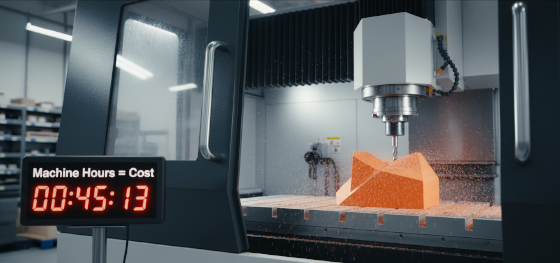
Quality replication starts with a perfect original. The master pattern is the physical "DNA" of your project. We typically manufacture this using 5-axis CNC machining (for high precision) or high-resolution SLA 3D printing (for complex geometries). The cost here is driven by machine hours and finishing labor. A simple blocky geometry might take 2 hours to machine and 1 hour to polish ($300). A complex automotive lens requiring an optical mirror finish (SPI A2) might require 10 hours of manual sanding and polishing ($800+).
You can reduce this variable to zero. If you already have a high-quality physical model—perhaps a legacy part or a 3D print you polished in-house—you can ship it to Jucheng Precision. We can use your supplied master to cast the mold, effectively eliminating the first term of the equation.
Variable 2: Silicone Mold Volume and Labor
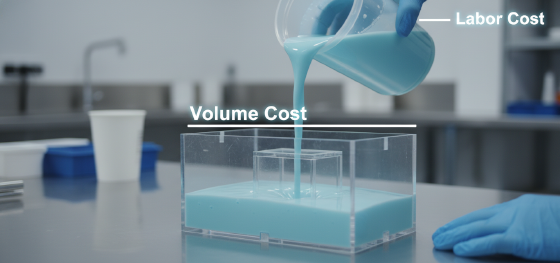
Silicone is sold by the kilogram, and it is not cheap. The cost of the mold is directly proportional to the bounding box of your part. We must build a casting box that allows for at least 20-30mm of silicone wall thickness around your part to ensure structural stability during vacuuming. A small gear might only require 1kg of silicone ($100). A large VR headset housing might consume 10kg ($500+).
Labor is the other half of this variable. The technician must construct the gate system, vents, and parting line. A simple "open-and-shut" box mold is quick to build. A complex mold requiring multiple zigzag parting lines and suspended cores to handle undercuts requires a master model maker's time. This complexity factor is often why online automated quotes fail—they calculate volume but miss the labor intensity of a difficult parting line.
Variable 3: Resin Consumption and Cycle Time
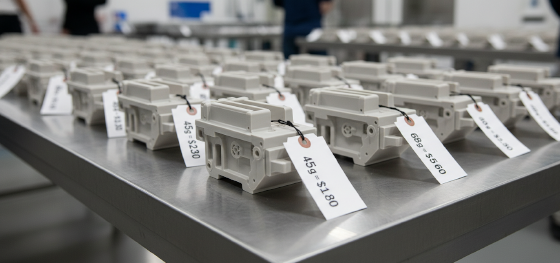
Once the tool is made, the per-part cost is relatively low. It consists of the Polyurethane Resin Cost (Volume × Specific Gravity × Price/kg) plus the Casting Labor. Cycle time is crucial here. Vacuum casting is a slow process; a mold might only yield 4 parts per day because the resin needs time to cure in the heating oven.
Post-processing adds the final layer of cost. Standard "As-Cast" parts are cheap. If you require a specific Pantone color match, we must mix pigments into the resin or paint the part afterwards. If you need threaded inserts, we must install them manually. Each of these steps adds minutes to the labor ticket.
Real World Math: Calculating a Sample Housing
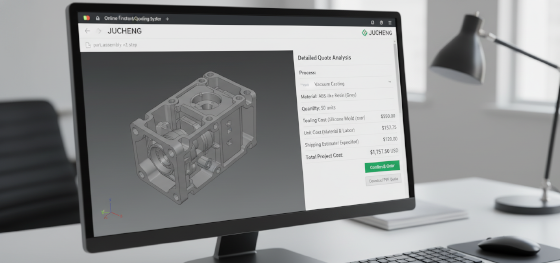
Let’s run a hypothetical scenario using our Vacuum Casting Cost Calculator logic. Imagine a handheld remote control housing (150mm x 50mm x 20mm).
1. Master Pattern: CNC machined from ABS. Moderate complexity. Cost: $350.
2. Silicone Mold: Requires 3kg of silicone. Standard parting line. Mold life is 20 shots. Cost: $400.
3. Unit Price: 50g of Hei-Cast 8150 resin ($5 material) + 30 mins labor ($20). Total Unit: $25.
Scenario A (Qty 1): $350 + $400 + $25 = $775 per part. (Expensive!)
Scenario B (Qty 20): $350 + $400 + ($25 × 20) = $1,250 Total. Divided by 20 = $62.50 per part.
This math proves why casting is the "Valley of Death" bridge. At 20 units, the price crashes from $775 to $62.50, offering massive value compared to 3D printing which would stay near $100-$150 per unit regardless of volume.
JUCHENG Engine: Automating the Calculation
Manual calculation is excellent for estimation, but dangerous for purchase orders. Hidden geometric features or material constraints can skew the numbers. Jucheng Precision has digitized this entire workflow. Our AI-driven quoting engine analyzes your STEP file geometry, automatically calculating the optimal bounding box for the mold, the precise volume of resin required, and the estimated CNC machining hours for the master pattern.
Stop guessing with spreadsheets. Upload your CAD files to JUCHENG today. Within hours, you will receive an itemized quote that breaks down the Master, Tooling, and Unit costs, giving you total transparency and the data you need to secure budget approval immediately.

