


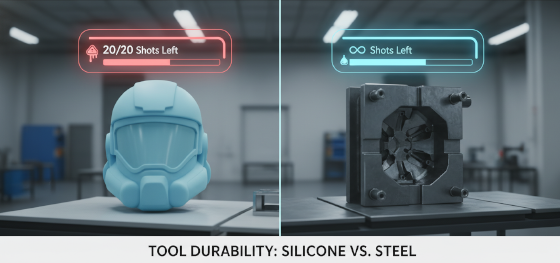
Sticker shock is common when reviewing a vacuum casting cost breakdown. A procurement manager expecting a cheap prototyping method often balks at seeing a $800 line item for a "Silicone Tool." After all, isn't it just liquid rubber poured into a box? This reductionist view ignores the skilled labor and material science required to create a functional mold. Unlike a steel injection mold, which is a permanent asset capable of producing millions of parts, a silicone mold is a sacrificial consumable. It is a biological entity with a finite lifespan, typically dying after twenty cycles due to chemical degradation. Therefore, analyzing silicone mold cost requires understanding that you are not purchasing a durable good; you are purchasing a limited run of high-fidelity replication potential. This guide dissects the three physical variables—volume, complexity, and lifespan—that dictate the price tag of your soft tooling.
Volume Physics: The Cost of Liquid Gold
Labor Intensity: The Art of the Parting Line
The Prerequisite: Master Pattern Investment
Lifespan Economics: The 20-Shot Limit
JUCHENG Optimization: Smart Mold Design
Volume Physics: The Cost of Liquid Gold
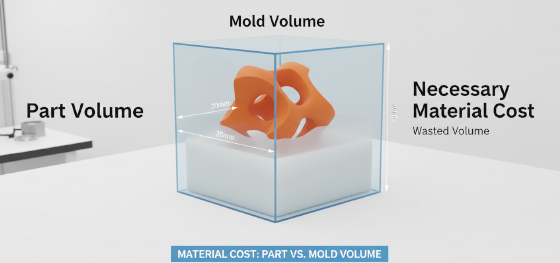
Raw material consumption drives the baseline expense. High-quality RTV (Room Temperature Vulcanizing) silicone is not cheap industrial sludge; it is an engineered chemical product sold by the kilogram. Determining the cost begins with the "Bounding Box." To ensure the mold does not tear under vacuum pressure or deform during the exothermic curing of the resin, we cannot simply coat the part in a thin skin. We must encase the master pattern in a solid block of silicone with a minimum structural margin of 20mm to 30mm on all sides.
Geometric scaling punishes large parts aggressively. A small 50mm gear might fit into a casting box requiring only 1kg of silicone. However, doubling the part dimensions doesn't double the silicone volume—it often cubes it. A VR headset housing might require a massive 10kg block of silicone just to maintain structural integrity. Since silicone is billed by weight, a large part inherently commands a high tooling fee, regardless of its geometric simplicity.
Labor Intensity: The Art of the Parting Line
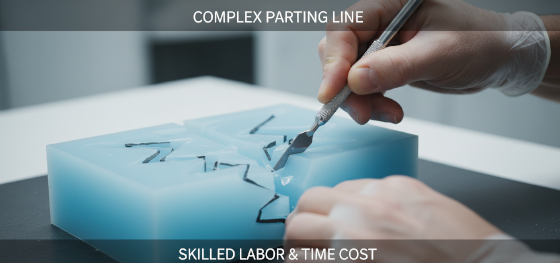
Creating a mold is a manual art form, not an automated process. Unlike CNC machining where a robot does the work, silicone molds are hand-cut by master technicians. The complexity of your design dictates the labor hours required. A simple "open-and-shut" box—like a remote control battery cover—can be cut open in thirty minutes using a flat parting line.
Under cuts and complex internal features destroy this efficiency. If your design features side-action holes, internal threads, or deep ribs, the technician must design a complex, non-planar parting line (often zigzagged) to allow the part to release without tearing the mold. They may even need to create separate "silicone cores" or inserts that are manually placed into the mold before every pour. A complex mold for an automotive manifold can take a skilled craftsman ten hours to cut and prepare. You are paying for this high-value expertise.
The Prerequisite: Master Pattern Investment
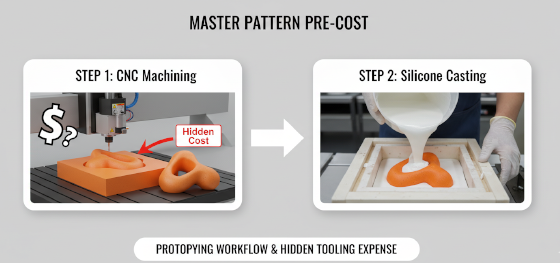
Clients often forget that the silicone mold is merely a negative copy. Before we can pour the liquid rubber, we must possess a physical positive: the Master Pattern. This represents a significant "Hidden Cost" inside the tooling quote. We typically manufacture this master using 5-axis CNC machining (for precision) or high-resolution SLA 3D printing (for complex curves).
Finishing this master pattern is non-negotiable. Because the silicone replicates every surface detail down to the micron, the master must be polished to the exact specification of the final part. If you require a high-gloss finish, a technician must hand-sand and polish the master for hours. This labor is front-loaded into the "Tooling Cost." Therefore, a $800 mold fee might actually consist of $300 for the CNC master pattern, $200 for finishing labor, and $300 for the actual silicone and pouring labor.
Lifespan Economics: The 20-Shot Limit
Silicone is chemically hostile to polyurethane. Every time the resin cures inside the mold, the exothermic reaction and chemical attack degrade the silicone's surface. Eventually, the mold becomes brittle, the surface finish turns rough, and dimensions begin to drift. This typically happens after 20 to 25 shots.
This "Mortality Rate" acts as a cost multiplier. If your project requires 50 parts, one mold is insufficient. We must manufacture *two* or *three* separate silicone molds to fulfill the order. While we only need to make the Master Pattern once, we must pay for the silicone volume and labor multiple times. This is why vacuum casting costs scale linearly in steps. Smart project managers optimize their batch sizes to align with multiples of 20 to maximize the utility of every dollar spent on tooling.
JUCHENG Optimization: Smart Mold Design
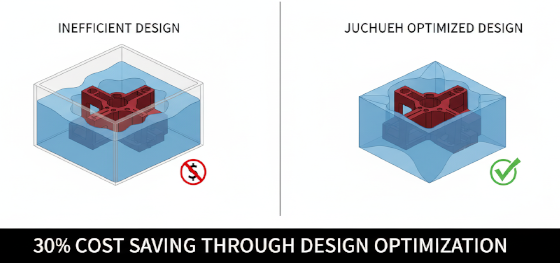
Reducing tooling cost requires engineering foresight. Jucheng Precision employs Design for Manufacturing (DFM) specifically for soft tooling. We analyze your CAD file to identify "Mold Killers"—features that require excessive silicone volume or dangerous undercuts. By suggesting minor design tweaks, such as adding draft angles or splitting a complex part into two simpler assemblies, we can often reduce the mold complexity and silicone consumption by 30%. We treat your budget as a finite resource, engineering the tool not just for quality, but for economic efficiency.

