


Procurement managers hemorrhage capital when they prematurely authorize expensive steel tooling for unverified product designs. Locking a geometry into massive blocks of H13 tool steel instantly paralyzes the engineering team's ability to iterate on critical mechanical flaws. Scaling production effectively demands recognizing the precise financial boundary between subtractive prototyping and net-shape replication.

Choosing between massive Hard Die Tooling and CNC Machining dictates the cash flow survival of any [2026] hardware launch. CNC machines carve parts independently without demanding exorbitant upfront engineering fees, but they suffer from agonizingly slow cycle times at scale. Conversely, custom dies spit out identical components in seconds but require terrifying non-recurring engineering (NRE) deposits.
Mastering this specific break-even calculation entirely prevents supply chain paralysis. Hardware executives must brutally evaluate rapid design shifts, gate freeze dynamics, and localized raw material waste. Precision economics relies strictly on matching the fabrication methodology to the exact lifecycle volume of the component.
content:
What Defines a Custom Die in Industrial Manufacturing?
Die Tooling vs CNC Machining: How Do They Compare?
When Should You Invest in High-Volume H13 Tooling?
When MUST You Avoid Hard Tooling and Stick to CNC?
What Are the True NRE Cost Breakeven Dynamics?
How Does Jucheng Optimize Tooling Costs in Shenzhen?
What Are the Most Critical Tooling and CNC FAQs?
What Defines a Custom Die in Industrial Manufacturing?
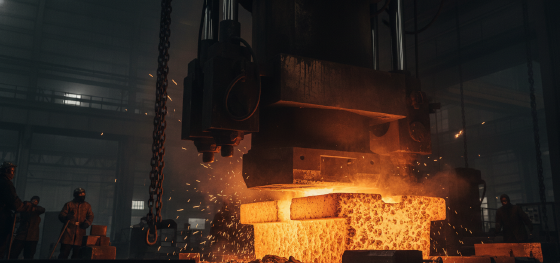
A die operates as an indestructible negative cavity engineered from hardened steel, designed to force molten alloys or sheet metal into permanent geometric shapes under extreme kinetic pressure.
Unlike cutting tools that remove material, dies reform raw matter through sheer force and thermal manipulation. High-pressure die casting involves injecting 700-degree molten aluminum into these steel blocks at supersonic speeds. The die must aggressively absorb this devastating thermal shock without cracking or warping during the subsequent rapid cooling cycle.
Fabricating the die itself requires thousands of hours of slow-wire EDM and hard milling. Toolmakers specifically utilize H13 chromium-molybdenum steel for its legendary resistance to heat checking and thermal fatigue. You are effectively building an industrial weapon designed to survive millions of repetitive, violent mechanical impacts.
Die Tooling vs CNC Machining: How Do They Compare?
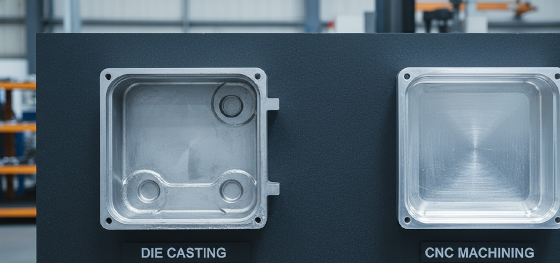
Subtractive machining burns through expensive raw billets and spindle hours linearly, whereas die casting requires astronomical upfront investment but drops unit costs to negligible pennies.
CNC mills slice parts from solid aluminum blocks, frequently turning 80% of the purchased metal into worthless recyclable chips. This tremendous waste, combined with the slow traversal of the cutting tool, makes the process economically punishing for massive runs. However, CNC guarantees aerospace-grade tolerances straight off the machine.
Die casting consumes exact volumetric material, creating net-shape components instantly with zero chip waste. The catch involves the draft angles and ejector pin marks inherent to the molding process. Parts emerging from a die often require secondary CNC operations to hit critical bearing press-fits, blending both technologies together.
| Manufacturing Metric | CNC Machining | Custom Die Casting | Financial & Design Impact |
|---|---|---|---|
| Upfront NRE Cost | Extremely Low (Programming) | Astronomical ($10k - $100k+) | CNC protects startup cash flow |
| Per-Unit Variable Cost | High (Material + Time) | Extremely Low (Material Only) | Dies dominate high-volume margins |
| Geometric Flexibility | Instant CAD Updates | Locked (Requires New Steel) | Dies punish unverified designs |
| Production Cycle Time | Hours per part | Seconds per part | Dies clear massive backlogs instantly |
When Should You Invest in High-Volume H13 Tooling?
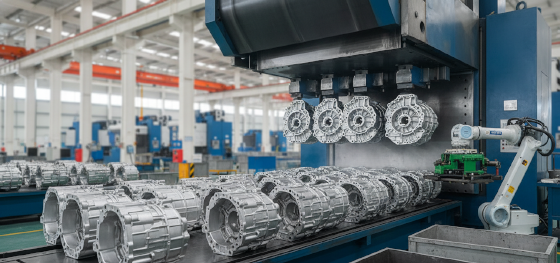
Commit to hard tooling exclusively when market demand guarantees continuous production runs exceeding ten thousand units of a completely verified, frozen CAD geometry.
Automotive manufacturers and consumer electronics giants rely entirely on custom dies. When producing identical motor housings for a global supply chain, spending eighty thousand dollars on a complex multi-cavity tool is a negligible rounding error. The die pays for itself within the first month of unyielding mass production.
Complex internal geometries also mandate tooling. If a part features intricate internal cooling channels or extremely thin, deep ribs, CNC end mills simply cannot reach the material without destructive vibration. Forcing liquid metal into these tight crevices via extreme injection pressure offers the only viable manufacturing pathway.
When MUST You Avoid Hard Tooling and Stick to CNC?
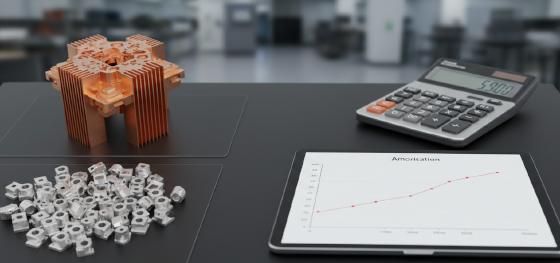
Deploying hard dies for early-stage prototypes or customized aerospace batches guarantees catastrophic financial ruin when inevitable design revisions render the steel obsolete.
Engineering change orders (ECOs) brutally punish hard tooling. You cannot easily add material back into a carved mold cavity. If a mating component changes dimensions, the entire die often requires complete scrapping. CNC machining avoids this nightmare entirely by allowing programmers to merely update a digital toolpath instantly.
Furthermore, parts requiring absolutely pristine, mirror-like aesthetic finishes without secondary processing should stay on the mill. Die-cast components naturally exhibit flow lines, gate residue, and ejector pin witness marks. CNC ensures pristine cosmetic surface integrity right off the final cutting pass.
What Are the True NRE Cost Breakeven Dynamics?

Calculating the precise volume where the astronomically high tooling NRE intersects and drops below the linear expense of CNC machine hours dictates your purchasing strategy.
Assume a complex aluminum manifold costs $300 to CNC machine. A die-cast version costs $15 per unit, but the mold commands a $30,000 NRE fee. Machining 100 units costs $30,000. Casting 100 units costs $31,500. The break-even point sits slightly above 100 units.
Scaling changes everything. Producing 5,000 units via CNC skyrockets your bill to $1.5 million. Casting those same 5,000 units, including the die cost, totals a mere $105,000. Procurement executives must aggressively forecast product lifecycles to trigger the transition to hard tooling at the exact mathematical sweet spot.
How Does Jucheng Optimize Tooling Costs in Shenzhen?

Operating within the Shenzhen precision manufacturing hub, Jucheng deploys modular Master Unit Die (MUD) systems to brutally slash non-recurring engineering expenses for low-volume bridge production.
Navigating global supply chain constraints requires eliminating bloated tooling overhead. Instead of charging you for the massive, heavy exterior steel mold frame, we utilize standardized MUD bases. You only pay for the specific custom cavity inserts carved by our high-speed EDM machines, reducing upfront costs by forty percent.
Our 8000-square-meter facility executes completely seamless transitions from 5-axis CNC prototyping directly into high-pressure die casting. We offer highly aggressive Free DFM reviews to calculate precise draft angles and eliminate costly side-actions from your CAD. Backed by ISO9001:2015, we engineer profitability directly into your tooling.
What Are the Most Critical Tooling and CNC FAQs?

Resolving hardcore manufacturing variables prevents catastrophic assembly failures during the high-volume transition of custom industrial hardware.
Can a CNC machine hit tighter tolerances than a high-pressure die?
Yes, universally. Subtractive milling avoids the violent thermal shrinkage inherent to molten metal solidification. While die casting generally holds +/- 0.05mm on critical features, high-end 5-axis CNC machines routinely hold +/- 0.005mm without issue, making CNC mandatory for critical bearing journals.
What causes internal porosity in die-cast components?
Porosity occurs when volatile atmospheric gases become trapped within the rapidly solidifying liquid metal. If the gate freezes prematurely before intensification pressure can squeeze out the trapped air, the resulting voids fundamentally destroy the structural integrity of the casting.
How long does an H13 aluminum die typically last before failure?
A properly maintained H13 tool steel die typically survives between 80,000 and 120,000 "shots" (injections) before severe thermal fatigue causes unacceptable heat checking on the cavity surface. Zinc dies run significantly cooler and can often exceed one million shots.

