


Your project is a success. The first 50 prototypes worked perfectly. Now, the sales team has landed a major order. You need to make 5,000 units.
The process that got you here, CNC machining, is too slow and expensive for this new scale. But investing in a high-volume process like Die Casting requires a huge upfront cost. You are at a critical crossroads.

The decision between Die casting vs CNC machining is one of the most important strategic choices a product company can make. It is not just a technical question. It is an economic one. This guide will give you a clear framework for making the right call.
content:
The Path of Subtraction: CNC Machining
The Path of Formation: Die Casting
The Battlefield of Cost: Finding the Breakeven Point
Beyond Cost: A Question of Material Integrity
The JUCHENG Advantage: A Partner for Both Paths
The Path of Subtraction: CNC Machining

CNC machining is a "subtractive" process. It starts with a solid block of metal and carves away everything that is not your part.
Its greatest strength is its flexibility. There is no upfront tooling cost. You can make one part, or ten parts, and the price per part is essentially the same. You can also make changes to the design very easily. You just need to update the CAD file.
However, it is a relatively slow process. Each part must be individually carved. And it can be wasteful, as a significant portion of the expensive raw material is turned into chips. This is why, as your production volume increases, the total cost of CNC machining climbs in a steady, linear fashion.
The Path of Formation: Die Casting
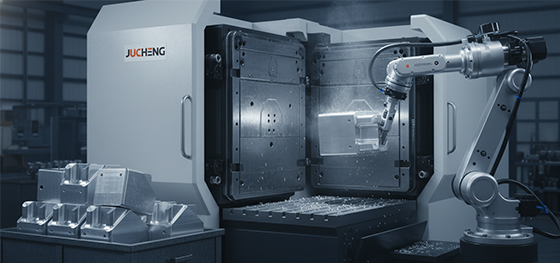
Die casting is a "forming" process. It starts with molten metal and shapes it using a reusable mold, or "die."
Its greatest strength is its speed at scale. Once the expensive die is made, the process is incredibly fast. A new part can be created every few seconds. There is also very little wasted material.
Its biggest disadvantage is the high upfront cost of that steel die. This is a major investment. It is also completely inflexible. Once the die is made, you cannot make any significant changes to the design. This is why the economics of die casting are all about a high initial investment followed by an extremely low price per part.
The Battlefield of Cost: Finding the Breakeven Point

So, which path is cheaper? The answer depends entirely on one number: your total production quantity.
At low volumes (1 to a few hundred), CNC is almost always cheaper. The high cost of the die casting tool is impossible to justify.
At very high volumes (tens of thousands), die casting is always cheaper. The low price per part quickly pays back the initial tooling investment and leads to massive savings.
The critical area is in the middle. There is a "breakeven point" where the total cost of both processes is the same. For most medium-sized aluminum parts, this breakeven point is typically between 500 and 1,000 pieces. If your expected volume is higher than this, it is time to start seriously considering an investment in die casting.
Beyond Cost: A Question of Material Integrity
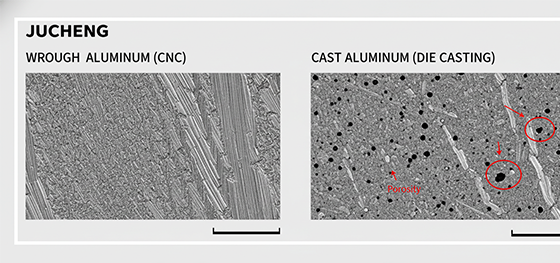
The decision is not just about cost. There is also a key difference in the material itself.
CNC machining carves parts from a solid block of "wrought" aluminum (like 6061). This material has been rolled and extruded, which gives it a very uniform, dense, and strong internal grain structure.
Die casting uses "cast" aluminum alloys (like A380). These are designed to flow as a liquid. While the final part is very strong, its microscopic grain structure is different. It can also contain a small amount of gas porosity.
For most applications, this difference is not a problem. But for a highly stressed, critical component (like a rock-climbing device), the superior strength and integrity of wrought aluminum from CNC machining might be a non-negotiable safety requirement.
The JUCHENG Advantage: A Partner for Both Paths
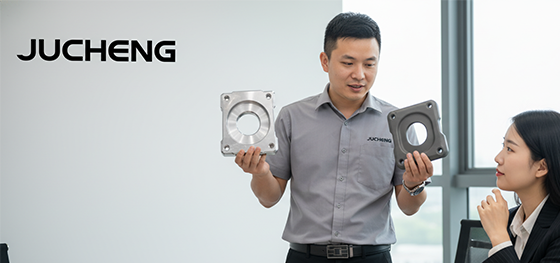
The Die casting vs CNC machining debate can be complex. Many suppliers will only offer you one path. If they are a CNC shop, they will tell you CNC is best. If they are a foundry, they will push you towards casting.
This is where JUCHENG is different. We are experts in both. We have over 150 CNC machines, and we have a professional die casting department. This makes us a neutral, unbiased advisor.
Our goal is not to sell you a specific process. Our goal is to help you find the smartest solution for your project at its current stage.
We will make your first 100 prototypes with CNC. Then, when you are ready to scale to 1,000 pieces, we will work with you to design and build your first die casting tool. We can be your partner for the entire journey, from 1 to 100,000. This is the advantage of a true one-stop-shop.

