


While a laser cutting machine is often viewed as a simple 'digital saw,' in Precision Laser Cutting, it serves as the most critical starting point for all subsequent Sheet Metal Fabrication. The quality of the final part—its ability to be bent, welded, and assembled without failure—is determined entirely by the integrity of the laser-cut edge.
For B2B buyers, understanding the technical standards of the cut—including edge perpendicularity, minimal heat-affected zones, and burr control—is essential for mitigating costly errors later in the assembly process. This guide explores the advanced quality control strategies that ensure the laser-cut part is a perfect foundation for high-reliability structural components.
content:
Edge Quality: The Three Dimensions of a Perfect Laser Cut
Thermal Management: Controlling the Heat-Affected Zone (HAZ) Risk
Process Integration: Ensuring Laser Cut Compatibility with Bending and Welding
Sourcing Standards: Automated Production and Material Diversity
Edge Quality: The Three Dimensions of a Perfect Laser Cut
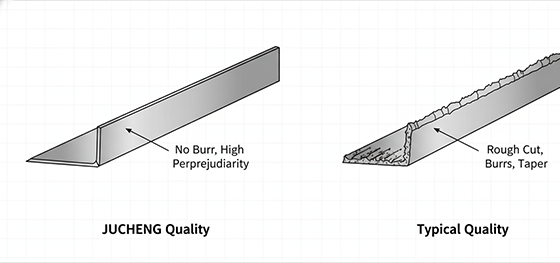
The quality of the laser cut is measured not only by how clean the surface looks, but by three measurable technical factors that impact the subsequent fabrication steps:
Perpendicularity (Taper): This measures how vertical the cut edge is. A poorly tuned laser creates a tapered (angled) cut, which leads to dimensional errors and gaps when parts are welded or assembled, especially on thick plates.
Burr Height: The burr is the small ridge of molten metal that solidifies on the bottom of the cut. For parts that require powder coating or precise mating, burr removal is a mandatory, costly secondary process. Expert laser cutting minimizes burr height, reducing post-processing labor.
Surface Roughness (Ra): The cut surface itself has a measurable roughness. A smoother surface from the laser reduces the need for grinding and ensures better adherence for chemical treatments like anodizing or painting.
Thermal Management: Controlling the Heat-Affected Zone (HAZ) Risk

Laser cutting, by its nature, involves extreme heat. This heat temporarily changes the metallurgical structure of the metal immediately next to the cut, creating the Heat-Affected Zone (HAZ):
Material Change: In structural steel, the HAZ can sometimes result in a hardened, brittle zone that is prone to cracking. In stainless steel, the HAZ loses its protective chromium layer, making the area vulnerable to corrosion.
HAZ Mitigation: Controlling the HAZ is achieved through precise programming, ensuring optimal power and speed are used, and by using high-purity assist gases (like nitrogen) to rapidly cool the metal during the cut.
Stress Relief: Cutting large sheets can release internal stresses inherent in the mill stock. For high-precision parts, a pre- or post-cut stress relief process may be necessary to prevent part warpage after the cut is complete.
Process Integration: Ensuring Laser Cut Compatibility with Bending and Welding
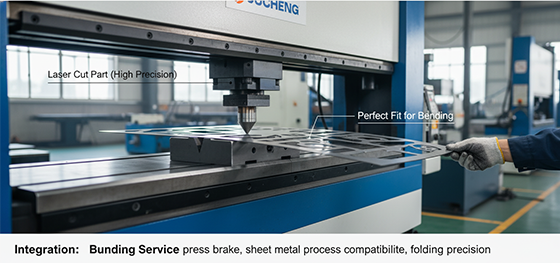
The laser cutter is the first step in a complex chain. Its output must be perfectly compatible with the subsequent forming and joining processes:
Bending Service Compatibility: The position and size of holes and cutouts must be precisely compensated in the laser program to account for material stretch during the Bending Service. An inaccurate laser cut leads directly to wrong bend angles and costly scrap.
Welding Service Preparation: For parts that require tight-fit welding seams, the laser must ensure the cut edge is clean and free of oxides or dross. A contaminated edge leads to poor weld penetration and structural weakness.
Full-Service Advantage: Working with an integrated manufacturer (like Jucheng) that manages Laser Cutting, Bending, and Welding under one roof ensures that the laser program is always optimized for the downstream fabrication requirements.
Sourcing Standards: Automated Production and Material Diversity

For B2B manufacturing, sourcing Precision Laser Cutting is about securing scalable capacity and certified process control for diverse materials:
Material Agility: A capable partner must be able to seamlessly switch between cutting various Sheet Metal materials—from Aluminum alloy and Stainless Steel to Mild Steel—while maintaining distinct process parameters for each.
Automated Production: Automated sheet loading and unloading systems ensure continuous, high-speed production, which is essential for low-cost, high-volume part runs.
Certification: Compliance with ISO and IATF 16949 standards ensures that the entire process, including material utilization and quality inspection, is rigorously controlled and documented.
Precision Laser Cutting is the silent guarantor of quality in Sheet Metal Fabrication. Jucheng Precision Technology ensures that every cut meets the highest standards of perpendicularity and surface integrity, creating the perfect starting point for your complex structural projects.
Secure precise, burr-free sheet metal components. Contact us today to discuss the full spectrum of our Laser Cutting, Bending, and Welding services.

