
Standard Sheet Metal Tolerances: ISO 2768 Industry Norms
Views: 2 Author: Allen Xiao Publish Time: 2026-07-04 Origin: Site


Establishing consistent quality boundaries before releasing custom blueprints to production is essential to managing product development costs. Adhering to standard sheet metal tolerances ensures that your custom brackets, multi-panel chassis, and industrial cabinets can be manufactured repeatably across different workshops without requiring extensive manual fitting. This universal coordination is a critical milestone in custom sheet metal fabrication, directly determining whether your manufacturing partners can interpret your geometric requirements cleanly. Suffer from high part rejection rates and infinite communication loops due to missing or overly strict tolerance callouts on your designs? When engineers model hardware without specifying standard, realistic limits, it forces estimators to assume the tightest possible classes, artificially inflating your manufacturing costs. Aligning your custom designs with standard commercial limits is the best way to secure your product margins. Let's explore why universal manufacturing guidelines are necessary to reduce transaction friction, analyze the specific dimensional classes of the widely accepted ISO 2768 standard, and review how to properly specify tolerance parameters on your active CAD drawings. Why are international tolerance standards essential for custom manufacturing contracts? Without globally recognized standard sheet metal tolerances, every single drawing would require hundreds of individual tolerance callouts, making blueprints incredibly cluttered and difficult to read. It would also lead to endless disputes between buyers and sellers regarding whether a finished component is legally compliant. By referencing universal standards directly in your title block, you establish an instant, legally binding quality agreement. The fabricator knows exactly which general tolerance band applies to all un-toleranced dimensions, allowing them to select the optimal shearing and bending equipment immediately with zero administrative delays. What is the structure of the ISO 2768 standard, and which tolerance classes apply to sheet metal? The most widely accepted standard for general sheet metal tolerances is ISO 2768. This standard is designed to simplify drawings by defining clear, scale-dependent permissible variations. Part 1 defines tolerances for linear dimensions and angular dimensions, dividing them into four accuracy classes: fine (f), medium (m), coarse (c), and very coarse (v). For high-quality custom metalwork, the industry-standard default is ISO 2768-m (medium). This class balances high manufacturing precision with economical machine speeds, allowing for highly repeatable parts without requiring expensive specialized setups. Below is a reference overview of these standard linear limit classes: How should design engineers properly document general and custom tolerances on their engineering drawings? Over-specifying tolerances is one of the most common budget leaks in product engineering. If a designer applies a tight ±0.1mm tolerance to non-critical external bracket dimensions, the fabricator must slow down laser cutting speeds and continuously check parts, increasing the unit price by up to 200%. To prevent this, always utilize general tolerances for standard features. Designers should specify the overall standard (such as 'General Tolerances according to ISO 2768-m') in the drawing's title block. This covers all un-toleranced flat cuts, bend lengths, and mounting holes. You should then reserve custom, tight tolerance callouts or geometric dimensioning and tolerancing (GD&T) symbols strictly for critical mating interfaces, such as slide-in rail clearances or bearing fits. How does Jucheng Precision consistently achieve and exceed strict global tolerance standards? Why compromise on accuracy when seeking cost-effective custom parts? At Jucheng Precision, we manage every single fabrication stage under a unified quality system. This integrated capability keeps our overall sheet metal tolerances remarkably low, ensuring that your parts are cut, bended, and assembled with extreme consistency. We process a wide range of materials, including lightweight aluminum, high-yield stainless steel, and easily formable carbon steel during high-precision sheet metal fabrication cycles. Our technical department provides a 24-hour free DFM analysis to check your CAD models, checking tolerances and tool clearances before production. Supported by our no MOQ policy and rapid delivery guarantee, we manage your project from initial flat pattern cutting to final, high-durability packaging and assembly. Our engineering team has compiled professional solutions to the most common quality and cost challenges faced by product developers: What is the standard tolerance for standard sheet metal tolerances in general B2B projects? Why do steel, aluminum, and galvanized steel have different tolerances for the same gauge? Does a tight dimensional tolerance always increase custom manufacturing costs? How does Jucheng Precision prevent thickness variations from affecting the standard sheet metal tolerances?
Why Do We Need Universal Sheet Metal Tolerance Standards?
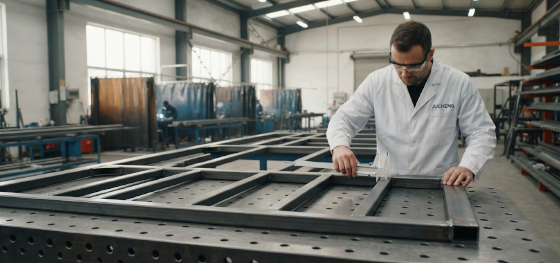
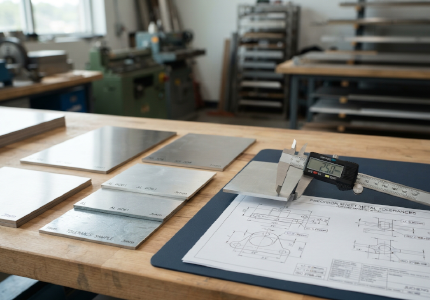
Universal standards establish a common technical language between product designers and manufacturing facilities, eliminating ambiguous dimensions and securing clear quality benchmarks.A Deep Dive into ISO 2768
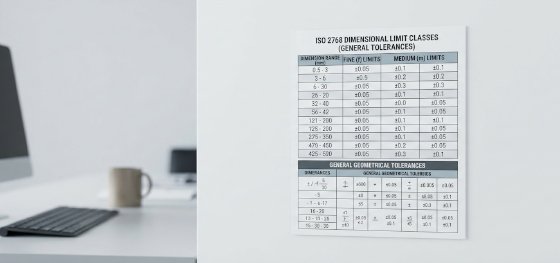
ISO 2768 is divided into Part 1 (linear and angular dimensions) and Part 2 (geometrical tolerances), utilizing classes like 'f' (fine) and 'm' (medium) to define permissible variations.
Dimension Segment Fine Class (ISO 2768-f) Medium Class (ISO 2768-m) Coarse Class (ISO 2768-c) 0.5 mm to 3 mm ±0.05 mm ±0.10 mm (Standard default) ±0.20 mm 3 mm to 6 mm ±0.05 mm ±0.10 mm ±0.30 mm 6 mm to 30 mm ±0.10 mm ±0.20 mm ±0.50 mm 30 mm to 120 mm ±0.15 mm ±0.30 mm ±0.80 mm Specifying Tolerances on Your CAD Drawings
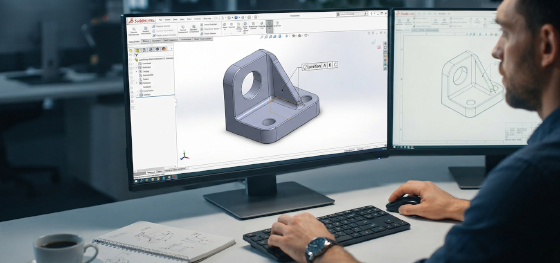
We recommend writing the selected general standard directly inside the title block, and reserving tight, custom tolerances strictly for critical mating interfaces.Jucheng Precision Meets and Exceeds Global Standards

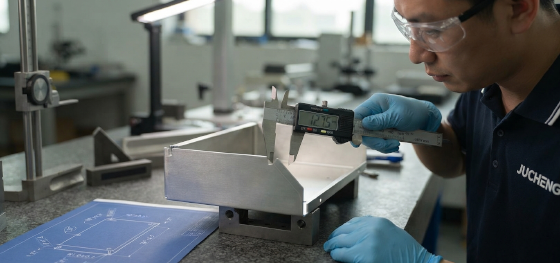
We combine advanced multi-axis fiber lasers and CNC press brakes with an in-house quality control team equipped with high-end coordinate measuring machines.FAQ: Critical Questions About Standard Sheet Metal Tolerances
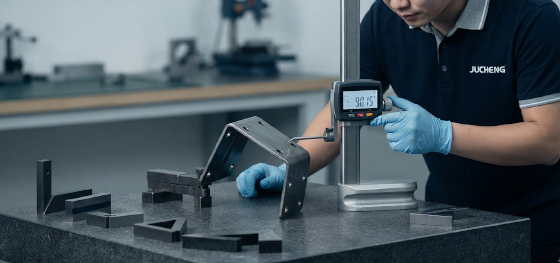
Under standard industrial norms (such as ISO 2768-m), the standard tolerance is approximately ±0.3mm for linear dimensions under 120mm, and ±1.0 degree for angular bends. These limits are highly cost-effective to manufacture, but high-end enclosures often require tighter custom tolerances down to ±0.1mm and ±0.5 degrees, which we achieve using advanced bottoming dies.
Different materials utilize separate raw rolling systems at the mill, resulting in different raw thickness tolerance bands. For example, a 16-gauge galvanized steel sheet is slightly thicker than standard cold-rolled steel due to its protective zinc coating. Our programmers calibrate our unfolding software using material-specific thickness tolerances to ensure that your flat patterns are cut precisely.
Yes, absolutely. Demanding tolerances tighter than standard commercial limits forces the shop to run secondary manual adjustments, slows down machine feed rates, and requires continuous CMM dimensional checks, driving up your labor costs. We recommend utilizing standard commercial tolerances wherever possible and only specifying tight tolerances for critical mating interfaces.
We bypass raw material variations by sourcing only premium, mill-certified steel coils with tight thickness tolerances. Our quality control team continuously measures the incoming sheets using calibrated digital micrometers, and inputs these real measurements into our CAD unfolding systems, ensuring that our progressive calculations and tool setups are perfectly matched to the actual metal thickness.





ㆍPrivacy: We respect your privacy. Here you can find an example of a non-disclosure agreement. By submitting this form, you agree to our terms & conditions and privacy policy.
