


Achieving a perfectly flat mounting surface on precision electronic chassis, semiconductor panels, or aerospace bracket arrays is an ongoing challenge for product designers. Specifying a realistic sheet metal flatness tolerance is a critical milestone in custom sheet metal fabrication, directly determining whether your mating assemblies mount flush without binding or inducing structural stress on delicate PCBs. This specialized geometric parameter requires managing both the physical stresses inherited from raw steel rolling mills and the thermal warping induced by laser cutting and welding.
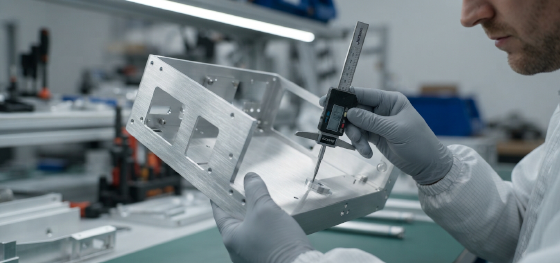
Suffer from large cabinet doors that bow or internal mounting plates that warp after thermal processing, ruining your alignment tolerances? When panels are modeled without analyzing the impact of heat-affected zones or residual stresses, the raw sheets often twist into non-compliant shapes during fabrication. Proactively integrating leveling techniques and hybrid machining options into your design phase is the best way to secure your product quality.
Let's explore how thermal cutting and welding heat warp flat sheets, analyze the mechanical leveling and stress-relief annealing techniques used to restore flat profiles, and review how post-weld CNC milling delivers flat mounting surfaces for critical applications.
The Impact of Heat: Laser Cutting and Welding Distortion

How do high-temperature laser cutting and welding processes warp flat metal panels?
Extreme localized heating concentrates thermal energy along cut paths and joint seams, inducing uneven expansion and high tensile contraction upon cooling.
Thermal processing introduces severe structural forces into raw plates. When high-power fiber lasers slice through carbon steel or stainless steel, the localized heat creates a narrow, high-temperature heat-affected zone adjacent to the kerf. As this heated boundary cools and contracts, it pulls the surrounding flat sheet inward, inducing a wavy, buckled profile commonly known as oil-canning.
Welding causes even more severe thermal warping. Fusing interlocking flanges with an electric arc heats the joints past their melting points, causing significant volumetric shrinkage. This shrinkage pulls adjacent panels out of alignment, throwing off your tight linear and angular tolerances. We manage these thermal stresses by deploying rigid copper chill blocks, utilizing progressive stitch welding, and optimizing weld paths to distribute heat input evenly.
Stress Relief and Mechanical Leveling Techniques

How can fabricators physically restore flatness to warped or bowed metal sheets?
We relieve internal stresses using multi-roller leveling machines that apply controlled, alternating bending forces, or execute thermal annealing in industrial ovens.
To restore flat profiles after shearing or punching, understanding raw plate memory is essential. When sheet metal is rolled at the mill, it inherits internal residual stresses. Any mechanical cutting releases these stresses unevenly, causing the sheet to bow even before thermal processing. We resolve this by running processed sheets through automated roller leveling machines.
These machines utilize a series of alternating rollers to stretch and compress the metal past its yield point, normalizing the internal grain structure. For heavily welded assemblies that experience severe thermal stress, we execute thermal stress-relief annealing in high-temperature ovens. This thermal treatment allows the metallic crystals to reorganize, completely eliminating the internal forces that cause post-fabrication warping.
CNC Facing: Guaranteeing Perfectly Flat Mounting Surfaces

How do we achieve extreme flatness tolerances under 0.05mm on welded sheet assemblies?
We combine fabrication with precision machining, utilizing high-speed CNC milling machines to fly-cut critical mounting faces flat after welding is completed.
When your custom hardware demands extreme flatness (such as mounting interfaces for optical sensors or vacuum-sealed pharmaceutical chambers), standard sheet metal tolerances are simply not tight enough. To meet these micro-precision limits, we implement a hybrid manufacturing approach. We first laser cut, bend, and weld the raw chassis, leaving extra material thickness on the critical mounting flanges.
Once the thermal stresses have stabilized, we mount the welded structure onto our multi-axis CNC milling centers. Using high-speed fly-cutters, we execute precision post-machining to shave off the warped surface layers. This mechanical material removal delivers flat mounting surfaces within 0.05mm, combining the cost-efficiency of sheet metal with the precision tolerances of CNC machining. We process a wide range of materials, including lightweight aluminum, high-yield stainless steel, and formable carbon steel.
High-Precision Flatness Control at JUCHENG

How does JUCHENG guarantee tight flatness tolerances across high-volume production?
We operate high-power fiber lasers and CNC benders backed by high-precision granite surface plates and multi-sensor coordinate measuring machines.
Integrating these precise flatness guidelines into your active sheet metal design cycle is the single most effective way to eliminate production defects. JUCHENG integrates these advanced geometric and material validations into our digital manufacturing network, ensuring that your CAD files translate into fully finished, durable structural panels with extreme dimensional precision.
We operate an IATF 16949 and ISO 13485 certified facility, utilizing over 150 high-performance manufacturing machines to execute complex stamping and forming runs. Our engineering team provides a 24-hour free DFM analysis to check your CAD models, checking tolerances and material limits before production. Supported by our no MOQ policy and rapid delivery guarantee, we manage your project from initial flat pattern cutting to final, high-durability powder coating and assembly.
FAQ: Critical Questions About Sheet Metal Flatness Tolerance
Our engineering team has compiled professional solutions to the most common flatness and warpage challenges faced by product developers:
How does thermal annealing improve the flatness of warped steel sheets?
Thermal annealing involves heating the fabricated metal parts in a furnace to a controlled temperature, holding it to allow the microcrystalline grains to relax, and cooling it slowly. This heat treatment relieves the internal residual stresses induced by laser cutting and welding, preventing subsequent warping during CNC post-machining.Why do different sheet metal gauges exhibit different flatness variations?
Thin-gauge sheets (such as 22 GA) possess very low structural stiffness and are highly sensitive to thermal warping from laser cutting and welding, causing them to buckle easily. Thick plates (such as 10 GA) have significantly higher moment of inertia, making them highly resistant to thermal distortion but requiring much higher force to mechanically level if they inherit mill coil memory.Does powder coating affect the standard flatness tolerance of sheet metal parts?
Powder coating does not physically warp the metal, but it adds a thick, cured polymer layer of 60 to 120 microns to the surface. If the coating is applied unevenly, or if the curing oven temperatures fluctuate too rapidly, the cooling phase can introduce minor surface tensions. We prevent this by maintaining strict temperature profiles in our curing ovens and utilizing precise electrostatic powder application.How does JUCHENG prevent thickness and flatness variations from affecting custom orders?
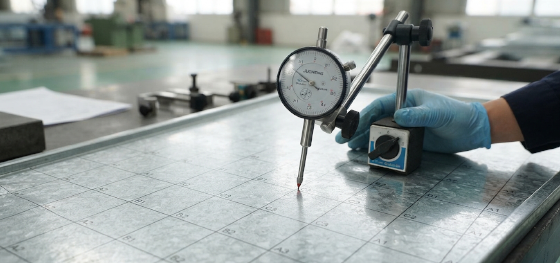
We bypass raw material variations by sourcing only premium, mill-certified steel sheets with tight thickness tolerances. Our quality control team measures flatness across a grid of coordinates using physical dial indicators on granite surface plates, or runs automatic scans on our multi-sensor coordinate measuring machines (CMM), ensuring every finished component meets your strict structural requirements.

