


Designing precise mounting apertures to secure printed circuit boards, heavy transformers, or high-vacuum structural shafts requires a deep understanding of manufacturing limits. Managing sheet metal hole tolerances represents one of the most critical stages in custom sheet metal fabrication, directly determining whether your fasteners align smoothly or bind due to egg-shaped distortion. This specialized drilling and punching process relies on balancing material tensile limits, laser kerf widths, and mechanical punch clearances on the shop floor.
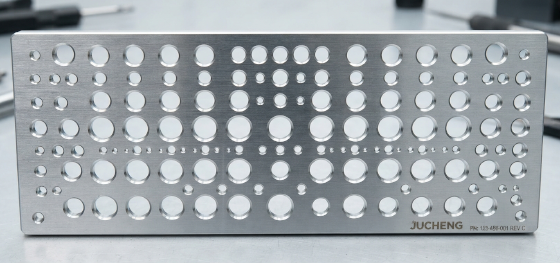
Suffer from mounting holes that stretch into elliptical, non-compliant profiles after press brake folding, making it impossible to insert standard bolts? When apertures are cut too close to a bend line without compensating for localized tensile stresses, the material on the outer flange stretches elastically, pulling the circular hole out of tolerance. Proactively integrating material-specific hole-to-edge clearances is the best way to secure your product quality.
Let's explore why thermal lasers struggle with micro-hole geometries, analyze why mechanical turret punching provides superior dimensional consistency, and review how secondary CNC milling achieves micro-level tolerances for critical bearing fits.
The Challenges of Laser Cutting Small Holes
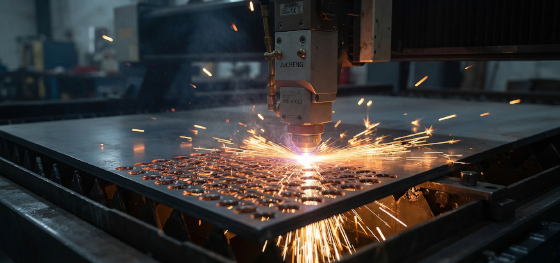
Why do standard fiber lasers struggle to cut perfectly circular micro-holes?
Concentrated thermal energy from laser beams melts adjacent metal on small diameters, creating a wide heat-affected zone and minor edge taper.
While high-speed laser cutting is exceptionally precise for long profiles, it faces physical limitations when processing small holes. As a general manufacturing rule, the minimum hole diameter should not be less than the material thickness. If you force a laser to cut a 1.0mm hole in a 3.0mm plate, the heat concentrates in a tiny area, causing the metal to melt and warp.
This thermal concentration creates a wide heat-affected zone (HAZ) that hardens the edge of carbon steel and stainless steel, making subsequent tapping or reaming highly difficult. Additionally, the divergent nature of the focused laser beam introduces a slight edge taper, causing the exit side of the hole to be narrower than the entrance side, throwing the part out of standard tolerances.
Why CNC Punching is Better for Standard Hardware Insertion
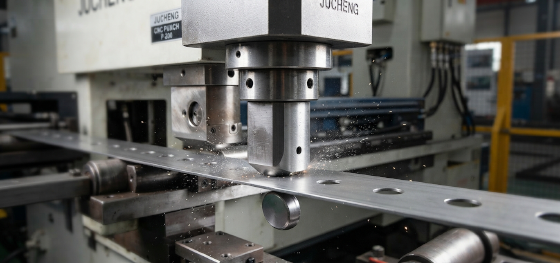
Why does mechanical turret punching deliver superior hole consistency for self-clinching fasteners?
Turret punching shears out standard round holes in a single mechanical stroke, maintaining consistent, non-tapered diameters with zero heat-induced hardening.
For high-volume assemblies requiring standard thread integration, utilizing CNC punching is the highly cost-effective and precise choice. Unlike lasers that trace perimeters, a turret punch press drives a hardened steel punch through the sheet elastically. This physical shearing action creates perfectly round, non-tapered holes with highly consistent diameters.
This extreme consistency is essential for successful hardware insertion. When installing self-clinching PEM nuts, standoffs, or studs, the mounting hole must hold a tight tolerance of +0.08mm. If the hole is too wide, there will not be enough sheet metal to cold-flow into the clinching groove, reducing the torque-out resistance. CNC punching ensures a perfect, tight-tolerance fit every single time.
The Ultimate Solution: CNC Machining and Reaming for Critical Holes
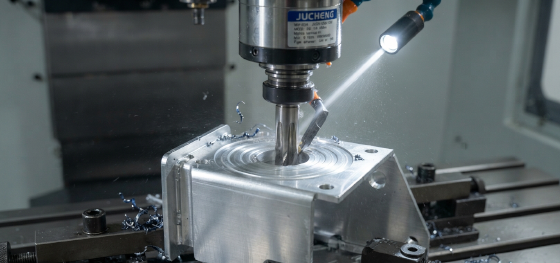
How do you achieve micro-level hole tolerances under 0.03mm on fabricated brackets?
We combine standard sheet fabrication with high-precision CNC milling, utilizing mechanical drilling and reaming to shave hole walls after forming.
When your custom hardware demands extreme precision (such as bearing mounts or tight-tolerance dowel alignments), standard sheet tolerances are simply not tight enough. To meet these micro-level limits, we implement a hybrid manufacturing approach. We first laser cut the flat pattern, deliberately leaving minor material allowances inside the critical mounting holes, and fold the brackets on our press brakes.
Once the physical forming stress has stabilized, we route the bended parts to our multi-axis CNC milling centers. Using high-speed carbide drills and precision reamers, we execute mechanical post-machining to shave the hole walls flat. This secondary machining process delivers perfectly round, non-tapered holes with exceptionally tight tolerances down to ±0.015mm. Below is a direct comparison of these drilling methods:
| Drilling Technology | Standard Diameter Tolerance | Edge Quality & Taper | Best B2B Application |
|---|---|---|---|
| CNC Fiber Laser | ±0.12 mm (Subject to thermal kerf) | Slight taper, hardened heat-affected layer | Venting grilles, large clearance holes, bracket slots |
| CNC Turret Punching | ±0.05 mm (Highly consistent) | Clean, vertical edges, zero heat effects | Standard PEM insert holes, repetitive modular grids |
| CNC Reaming (Post-Milling) | ±0.015 mm (Micro-precision limits) | Flawless, perfectly round, zero burrs | Precision bearing fits, high-load dowel alignments |
Flawless Hardware Assembly at Jucheng Precision
How does Jucheng Precision maintain extreme quality control across hole fabrication?
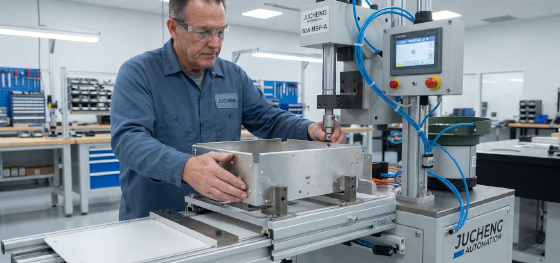
We operate high-power fiber lasers, CNC turret presses, and multi-axis machining centers managed by certified technicians, checking all hole alignments before assembly.
Why pay premium prices for scattered processing? At Jucheng Precision, we manage cutting, bending, and powder coating under a unified quality system. This integrated process capability keeps our overall sheet metal tolerances remarkably low, ensuring that your parts are cut, bended, and assembled with extreme consistency.
We process a wide range of materials, including lightweight aluminum, high-yield stainless steel, and easily formable carbon steel. Our technical department provides a 24-hour free DFM analysis to check your CAD models, checking tolerances and tool clearances before production. Supported by our no MOQ policy and rapid delivery guarantee, we manage your project from initial flat pattern cutting to final, high-durability packaging and assembly.
FAQ: Critical Questions About Sheet Metal Hole Tolerances
Our engineering team has compiled professional solutions to the most common quality and cost challenges faced by product developers:
What is the standard tolerance for standard sheet metal hole tolerances in general projects?
Under standard commercial norms (such as ISO 2768-m), the standard tolerance for laser-cut or punched holes is approximately ±0.1mm to ±0.15mm for diameters under 30mm. While these limits are highly cost-effective to manufacture, high-end optical brackets or bearing mounts often require tighter custom tolerances down to ±0.02mm, which we achieve using CNC post-reaming.Why do holes placed close to a bend line stretch, and how do we prevent it?
Placing a hole close to a fold line exposes the hollow cavity to intense tensile stresses during bending, stretching the hole into an deformed, elliptical shape. To prevent this, always maintain a minimum hole-to-bend distance of twice the material thickness plus the inner bend radius, ensuring that the hole boundary sits completely outside the active tensile deformation zone.Does Jucheng Precision charge extra tooling fees for standard CNC punching?
Absolutely not. Jucheng Precision maintains an extensive in-house library of standard, high-grade round, square, and slotted punch dies. If your designs utilize standard industrial dimensions, we can process your custom venting panels and hardware mounting holes immediately, allowing you to bypass any custom tooling or NRE mold expenses completely.How does Jucheng Precision prevent thickness and diameter variations in high-volume orders?
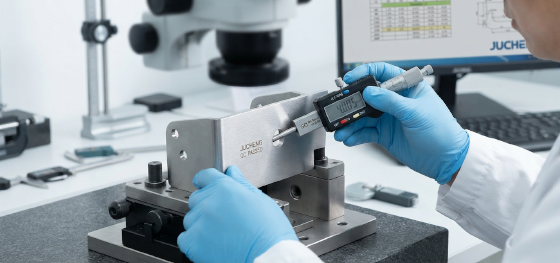
We bypass raw material variations by sourcing only premium, mill-certified steel coils with tight thickness tolerances. Our quality control team continuously measures the incoming sheets using calibrated digital micrometers, and conducts full coordinate measuring machine (CMM) dimensional checks on completed parts, ensuring that every hole remains within your strict tolerance specifications.

