


Scaling up custom bracket or terminal production from manual prototyping to automated high-volume press runs is a major milestone in custom sheet metal fabrication. When your design requires hundreds of thousands of identical parts, executing robust sheet metal stamping tolerances is the defining factor that determines whether your assembly line operates continuously or halts due to dimensional drifts. This advanced die-shearing process relies on high-pressure mechanical presses and custom tool steel dies to blank, pierce, and form complex metal features in milliseconds.

Suffer from high part rejection rates and premature die chipping during long production runs? When progressive toolpaths are modeled without analyzing dynamic die clearances, punch wear patterns, or high-speed thermal expansions, it forces technicians to continuously shut down the press lines for manual adjustment. Proactively optimizing your stamping clearances to match the natural ductility of your alloys is the best way to secure your product quality.
Let's examine how microscopic die clearances and punch wear dictate dimensional accuracy, compare progressive die setups directly against single-stage manual stamping, and review how to maintain high-speed repeatability over ten thousand parts.
Die Clearance and Tool Wear: The Enemies of Precision
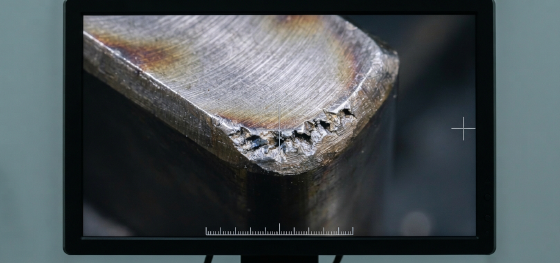
How do microscopic die clearances and progressive tool wear impact stamping precision?
Incorrect clearance between the punch and matching die causes excessive material stretching, leading to massive burrs and rapid dimensional variations.
Managing high-precision stamped parts requires a deep understanding of the cutting interface. The gap between the punch and the die is defined as the die clearance, typically calculated as 5% to 10% of the raw material thickness. If this clearance is too tight, the metal fractures prematurely, causing double shearing and rapid tool chipping; if the clearance is too wide, the metal stretches too far before separating, resulting in an excessive burr height.
As the mechanical press strikes continuously, the sharp edges of the tool steel punches experience progressive abrasive wear. This dulling alters the cutting dynamics, increasing the tensile stresses along the shear line. This tool wear eventually blows out your tight dimensional tolerances, forcing the operator to stop the press, unmount the massive die set, and grind the punch faces sharp to restore clean shear profiles.
Progressive Die Tolerances vs. Single Stage Stamping
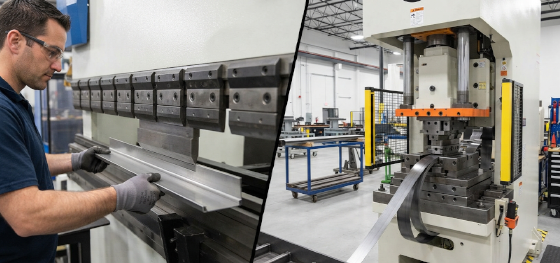
What is the difference in dimensional accuracy and cost between progressive and single-stage stamping?
Progressive dies feed a continuous metal strip through consecutive automated stations to hold extremely tight tolerances, while single-stage stamping utilizes separate manual setups with wider tolerance bands.
When evaluating high-volume manufacturing methods, designers must choose between single-stage tooling and complex progressive dies based on budget and precision. Single-stage stamping (also known as stage tooling) processes one cut or fold per strike, requiring operators to manually transfer parts between separate presses. This manual handling introduces positioning variations, limiting your standard tolerances to ±0.25mm.
Conversely, progressive dies automate the entire workflow. The raw coil is fed through consecutive stations that execute blanking, piercing, and forming sequentially before blanking the finished part. This continuous feed completely eliminates manual transfer errors, allowing us to hold extremely tight tolerances down to ±0.05mm across complex parts. Below is a direct comparison of the two approaches:
| Tolerance Type | Single-Stage Press Tooling | Progressive Die Stamping |
|---|---|---|
| Linear Dimension Tolerance | ±0.25 mm (Requires manual alignment) | ±0.05 mm (Automated sensor feed) |
| Hole Position Tolerance | ±0.20 mm | ±0.03 mm (Highly consistent spacing) |
| Angular Bending Tolerance | ±1.5° (Subject to operator variations) | ±0.5° (Controlled progressive coining) |
| Initial Mold Cost (NRE) | Low (Economical stages) | High (Premium multi-station block) |
Achieving Repeatability over 10,000+ Parts

How do high-speed stamping presses maintain micron-level consistency over thousands of continuous cycles?
We control heat build-up using active oil mist cooling, and run continuous optical sensor tracking to monitor part dimensions in real time.
Running a progressive die at speeds exceeding 200 strokes per minute generates immense friction heat. This rapid thermal energy causes the steel die plates to expand, shifting your tight dimensional tolerances. To maintain micron-level repeatability over massive runs, we implement advanced thermal management, using automated lubricating oil misters to cool the punch interfaces and prevent thermal expansion.
We also implement advanced sensor technology directly inside the press. Electronic sensors monitor the feed alignment of the continuous metal strip and measure the punch travel depth for every single strike, automatically stopping the press if the strip misaligns. This proactive monitoring protects the expensive steel dies from overload damage and ensures that the tenth-thousandth part matches the first article perfectly.
Rapid Tooling and In-House Die Maintenance at JUCHENG
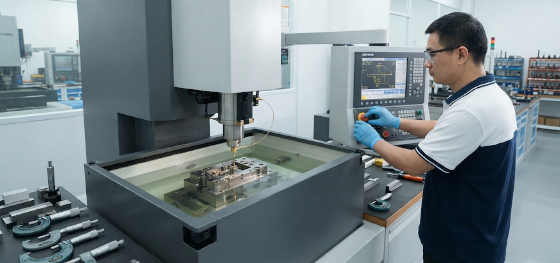
How does JUCHENG prevent tool wear from throwing high-volume stamped parts out of tolerance?
We operate an in-house toolroom equipped with high-precision wire EDM machines, executing rapid, automated grinding to restore punch sharpness without shipping dies out.
Why risk your project tolerances on suppliers who outsource their tooling maintenance? At JUCHENG, we manage our progressive dies, stamping presses, and finishing lines under a unified quality system. This integrated capability keeps our overall sheet metal tolerances remarkably low, ensuring that your parts are stamped, deburred, and packaged with zero dimensional drift.
We operate an in-house toolroom equipped with advanced wire EDM (Electrical Discharge Machining) systems, allowing our toolmakers to execute rapid, high-precision grinding on worn punches within hours. We process a wide range of materials, including lightweight aluminum, high-yield stainless steel, and easily formable carbon steel. Supported by our 24-hour free DFM reviews, no MOQ policy, and rapid delivery guarantee, we manage your project from initial tool design to final high-precision assembly.
FAQ: Critical Questions About Sheet Metal Stamping Tolerances

Our engineering team has compiled professional solutions to the most common quality and cost challenges faced during high-volume stamping runs:
What is the standard dimensional tolerance for progressive die stamping?
Under standard commercial norms, progressive die stamping can easily hold tolerances of ±0.05mm to ±0.1mm for linear dimensions and hole positions, and ±0.5 degrees for angular folds. These tight tolerances make progressive dies the standard choice for manufacturing high-precision electrical terminals, spring clips, and micro-brackets.Why does a larger punch radius prolong the life of progressive dies?
Sharp corners on stamping punches concentrate immense shear stresses, causing the tool steel to chip and wear rapidly. Designing a larger corner radius (typically over 0.5 times the material thickness) distributes the shearing forces evenly, which significantly extends tool life and prevents your parts from throwing out of tolerance due to tool wear.Does JUCHENG utilize rapid tooling to lower progressive die costs?
Yes, absolutely. Designing complete progressive steel dies carries a high upfront cost. For low-volume production runs (1,000 to 5,000 units), JUCHENG utilizes rapid modular tooling setups. We insert custom, pre-hardened die plates into standard master mold bases, lowering your upfront NRE tooling expenses by up to fifty percent.How does JUCHENG prevent thickness variations from affecting the sheet metal stamping tolerances?
We bypass raw material variations by sourcing only premium, mill-certified steel coils with tight thickness tolerances. Our quality control team continuously measures the incoming coils, monitors the punch shear force in real time, and conducts full coordinate measuring machine (CMM) dimensional checks on completed parts, ensuring that every stamped bracket remains within your strict tolerance specifications.

