


Your CAD model is a world of perfect numbers. A flange is exactly 50.00mm. A hole is exactly 10.00mm in diameter. An angle is a perfect 90 degrees.

Then your physical part arrives. You measure it. The flange is 50.15mm. The hole is 10.08mm. The angle is 90.5 degrees. Is the part defective? Is the manufacturer's machine broken?
Welcome to the real world. This is the world of Sheet metal tolerances. It is not a world of perfect numbers. It is a world of acceptable, predictable variation. Understanding this world is the key to designing parts that actually work.
content:
The Root of All Variation: Metal Isn't Perfect
A Common Language: The ISO 2768 Standard
The Hierarchy of Precision
The True Enemy of Assembly: Tolerance Stack-Up
Designing and Manufacturing for Control
The Root of All Variation: Metal Isn't Perfect
Why can't a physical part be perfect? The reason is physics. Metal is a physical material with memory and imperfections.
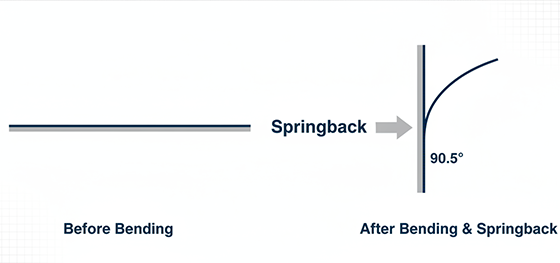
The biggest source of variation in Sheet Metal Fabrication is "springback." When you bend a piece of metal, it does not just stay in its new shape. The internal stresses cause it to spring back slightly towards its original flat state. A 90-degree bend might relax to 90.5 or 91 degrees.
The material itself is not perfectly uniform. The thickness of a sheet might vary slightly from one end to the other. Its hardness might not be perfectly consistent. All these tiny physical variations add up. The goal of manufacturing is not to eliminate variation, which is impossible. It is to control it within an acceptable range. This range is called "tolerance."
A Common Language: The ISO 2768 Standard
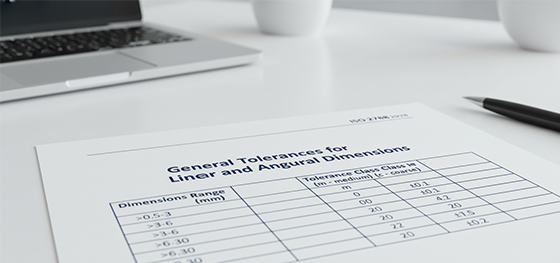
How do we define an "acceptable" range? We use a common, international language. The most widely used standard for general tolerances is ISO 2768.
This standard provides a simple way to specify tolerances without having to put a "+/-" number on every single dimension on your drawing. You simply add a note, such as "Tolerances to ISO 2768-m."
The "m" stands for "medium." The standard has several classes. For sheet metal, "m" (medium) and "c" (coarse) are the most common. ISO 2768-m defines a clear set of acceptable variations for different dimension ranges. For example, for a dimension between 30mm and 120mm, the tolerance might be +/- 0.3mm.
Using this standard simplifies communication. It creates a clear contract between you and your manufacturer. You know what to expect, and they know what to deliver.
The Hierarchy of Precision
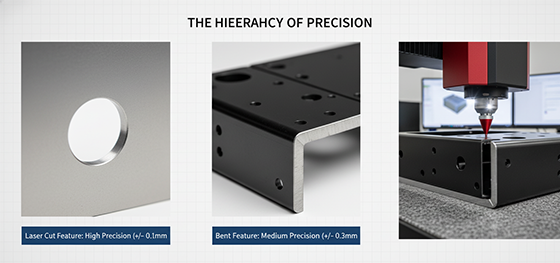
It is important to know that not all features on a sheet metal part have the same tolerance. There is a hierarchy of precision.
Features created by the laser cutter are the most precise. This includes the outside profile of your part and any internal holes or cutouts. These dimensions can typically be held to a very tight tolerance, often around +/- 0.1mm.
Features created by the press brake are less precise. The position of a bend relative to an edge, or the final angle of a bend, is subject to the physics of springback. These dimensions typically have a wider tolerance, perhaps +/- 0.3mm or +/- 1 degree.
A smart designer understands this hierarchy. They will use the laser-cut features as the precise "datum" points. They will design their assembly so that the most critical alignments depend on these accurate, laser-cut holes, not on the less-accurate bent flanges.
The True Enemy of Assembly: Tolerance Stack-Up
A small variation of 0.3mm on a single part seems tiny. But the true enemy of a complex assembly is "tolerance stack-up."
Imagine you are building a server chassis from five separate parts that are bolted together. Each part has a small, acceptable variation. Part A might be 0.2mm longer than nominal. Part B might be 0.1mm shorter. Part C might be 0.3mm longer.
When you add all these small variations together, the final length of your assembly could be significantly different from what you designed. This is stack-up. It can cause the final cover panel to not fit, or the rack-mounting holes to be misaligned.
A good designer must anticipate this. They must perform a tolerance analysis to ensure that even in the worst-case scenario, their assembly will still fit together.
Designing and Manufacturing for Control
So, how do we control all this variation? It is a partnership.
Your job as a designer is to create a robust design. A design that is not sensitive to small variations. And to specify tolerances that are realistic for the process. Asking for CNC-level tolerances on a sheet metal part is a recipe for extreme cost.
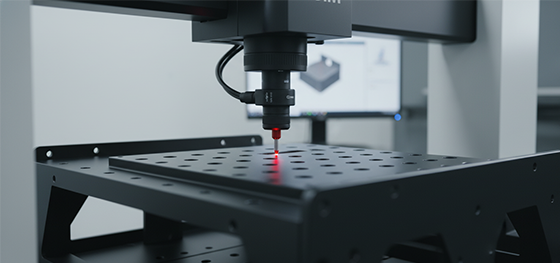
Our job as a manufacturer is to use our expertise and equipment to control the process. We use modern, precise machines. We have skilled operators who know how to compensate for springback. And we use advanced inspection tools like CMMs to verify that the parts we ship meet the agreed-upon Sheet metal tolerances.
This data-driven approach is your guarantee. It turns the chaotic world of physical variation into a controlled, predictable, and successful manufacturing process.

