Choosing Between 4140 Steel vs 4340 for High-Stress Parts
Views: 6 Author: Allen Xiao Publish Time: 2026-01-08 Origin: Site
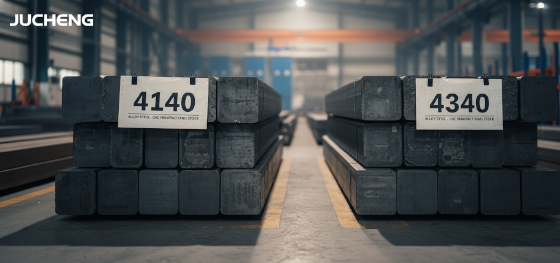
Picking the right alloy for high-stress parts often feels like a high-stakes gamble. You stand between two giants of the engineering world. One is the industry standard, known for its versatility and toughness. The other is a premium upgrade, designed to survive where others shatter. This is the core of the 4140 steel vs 4340 debate. Both belong to the chromium-molybdenum family, but they serve different engineering masters.
If you build parts for standard machinery or automotive suspension, 4140 is usually your hero. It offers incredible reliability at a price that makes sense for mass production. However, when the loads become extreme or the part cross-section grows thick, 4140 reveals its limits. That is where 4340 enters the frame. It adds nickel to the recipe, creating a metal that thrives under impact and cycles of fatigue that would snap standard alloys. At Jucheng Precision, we specialize in high-torque CNC Steel Machining, and we know that the right choice here defines the lifespan of your entire machine.
Choosing between these two grades requires more than a look at tensile numbers. It requires an understanding of through-hardenability and fracture toughness. This guide provides a manufacturing perspective on these two alloy powerhouses, helping you decide when to stick with the standard and when to pay for the premium protection of nickel-alloyed steel.
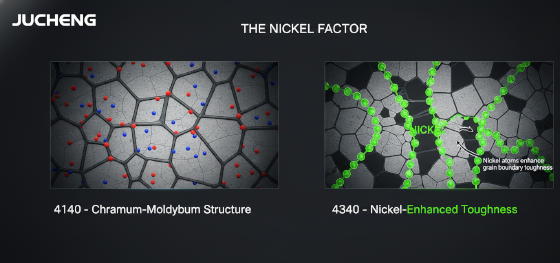
Chemistry dictates destiny in metallurgy. AISI 4140 is a chromium-molybdenum alloy. It relies on roughly 1% chromium and a small amount of molybdenum to achieve its strength and hardenability. It is a fantastic all-rounder. But AISI 4340 takes this foundation and adds roughly 1.8% nickel to the matrix. This addition is not just a minor tweak; it is a fundamental transformation of the material’s atomic behavior.
Nickel acts as a powerful grain refiner. In the 4140 steel vs 4340 comparison, nickel provides the latter with a massive boost in fracture toughness. While chromium helps with hardness, it can sometimes make a metal more prone to cracking under sudden impact. Nickel counteracts this. It allows the metal to stay ductile even when it is hardened to high levels. For an engineer, this means you can design a part that is incredibly hard on the surface but retains the internal "fight" needed to resist snapping when things go wrong. At Jucheng Precision, we see this most often in aerospace landing gear and heavy-duty drivetrain components where failure is not an option.
Fatigue and Impact: Surviving the Unpredictable
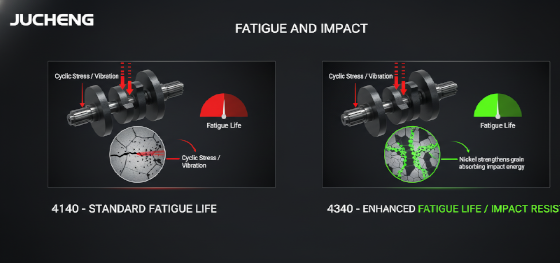
Static loads are easy to calculate. It is the dynamic, vibrating, and slamming loads that kill machines. This is where 4340 earns its higher price tag. Because of the nickel content and specific heat treatment response, 4340 has a fatigue strength that exceeds 4140, especially in extreme conditions. It can survive millions of cycles of high-intensity stress without developing the microscopic cracks that lead to catastrophic failure.
Consider impact resistance. In a Charpy V-Notch test, 4340 consistently outperforms 4140, particularly at low temperatures. If your machine operates in sub-zero environments—like oil rigs in the North Sea or high-altitude aircraft—4140 can become brittle and shatter like glass under impact. 4340 remains tough. This "unpredictability insurance" is why defense and aerospace industries mandate 4340 for structural nodes and engine shafts. When we perform CNC Steel Machiningfor these sectors, we treat the material with specific tool paths to ensure the surface integrity is flawless, as even a tiny scratch can become a starting point for fatigue failure in these high-stress environments.
Through-Hardenability: Solving the Thick Section Problem
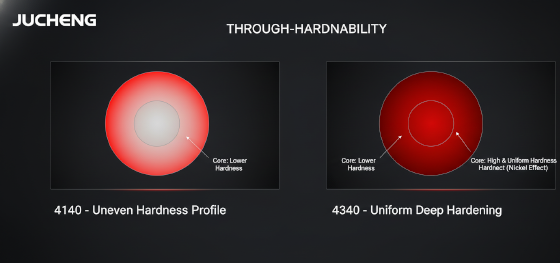
Size matters in heat treatment. This is perhaps the most technical yet critical distinction in the 4140 steel vs 4340 battle. It comes down to through-hardenability. When you quench a thick bar of steel, the center cools slower than the surface. 4140 has moderate hardenability. If your part is thicker than 2 or 3 inches, the center may not fully transform into the hard martensitic structure you need. You end up with a "soft core" that can lead to internal deformation and failure under load.
4340 is the undisputed king of deep hardening. The alloying elements allow the metal to reach its full hardness even in thick cross-sections, sometimes up to 6 inches or more. Whether it is a massive crankshaft or a heavy-duty gear, 4340 ensures that the mechanical properties are uniform from the skin to the very heart of the part. This consistency is vital for large industrial equipment. Jucheng Precision manages the entire heat treatment logistics for our clients, ensuring that the 4340 parts we machine have been quenched and tempered to reach that perfect, uniform hardness profile that large-scale engineering demands.
Machining Reality: Cost vs Performance
From the perspective of a CNC machinist, neither of these alloys is "easy." They both push back against the cutter. However, 4340 is noticeably more challenging. Because it is tougher and more resilient, it generates more heat and causes faster tool wear than 4140. It requires rigid setups, high-torque spindles, and premium carbide tooling with advanced AlTiN coatings to handle the abrasive nature of the nickel-enriched structure.
Then there is the budget. 4340 raw material is significantly more expensive than 4140, largely due to the high cost of nickel. When you combine higher material costs with slower machining speeds and more frequent tool changes, the final price per part can be 30% to 50% higher for 4340. At Jucheng Precision, we are honest with our clients. If 4140 can do the job safely, we recommend it to save you money. But if the physics of your application demand the 4340 edge, we use our 5-axis capabilities to optimize cycle times, helping to mitigate the "alloy premium" and get your project finished on budget.
Choosing for the Application: JUCHENG's Verdict
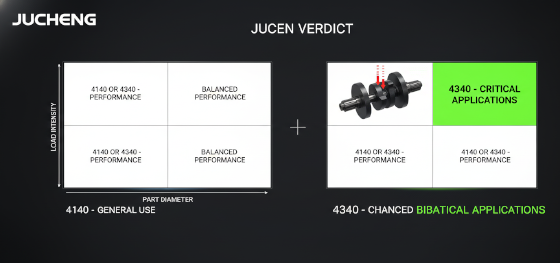
How do you make the final call? It comes down to a balance of risk and geometry. In the 4140 steel vs 4340 comparison, the decision matrix is usually driven by two factors: section thickness and load intensity.
Stick to 4140 Steel if: • The part diameter is under 3 inches. • The environment is standard temperature. • You need high strength but not extreme impact resistance. • Project budget is a primary constraint.
Upgrade to 4340 Steel if: • The part has thick cross-sections requiring uniform hardness. • The application involves high-speed rotation or reciprocating fatigue. • The part must survive shock loads or low-temperature environments. • Failure would lead to catastrophic machine damage or safety risks.
At Jucheng Precision, our engineers are here to guide your material strategy. We provide a free DFM review for every project, helping you analyze whether the "Good" of 4140 is enough or if the "Best" of 4340 is a necessary investment. With our specialized CNC Steel Machining expertise, we ensure that whichever alloy you choose, it is machined to perfection and verified for integrity. Contact us today to discuss your next high-stress steel project.
ㆍFill in your requirements and upload your 2D&3D file, we will feedback your project quotation and DFM within 24 hours.
ㆍFile types: STEP, STP, IGES, IGS, SLDPRT, 3DM, SAT or X_T files File size: < 128 MB Part size: < 1500*1500*1500 mm ㆍPrivacy: We respect your privacy. Here you can find an example of a non-disclosure agreement. By submitting this form, you agree to our terms & conditions and privacy policy.