


In industries where mechanical failure is not merely an inconvenience but a potential catastrophe, material selection becomes a matter of life and death. When a component must endure the massive impact of an aircraft landing, the extreme torque of a high-performance racing engine, or the crushing pressures of deep-sea exploration, standard carbon steels are quickly discarded. Engineers instead turn to the "Big Brother" of the alloy family: AISI 4340. Often referred to as "Aircraft Quality" steel, this nickel-chromium-molybdenum alloy is the ultimate insurance policy for mission-critical hardware.
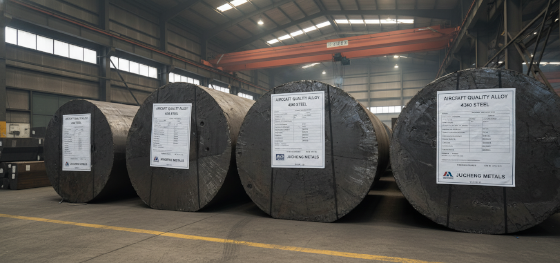
However, the same characteristics that allow this metal to survive in a jet engine make it incredibly difficult to shape in a machine shop. Machining 4340 steel is a high-stakes endeavor that requires specialized knowledge of heat management and tool pressure. It is a material that balances extreme hardness with incredible toughness, creating a unique challenge for even the most advanced CNC Steel Machining facilities. At Jucheng Precision, we have built our reputation on mastering these "difficult" alloys, providing our global clients with finished 4340 components that meet the most stringent aerospace and defense standards.
Whether your design calls for a heavy-duty crankshaft or a complex landing gear node, understanding the metallurgical depth of 4340 is essential for a successful production run. This guide explores the engineering advantages of this high-performance alloy and the technical strategies JUCHENG employs to ensure every cut is as precise as the material is tough.
Nickel Advantage: Why 4340 is the "Big Brother"
Through-Hardenability: Deep Strength in Large Sections
Machining Battle: Stability and Torque
Mission Critical Applications: Landing Gear and Beyond
JUCHENG's Precision Commitment: Mission-Ready Parts
Nickel Advantage: Why 4340 is the "Big Brother"
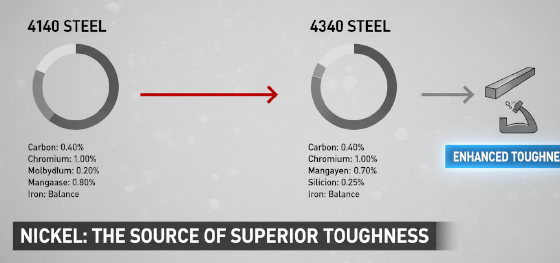
While 4140 chromoly is impressive, 4340 takes performance to a higher echelon by adding a critical ingredient: Nickel. A typical 4340 alloy contains roughly 1.8% nickel along with its chromium and molybdenum content. This specific combination creates a metallurgical synergy that is difficult to match. Nickel's primary role is to improve the metal's "fracture toughness," especially at low temperatures.
In high-stress environments, materials often face a trade-off: as they become harder, they become more brittle. 4340 defies this logic. The nickel content allows the steel to maintain high tensile strength while retaining the ability to absorb energy and resist cracking under impact. This makes it an "Alpha" material in the steel family. It can be heat-treated to incredibly high levels (often reaching 200,000 psi tensile strength) without becoming glass-like. For the engineers we serve, 4340 is the material specified when the cost of a part failure is simply too high to calculate.
Through-Hardenability: Deep Strength in Large Sections
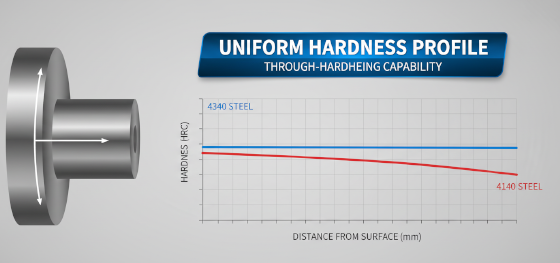
One of the hidden secrets of 4340 is its superior through-hardenability. In many other steel grades, when you quench a large, thick part, the cooling rate at the center is slower than at the surface. This often results in a "soft core," where only the outer skin is truly hardened. For a massive drive shaft or a heavy-duty gear, this is a fatal flaw.
The specific alloy blend in 4340 ensures that the "Critical Cooling Rate" is slow enough that the material can transform into its hardened state even in thick cross-sections. This means that a 10-inch thick 4340 axle will have the same high strength and hardness at its very center as it does on its surface. This "deep hardening" capability is why 4340 is mandated for large-scale heavy equipment components and high-integrity aerospace forgings. When JUCHENG handles these large-scale parts, our clients know that the structural integrity is uniform throughout the entire volume of the metal.
Machining Battle: Stability and Torque
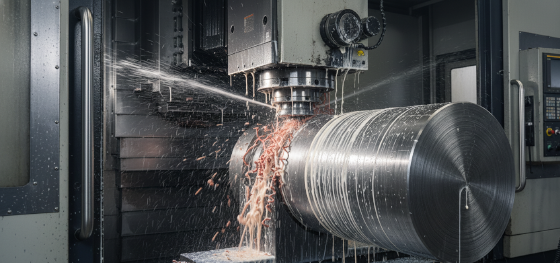
If 1018 steel is like cutting butter and 4140 is like cutting hard plastic, machining 4340 steel is like cutting through cold granite. Because of its massive toughness and hardness, the material pushes back against the tool with immense force. This is not a material for lightweight hobby machines; it requires high-torque, rigid CNC centers and expert-level tooling strategies.
At Jucheng Precision, we tackle 4340 with a "Rigidity-First" approach. We utilize high-tensile tool holders and advanced carbide coatings like AlTiN (Aluminum Titanium Nitride) that can withstand the extreme temperatures generated at the cutting interface. Because 4340 is so tough, the heat doesn't easily dissipate into the chips; it stays at the tool tip. We use heavy-duty face mills and specialized end mills designed for "Hard Milling" to ensure clean material removal. Furthermore, we pay close attention to vibration (chatter). Because 4340 has such high elastic modulus, any vibration can quickly lead to work hardening, which will destroy a cutting edge in seconds. By optimizing our tool paths and using variable-pitch cutters, we maintain a smooth, controlled cut that preserves tolerances of +/- 0.01mm even on large-scale alloy parts.
Mission Critical Applications: Landing Gear and Beyond
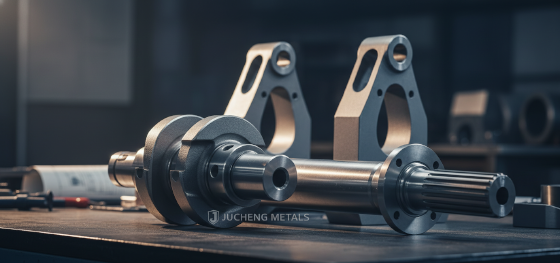
Where do you find 4340 in the real world? Usually, you find it at the point of maximum stress. It is the backbone of the global aerospace and defense industries.
The primary application for 4340 is aircraft landing gear. These components must survive the violent transition from zero load to hundreds of thousands of pounds in a split second, often in freezing temperatures. 4340's fatigue resistance ensures it can do this thousands of times over a plane's life. In the energy sector, it is used for high-strength downhole tools and drill collars. In motorsports, elite-level crankshafts and connecting rods are machined from 4340 billets to handle the explosive power of top-fuel dragsters. If the environment is high-impact, high-torque, or high-vibration, 4340 is likely the material doing the heavy lifting.
JUCHENG's Precision Commitment: Mission-Ready Parts

At Jucheng Precision, we understand that when a client specifies 4340, they are entrusting us with a mission-critical part. This is why our quality protocol for this alloy goes far beyond simple dimensional checks.
We verify every batch of 4340 using our in-house spectrometer to ensure the nickel and molybdenum levels are exactly where they should be. We offer full material traceability (Mill Test Reports) and, for aerospace clients, we can facilitate Non-Destructive Testing (NDT) like ultrasonic or magnetic particle inspection to guarantee that the part is free from internal defects. Our facility is optimized for the rigors of heavy alloy machining, ensuring that your parts are not just machined to print, but are structurally sound and "Mission-Ready." If your next project demands the ultimate strength of 4340 steel, let Jucheng Precision prove why we are the preferred partner for complex, high-integrity manufacturing.

