


Engineering design is a constant negotiation between theoretical performance and economic reality. In the world of industrial steel, this negotiation often centers on a critical fork in the road: the decision to stick with a reliable medium-carbon steel or upgrade to a high-performance chromium-molybdenum alloy. This is the fundamental clash of 1045 vs 4140 steel. It is a choice that determines whether a part simply functions or truly survives under extreme environmental stress.
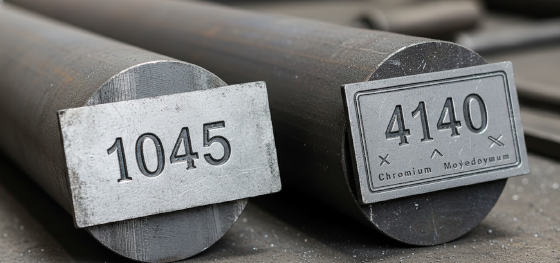
While both materials are staples in any high-end CNC Steel Machining facility, they serve vastly different masters. AISI 1045 is the dependable workhorse, offering excellent strength and hardenability for a wide array of general-purpose mechanical components. AISI 4140, however, is a sophisticated athlete, enriched with alloying elements that provide a safety margin for high-impact and high-fatigue scenarios. At Jucheng Precision, we handle thousands of tons of both alloys annually, helping our clients understand that choosing the wrong one can lead to either a wasted budget or a catastrophic mechanical failure.
Selecting the correct grade is not just about looking at a data sheet. It is about understanding how the metal reacts to the cutting tool, how it responds to the quenching furnace, and how it behaves after ten million cycles of vibration. This guide provides a comprehensive technical analysis to help you navigate the leap from carbon to alloy steel.
Alloy Advantage: What Chromium and Molybdenum Add
Toughness vs Hardness: The Resilience Factor
Through-Hardening vs Surface Hardening
Machining Strategy: Managing High Stress in the Shop
JUCHENG Decision Guide: Cost vs Lifecycle
Alloy Advantage: What Chromium and Molybdenum Add
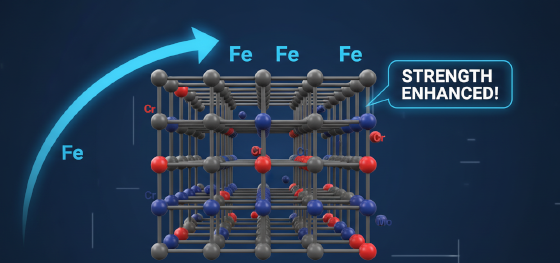
The primary difference in the 1045 vs 4140 steel debate begins at the atomic level. AISI 1045 is a straightforward carbon steel. Its strength is derived almost entirely from its 0.45% carbon content and a small amount of manganese. It is a "pure" expression of carbon-iron synergy. It is predictable, robust, and relatively inexpensive to produce because it lacks expensive additive elements.
AISI 4140 is a different beast altogether. It falls into the category of "Low Alloy Steel," but the word "low" is deceptive. The addition of Chromium (approximately 0.8% to 1.1%) and Molybdenum (0.15% to 0.25%) transforms the material. Chromium increases the steel's responsiveness to heat treatment and provides a significant boost to its natural hardness and corrosion resistance. Molybdenum is the "secret sauce" that prevents the material from becoming brittle when it is hardened to high levels. This combination creates a synergistic effect that allows 4140 to achieve mechanical properties that 1045 simply cannot reach, no matter how aggressively it is heat-treated. When we provide CNC Steel Machining services for 4140, we are working with a material that has been chemically engineered to withstand the worst-case scenario.
Toughness vs Hardness: The Resilience Factor
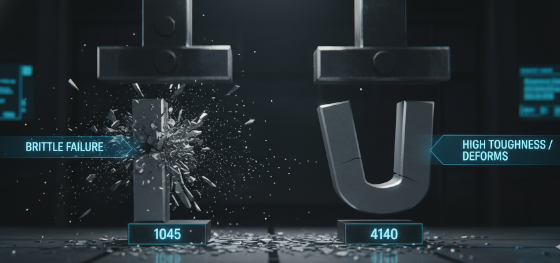
A common mistake in engineering is confusing hardness with toughness. Hardness is the ability to resist surface indentation; toughness is the ability to absorb energy and deform plastically before fracturing. 1045 steel can be made quite hard through induction quenching, but it lacks the inherent toughness of an alloyed steel. If a 1045 shaft is subjected to a sudden, violent shock load, it is more likely to snap like a ceramic rod if it has been hardened too deeply.
This is where 4140 wins the 1045 vs 4140 steel battle for high-stress applications. The chromium and molybdenum matrix provides superior "fracture toughness." In a Charpy impact test, 4140 consistently absorbs significantly more energy than 1045 at the same hardness levels. This resilience makes 4140 the only logical choice for safety-critical parts like steering knuckles, high-pressure fasteners, and racing suspension components. It doesn't just hold the load; it survives the impact. For our clients at Jucheng Precision, 4140 represents a higher safety factor—a buffer against the unpredictable forces of the real world.
Through-Hardening vs Surface Hardening

Another critical factor in material selection is the "depth of hardenability." This refers to how deep the hardening effect penetrates during the quenching process. Because 1045 lacks significant alloying elements, its hardenability is relatively low. If you quench a thick 1045 bar, only the outer few millimeters will reach maximum hardness. The core remains soft. This is excellent for wear-resistant shafts that need a ductile core, but it is a weakness for structural parts that need uniform strength throughout.
4140 is a "through-hardening" steel. Its alloy content allows the martensitic transformation to occur much more slowly, meaning the hardening effect can reach the very center of even large cross-sections. Whether you are machining a 1-inch bolt or a 4-inch diameter drive axle, 4140 provides consistent, uniform strength from the skin to the core. This uniformity is vital for preventing internal stress fractures that can lead to sudden part failure. When we perform CNC Steel Machining on 4140, we often start with pre-hardened material, ensuring that the hardness we see on the surface is the hardness you have throughout the entire volume of the part.
Machining Strategy: Managing High Stress in the Shop
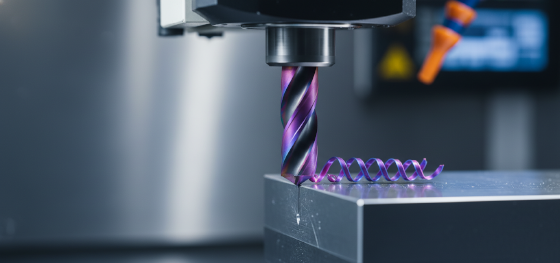
From the perspective of a CNC machinist, 1045 and 4140 require completely different mindsets. 1045 is a "friendly" steel. It is predictable, generates manageable heat, and allows for high material removal rates. It is the king of efficiency. We can run our lathes at high surface speeds, achieving excellent finishes with standard carbide tooling. For high-volume projects where cost-per-part is the primary driver, 1045 is hard to beat.
Machining 4140, especially in its pre-hardened state, is a high-stress operation. The material's toughness means it pushes back against the cutting edge with significant force. This generates intense heat that can degrade tool coatings rapidly. At Jucheng Precision, we use specialized high-torque machines and AlTiN-coated carbide tools to tame 4140. We utilize dynamic milling toolpaths to manage heat and prevent work hardening. While the cycle times for 4140 are invariably longer than for 1045, the precision and surface integrity we achieve are world-class. We don't just cut 4140; we manage its stresses to ensure that the finished part is free of the microscopic surface cracks that lead to fatigue failure.
JUCHENG Decision Guide: Cost vs Lifecycle
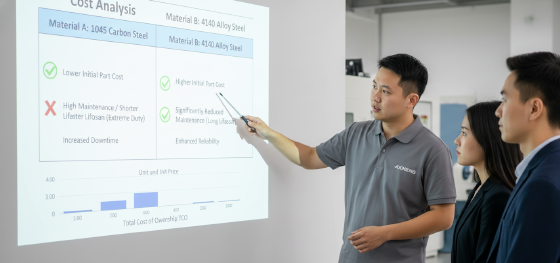
Final selection often boils down to the total cost of ownership. 1045 is cheaper to buy and cheaper to machine. If your part lives in a low-vibration, static environment, spending the extra money for 4140 is likely an over-engineered mistake.
However, if the part is a critical failure point in a million-dollar machine, 4140 is the bargain of the century. The cost difference between 1045 vs 4140 steel is usually measured in a few dollars per part, but the cost of a failed shaft in the field can be measured in tens of thousands of dollars in downtime and liability. JUCHENG recommends 1045 for shafts, gears, and pins where surface hardness is the main goal. We strongly advise 4140 for anything involving high-speed rotation, reciprocating loads, or safety-critical structural support. Our engineering team provides a free DFM review for every project, helping you calculate the ROI of your material choice. Whether you need the economy of 1045 or the extreme resilience of 4140, Jucheng Precision has the expertise to manufacture your steel components to perfection.

