

Grasping Fragility: The Science of Overmolding robotic fingertips
Views: 2 Author: Allen Xiao Publish Time: 2026-04-06


Frictional interfaces determine the success or failure of any automated manipulation task. When engineering a dexterous, multi-fingered end-effector designed to pluck a ripe strawberry or securely handle a slippery glass vial, raw mechanical force is actually a massive liability. If the contact point is made of rigid steel or hard 3D-printed Nylon, the robot must apply excessive crush-pressure just to generate enough static friction to hold the object. This inevitably destroys fragile payloads. Solving this compliance paradox requires the strategic implementation of Overmolding robotic fingertips. This advanced injection discipline bridges the gap between industrial rigidity and biological sensitivity, fusing a high-modulus skeletal structure with a highly compliant, energy-absorbing elastomeric skin. Jucheng Precision operates as an elite multi-material laboratory in the Shenzhen precision manufacturing hub, providing the thermodynamic control required to execute these complex "Dual-Shot" and "Pick-and-Place" molding sequences. As a specialized subset of humanoid robot parts development for 2026, we engineer bionic interfaces that deliver absolute tactile authority, ensuring your machines can interact with the delicate chaos of the real world without leaving a scratch.
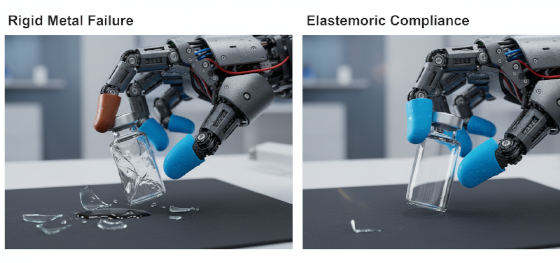
Executing a permanent multi-polymer bond demands the ruthless rejection of simple glues and topical adhesives. Amateurs frequently attempt to wrap a silicone sleeve around a metal finger or use industrial cyanoacrylate to attach a rubber pad. In a high-cycle robotic application, these superficial bonds will inevitably roll, peel, or shear off within days. Jucheng Precision eliminates these "Delamination Nightmares" by forcing the two materials to chemically cross-link at a molecular level while the polymers are still in a molten, highly energetic state. This guide unpacks the physics of surface compliance, the critical selection of Shore 30A to 50A durometers, and why our surgical DFM (Design for Manufacturing) review of mechanical interlocks is the mandatory foundation for anyone developing indestructible bionic hands.
content:
Why is an elastomeric 'Skin' mandatory for grasping fragile objects?
How does the overmolding process combine rigid bones with soft elastomers?
Chemical vs. Mechanical Bonding: How to prevent the fingertip from peeling off?
How does JUCHENG leverage multi-material expertise for bionic hands?
Frequently Asked Questions: Overmolded Grippers
Why is an elastomeric 'Skin' mandatory for grasping fragile objects?
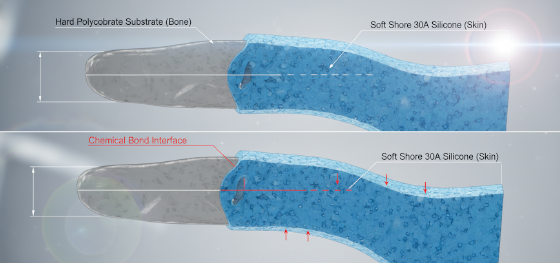
Contact mechanics dictate that a hard surface cannot safely grip a hard object without inducing localized stress fractures. A rigid metal or plastic finger creates a "Point Load"—a tiny, concentrated area of extreme pressure where it touches the payload. To safely lift an egg or a thin-walled electronic component, the robot's "Skin" must deform around the object's geometry. This deformation creates a "Conformal Contact Patch," distributing the clamping force evenly across a massive surface area. Furthermore, elastomers possess inherently high coefficients of friction. By utilizing materials with a Shore hardness between 30A (similar to a soft gel pad) and 50A (similar to a pencil eraser), the robot can lift heavy, slippery items using minimal motor torque. This allows engineers to downsize the actuators in the robotic hand, saving critical weight and extending battery life, while simultaneously preventing the catastrophic crushing of the target object.
How does the overmolding process combine rigid bones with soft elastomers?

Synchronizing the thermal states of two vastly different materials is the core challenge of multi-shot manufacturing. The process typically begins with the "First Hit," where the rigid skeletal bone—often molded from high-impact ABS, Polycarbonate, or Glass-Filled Nylon—is injected. Once this substrate has cooled enough to achieve dimensional stability but still retains high surface energy, it is transferred into a secondary mold cavity. This second tool is slightly larger, creating a precise void where the "Skin" will reside. The "Second Hit" involves injecting a molten Thermoplastic Elastomer (TPE, TPU) or Liquid Silicone Rubber (LSR) into that void. The liquid elastomer flows around the rigid bone, conforming to its shape. Because the second material is injected under intense heat and pressure, it melts the microscopic surface layer of the rigid plastic, allowing the molecular chains of both materials to intertwine before freezing. Jucheng Precision tightly controls this thermodynamic "Open Window" to ensure the resulting bionic finger acts as a single, inseparable monolithic entity.
Chemical vs. Mechanical Bonding: How to prevent the fingertip from peeling off?
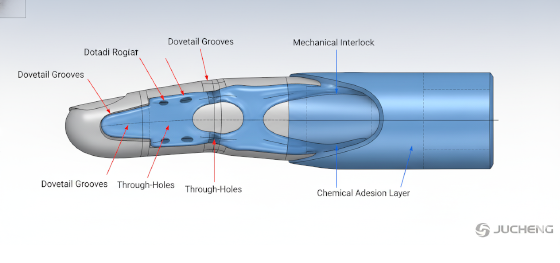
Molecular affinity is a requirement, but geometric insurance is the ultimate savior of a high-shear joint. Chemical bonding relies entirely on the polar compatibility between the two resins (e.g., TPU bonds beautifully to ABS, but refuses to stick to POM or bare Aluminum). However, when a robotic hand forcefully drags a heavy object, the sheer stress on the fingertip can overwhelm even the strongest covalent bond, causing the rubber to peel. To combat this "Delamination Crisis," Jucheng Precision mandates the inclusion of "Mechanical Interlocks" during our DFM review of the rigid bone. We instruct designers to add "Through-Holes," "Dovetail Grooves," and "Undercut Channels" into the substrate. During the second injection phase, the liquid elastomer flows *through* these holes and locks into the grooves. Once it cures, the rubber is physically anchored *inside* the rigid bone, creating a "Polymer Rivet." Even if chemical adhesion fails completely, the fingertip cannot be ripped off the skeleton without physically tearing the elastomer itself.
How does JUCHENG leverage multi-material expertise for bionic hands?
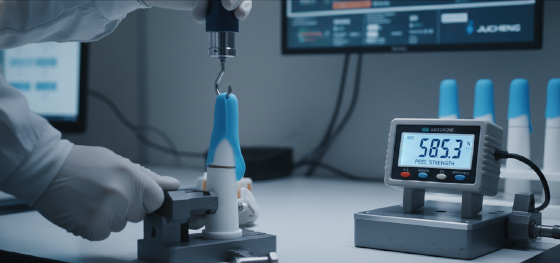
Manufacturing excellence at Jucheng Precision is built on the foundation of material-agnostic routing. We don't just "shoot TPE over plastic"; we engineer the entire haptic experience. Our facility, housing advanced two-shot injection presses and dedicated urethane casting labs, is optimized for the aggressive iteration cycles of bionic development. If you need 20 prototypes for a quick grasping trial, we utilize rapid aluminum tooling and vacuum casting to overmold soft silicone onto 3D-printed titanium bones in a matter of days. When you are ready for 10,000 units, we transition you to high-speed, automated 2K molding. We provide full material lot traceability and destructive "Peel-Strength" inspection reports for every batch, ensuring your hardware journey is lean, predictable, and structurally sovereign. Stop gambling your robot's dexterity on vendors who lack the specialized knowledge of polymer adhesion. Leverage our decade of multi-resin mastery to validate rapidly and launch with an uncompromising grip. Contact our technical team today for a free DFM review.
Frequently Asked Questions: Overmolded Grippers
Question: What is the recommended thickness for the soft elastomeric layer on a robotic fingertip?
Answer: To ensure proper flow and prevent "sink marks" on the rigid substrate, we typically recommend a uniform overmold thickness of 1.5mm to 3.0mm. Anything thicker may require specialized foaming agents or hollow core designs.
Question: Can JUCHENG overmold soft silicone directly onto a metal (Aluminum/Titanium) robot bone?
Answer: Yes. While metals do not naturally chemically bond with plastics, we utilize specialized heat-activated primers and aggressive mechanical interlock designs to permanently anchor Liquid Silicone Rubber (LSR) or TPE to CNC-machined metal linkages.
Question: How do you prevent "Flash" (messy rubber edges) where the hard and soft materials meet?
Answer: We design a "Step-Joint Shut-off" into the rigid bone. This provides a flat, hard ledge for the secondary mold steel to clamp down against, creating a hermetic seal that prevents the low-viscosity elastomer from bleeding onto the clean rigid surfaces.

ㆍPrivacy: We respect your privacy. Here you can find an example of a non-disclosure agreement. By submitting this form, you agree to our terms & conditions and privacy policy.
